
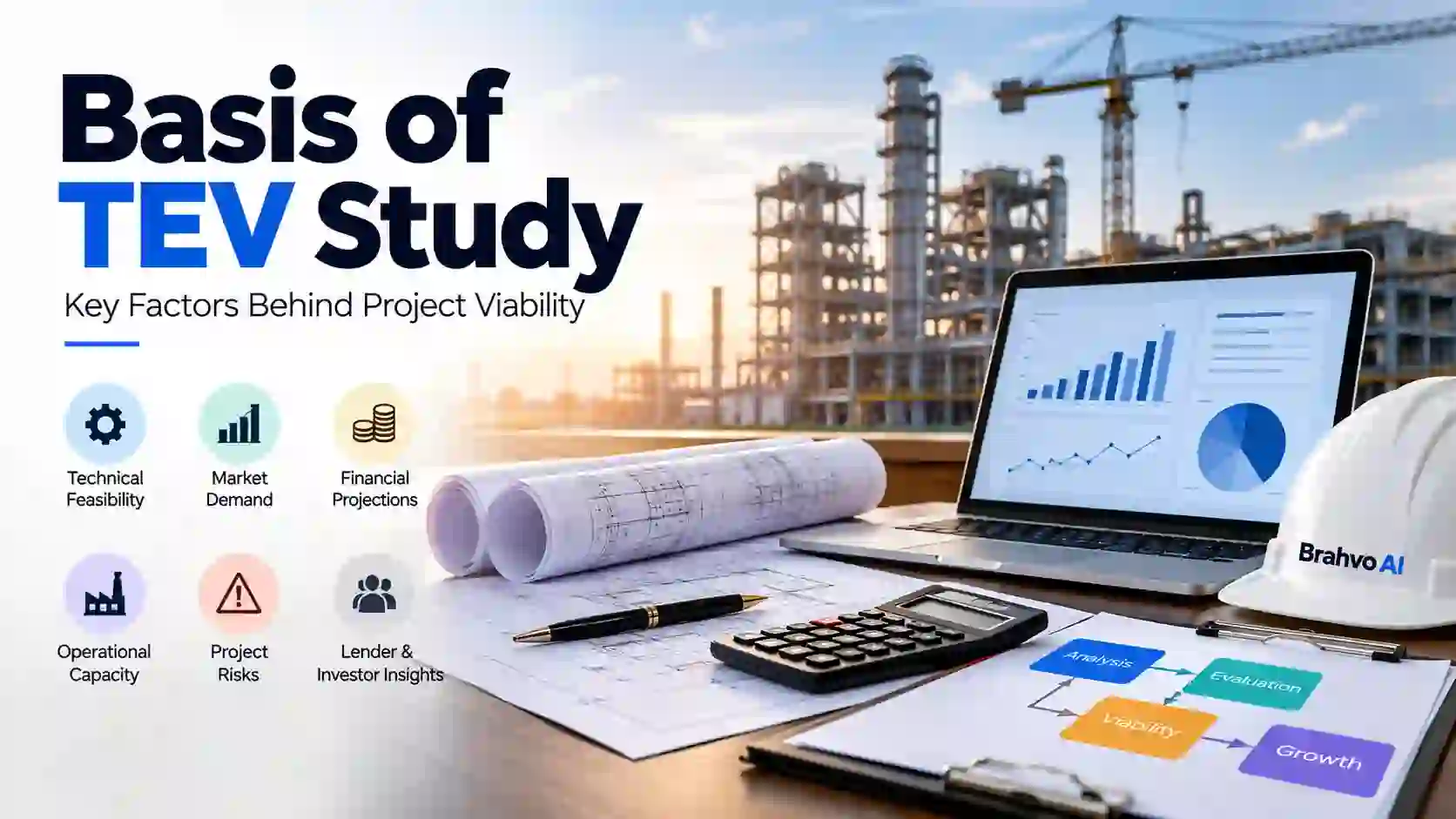
What Is the Basis of a TEV Study and Why Does It Matter?
A project can look profitable on paper and still create
serious problems once construction begins. Maybe the production capacity is too
high for the available market. Maybe the machinery cost was underestimated.
Maybe working capital requirements were treated as an afterthought. Or perhaps
the promoter assumed that revenue would start immediately after commissioning.
These are the kinds of gaps a TEV study is meant to expose.
The basis of TEV study is essentially the set of
technical, commercial, operational, financial, and market assumptions used to
determine whether a proposed project is practical and economically viable. A
Techno Economic Viability study does not simply ask whether a business idea
sounds profitable. It examines how the project is expected to work, what it
will cost, what it can realistically generate, and where the major risks sit.
For a manufacturing company, this may involve production
capacity, machinery, raw materials, utilities, manpower, technology, plant
layout, selling prices, and expected demand. For an infrastructure or service
project, the assumptions can look quite different.
The important point is that the numbers in a TEV report do
not exist independently. They are connected.
A higher installed capacity affects machinery investment.
Machinery investment affects depreciation and financing requirements.
Production capacity affects raw material consumption and manpower. Expected
production affects revenue. Revenue and operating costs then affect cash flow
and debt repayment capacity.
That connection is why the basis of TEV study matters
so much.
A lender reviewing a project finance proposal is not only
interested in the projected profit. The lender wants to understand whether the
assumptions behind that profit are reasonable and whether the project can
generate enough cash to meet its financial obligations.
A promoter should look at the study in much the same way.
If an assumption cannot be explained, supported, or
reasonably justified, it deserves another look before the project moves too far
ahead.
How Technical Feasibility Shapes a TEV Study
Technical feasibility is often where the practical reality
of a project begins.
A financial model may show attractive returns, but those
returns depend on the project being physically capable of producing the assumed
output. That means the technical side of the project has a direct influence on
almost every major financial assumption.
Consider a proposed manufacturing unit with an annual
installed capacity of 50,000 units. The TEV study cannot simply take 50,000
units and multiply that figure by a selling price.
It needs to examine how that capacity will actually be
achieved.
What machinery is required? What technology will be used?
How many operating shifts are planned? What is the expected utilization during
the first few years? Are utilities such as electricity, water, fuel, compressed
air, or steam sufficient? Is the proposed plant location suitable for the
operation? Are raw materials readily available?
These questions form an important part of the basis of
TEV study.
Capacity utilization is particularly important. A new plant
rarely operates at full capacity from day one. Production may start at a lower
level while employees are trained, machinery is commissioned, customer
relationships are developed, and operational processes settle down.
A sensible TEV assessment therefore needs to distinguish
between installed capacity and expected actual production.
Technology selection also matters. A technically
sophisticated production line may provide efficiency advantages, but it could
require higher upfront investment, specialized manpower, imported components,
or more expensive maintenance. A lower-cost setup may reduce capital
expenditure but create different operating limitations.
There is no universal answer.
The technical assumptions need to make sense for the
particular project, its product, location, operating model, and intended
market.
This is also where project timelines become relevant. Land
development, construction, equipment procurement, installation, testing, and
commercial production all take time. If a financial projection assumes
full-year revenue during a period when the plant is still under installation,
the resulting cash flow picture can become misleading.
Technical feasibility is therefore not a separate chapter
that sits beside the financial model. It feeds the financial model.
Market Demand and Revenue Assumptions Behind the Study
This is one area where project reports can become overly
optimistic.
A company may have an excellent production setup and still
struggle if customers are not willing to buy the projected volume at the
assumed price.
The market side of the basis of TEV study should
therefore go beyond statements such as "the industry is growing" or
"demand is expected to increase."
The actual question is much narrower.
Can this particular project reasonably sell its expected
output?
That requires looking at the product, target customers,
pricing, competitors, distribution model, geography, industry demand, and
expected market share. For an existing company expanding capacity, historical
sales can provide useful evidence. For a new business, the assumptions may need
stronger support because there may be little internal sales history to rely on.
Pricing deserves similar attention.
Suppose a project assumes an average selling price of $100
per unit. A small change in realized pricing can materially affect revenue when
production volumes are large. The TEV study should therefore consider how the
assumed price relates to current market conditions, product specifications,
customer segments, and expected discounts.
A promoter might have a strong reason for expecting a
premium price. That is fine. The assumption just needs to be explainable.
The same applies to sales ramp-up.
Imagine a new consumer product facility planned around
100,000 units of annual production. The financial model assumes 80 percent
utilization in its first year because the machinery can technically produce
that volume. But the sales team has not yet established the distribution
network.
The technical capacity exists. The commercial capacity may
not.
That distinction can materially change the project's
projected cash flows.
For projects with existing customers, purchase orders,
long-term contracts, or established distribution channels, these factors can
provide stronger support for revenue assumptions. For new projects, market
research, promoter experience, industry data, and realistic ramp-up assumptions
become more important.
I might be wrong here, but many weak project projections do
not fail because the spreadsheet contains a mathematical error. They fail
because one optimistic commercial assumption gets repeated across five years
and starts looking like a fact.
That is something a TEV study should catch.
Financial Projections and Investment Requirements
Once the technical and market assumptions are established,
they begin feeding directly into the financial analysis.
The financial section of a TEV study typically brings
together project cost, funding structure, revenue projections, operating
expenses, profitability, cash flows, working capital, debt servicing, and other
relevant indicators.
The basis of TEV study needs to make these
assumptions traceable.
Project cost is an obvious starting point.
Depending on the project, this can include land, building
and civil works, plant and machinery, electrical installations, utilities,
preliminary expenses, professional fees, pre-operative expenses, contingencies,
and other capital requirements.
But the initial investment is only part of the financing
requirement.
Working capital can become a major issue after commercial
operations begin. A business may need to purchase inventory before receiving
payment from customers. Receivables may remain outstanding for weeks or months.
At the same time, salaries, utilities, logistics, rent, and supplier payments
continue.
A project can therefore be profitable on an accounting basis
and still experience cash pressure.
This is why a TEV study should examine working capital
assumptions alongside projected revenue and operating costs.
Debt structure also matters. The proposed loan amount,
promoter contribution, interest assumptions, repayment period, moratorium, and
repayment schedule can influence the project's cash flow and debt servicing
position.
A useful financial assessment does not simply produce a
projected profit and loss statement. It asks whether the project's operating
cash generation is sufficient to support the proposed financing structure.
Sensitivity analysis can make this more useful.
What happens if sales are 10 percent lower than projected?
What if raw material prices increase? What if commissioning is delayed? What if
the selling price falls while fixed costs remain unchanged?
These scenarios help show how dependent the project is on
individual assumptions.
For example, a project with strong projected profitability
may have limited tolerance for a decline in capacity utilization. Another
project may be more sensitive to raw material costs than selling prices.
Those differences matter when assessing economic viability.
Assessing Operational Capacity, Costs, and Resources
A project does not operate through machinery alone. People,
materials, utilities, systems, suppliers, maintenance, logistics, and working
processes all affect its ability to perform.
That is why operational capacity forms another important
part of the basis of TEV study.
Start with manpower.
How many employees are required? What skills are needed? Are
experienced workers available in the proposed location? Will the company need
technical specialists? What will the annual salary and wage cost look like as
operations scale?
Then look at raw materials.
Are key inputs locally available? Are any materials
dependent on imports? How volatile are their prices? What inventory levels are
required? Does the project depend heavily on one supplier?
These questions can have financial consequences.
A manufacturing unit that depends on an imported raw
material may face longer procurement cycles, foreign exchange exposure, freight
costs, and inventory requirements. A project relying on a single critical
supplier may face a different operational risk.
Utilities also deserve attention.
Electricity consumption, fuel, water requirements, waste
treatment, storage, transportation, and maintenance costs can materially affect
operating expenses. Underestimating these costs can make the projected
operating margin look better than it may be in practice.
Operational capacity should also be viewed against the
planned production schedule.
A factory designed for three shifts may require
significantly different manpower and utility assumptions than one operating for
a single shift. Similarly, equipment maintenance and downtime can affect actual
production even when installed capacity looks attractive.
A practical TEV assessment therefore connects capacity with
resources.
If the report assumes 75 percent utilization, there should
be a reasonable operational explanation for how that level will be achieved. If
the project requires a specialized workforce, that requirement should appear in
the staffing and cost assumptions. If production depends on uninterrupted
utilities, the project design should account for that reality.
This is where the basis of TEV study becomes more
than a collection of financial figures.
It becomes a test of whether the proposed business can
function as described once the projections leave the spreadsheet and meet the
real world.
Project Risks That Can Change TEV Study Outcomes
Even a carefully prepared TEV study is based on assumptions.
Some assumptions will eventually change.
Construction may take longer than expected. Machinery prices
may increase. Demand may develop more slowly. Raw material costs may rise.
Interest rates may change. A new competitor may enter the market. A key
customer may delay payments.
The basis of TEV study should account for these
possibilities rather than treating the initial projections as fixed outcomes.
Risk assessment usually starts with identifying the
assumptions that have the greatest influence on the project. For a
manufacturing business, raw material prices and capacity utilization may be
major variables. For an infrastructure project, construction timelines, project
costs, traffic or usage assumptions, and financing conditions could matter
more.
Not every risk deserves the same level of attention.
A small increase in office expenses is unlikely to change
the viability of a large industrial project. A 15 percent increase in the cost
of its primary raw material might.
This distinction is useful when building sensitivity
scenarios.
Suppose a new manufacturing project is expected to generate
$12 million in annual revenue once stabilized. The model assumes 80 percent
capacity utilization, a 10 percent operating margin, and a two year ramp-up
period. If the project can remain financially viable at 65 percent utilization,
the assumptions have some breathing room. If the project becomes difficult to
service at 70 percent utilization, the lender and promoter may need to look
more closely at the sales assumptions.
Timing risk can be just as important.
A six month delay in commercial production does not simply
remove six months of revenue. It can also extend interest during construction,
delay customer acquisition, increase project overhead, and change the working
capital cycle.
That is why project risk should be connected to the
financial model.
A list of risks sitting at the end of a report has limited
value if none of those risks are reflected in the numbers.
How Lenders and Investors Read TEV Study Findings
A promoter may read a TEV study by asking, "Can this
project make money?"
A lender is likely to ask another question first: "Can
the project generate enough cash to meet its obligations?"
That difference changes how the findings are interpreted.
The basis of TEV study gives lenders a way to examine
the assumptions behind the proposed financing. They may look at projected
revenue, operating costs, profitability, cash flows, debt servicing capacity,
promoter contribution, working capital requirements, and sensitivity to adverse
changes.
The exact review process varies by institution and project
type, but the underlying concern is fairly practical. The projected financial
performance needs to be supported by reasonable project assumptions.
For example, strong projected revenue may attract attention,
but the lender may want to understand how that revenue will actually be
generated. Is there an established customer base? Are there contracts or
purchase commitments? Does the proposed production capacity make sense compared
with expected demand?
The same thinking applies to project cost.
If machinery quotations indicate one level of investment
while the financial model uses another, the difference needs to be explained.
If the promoter contribution appears insufficient to cover cost overruns or
working capital requirements, that can raise another question.
Debt servicing is another major consideration.
A project may show accounting profits but still experience
periods of weak cash generation. The timing of receivables, inventory
purchases, operating expenses, interest payments, and principal repayments can
all affect available cash.
This is why the TEV study needs to connect the technical
plan with the financial projections.
Investors may look beyond debt servicing and examine the
broader economic potential of the project. They can be interested in market
size, scalability, capital efficiency, margins, competitive positioning, and
potential returns.
The same report can therefore be read differently by
different stakeholders.
There is no single number that explains whether a project
works.
Common Mistakes in the Basis of TEV Study
Some mistakes are obvious. Others look reasonable inside a
spreadsheet and only become problematic when the assumptions are tested.
One common issue is treating installed capacity as actual
production. A plant capable of producing 100,000 units does not automatically
sell 100,000 units.
Another is using a constant selling price for several years
without considering market conditions, discounts, product mix, or customer
negotiations.
Operating costs can also be understated.
Promoters sometimes focus heavily on machinery, building,
and other capital expenditure while giving less attention to maintenance,
manpower, utilities, logistics, insurance, repairs, administrative costs, and
working capital.
Then there is the commissioning timeline.
A financial projection may show revenue beginning
immediately after the project investment. In reality, equipment installation,
testing, regulatory approvals, hiring, trial production, and customer
onboarding may take considerable time.
The basis of TEV study should reflect that
transition.
Another mistake is relying on unsupported market
assumptions. Saying that an industry is growing does not necessarily establish
that a particular project will capture enough demand.
There is also a tendency to make every year look comfortably
better than the previous year.
Revenue increases. Margins expand. Capacity utilization
rises. Costs remain controlled. Cash flows become stronger.
Sometimes that is justified. Sometimes it is simply what
happens when the model is built around an optimistic base case.
A better approach is to ask which assumptions are genuinely
supported and which ones represent management expectations.
One more issue deserves attention: inconsistent assumptions
between different sections of the report.
If the technical section assumes one production capacity,
the market analysis assumes another sales volume, and the financial model uses
a third figure, the report becomes difficult to rely on.
Small inconsistencies can create bigger questions because
they make reviewers wonder what else may not align.
How Brahvo AI Can Support TEV Study Analysis
Brahvo AI can support the analysis and presentation of
information used in a TEV study, particularly where large amounts of project
information need to be reviewed, organized, compared, or communicated clearly.
The useful role here is not to replace project-specific
technical or financial judgment.
Instead, AI can assist with information-heavy parts of the
process.
For example, project teams may have financial projections,
technical specifications, market information, cost estimates, operational
assumptions, and supporting documents spread across different files. Reviewing
these materials manually can make it harder to spot inconsistencies.
An AI based workflow can help organize the information and
surface areas that deserve closer human review.
Consider a manufacturing project where the financial model
assumes 70 percent capacity utilization, while another project document refers
to a production volume that would require 85 percent utilization. That
difference may be easy to overlook during a rushed review.
The important part is what happens next.
The discrepancy still needs to be checked by someone who
understands the project.
Brahvo AI can also support the creation of clear visual
explanations around complex project information. Technical and financial
concepts are not always easy to communicate to management teams, lenders,
investors, or internal stakeholders.
AI video and visual content can make certain project
concepts easier to present, particularly when the underlying information needs
to be explained to people who are not involved in the technical work every day.
For example, a project team could use AI assisted video
content to explain a production process, project timeline, capacity
assumptions, or the relationship between project investment and expected
operations.
That does not make the underlying TEV assessment more
accurate by itself.
The quality still comes from the quality of the project
information, assumptions, analysis, and professional judgment behind it.
This distinction matters.
AI can help process and communicate information faster, but
it should not turn an unsupported assumption into a credible one.
FAQs About the Basis of TEV Study
What is the basis of a TEV study?
The basis of a TEV study refers to the technical, market,
operational, financial, and commercial assumptions used to assess a project's
feasibility and economic viability. It forms the foundation for the projections
and analysis presented in the TEV report.
Why is the basis of TEV study important for project
financing?
Lenders need to understand how projected revenue, costs,
cash flows, and debt servicing capacity have been calculated. A clear basis
helps them evaluate whether the assumptions behind the project projections are
reasonable and internally consistent.
What technical information is normally considered in a
TEV study?
It can include production capacity, technology, machinery,
plant layout, utilities, raw materials, manpower, production processes,
implementation timelines, and operating requirements. The exact information
depends on the nature of the project.
Does a TEV study consider market demand?
Yes. Market demand can directly affect projected production
and revenue. The assessment may consider the target market, product demand,
pricing, customer segments, distribution, existing sales, and other commercial
factors relevant to the project.
How does capacity utilization affect a TEV study?
Capacity utilization affects production volume, revenue,
operating costs, cash flow, and profitability. A project operating at 50
percent utilization has a very different financial profile from the same
project operating at 85 percent utilization.
What financial information is important in a TEV study?
Depending on the project, this can include project cost,
means of finance, revenue projections, operating expenses, working capital,
profitability, cash flows, debt obligations, and sensitivity analysis.
Can project risks change the outcome of a TEV study?
Yes. Changes in project cost, construction timelines,
selling prices, raw material costs, capacity utilization, working capital
requirements, or other major assumptions can materially affect the projected
financial performance.
Is a TEV study the same as a business plan?
No. There can be some overlap, but they serve different
purposes. A business plan generally explains the broader business model and
strategy, while a TEV study focuses more specifically on the technical and
economic feasibility of the proposed project.
Can AI be used in TEV study analysis?
AI can assist with tasks such as document analysis,
information organization, consistency checks, data interpretation, and visual
communication. Human technical, financial, and commercial judgment remains
important, particularly when validating assumptions and assessing project
risks.
What should be checked before relying on a TEV study?
The assumptions should be reviewed for consistency,
supporting evidence, realistic capacity utilization, market demand, project
costs, working capital requirements, implementation timelines, and sensitivity
to major risks. The projections should also align with the actual technical and
operational plan.