
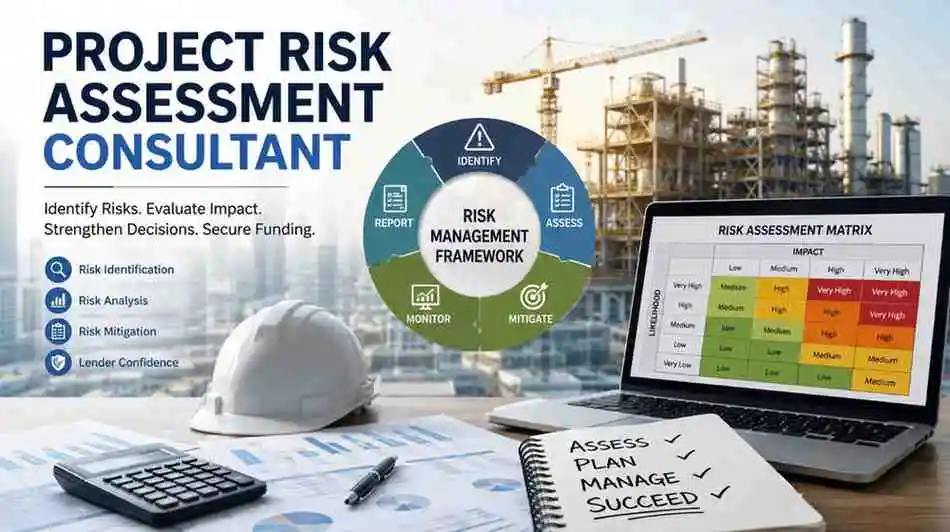
A Project Risk Assessment Consultant is usually brought in when a business or project promoter needs a realistic view of what can go wrong before committing substantial money, approaching lenders, or reaching financial closure. The work is not simply about preparing a list of risks. A proper assessment looks at whether those risks are understood, measurable, manageable, and acceptable from a business and lending perspective.
This distinction matters.
A project may look profitable on paper and still carry serious risks. A manufacturing unit may have strong projected demand, but the promoter may have underestimated machinery installation time. A solar project may have a sound power purchase arrangement but depend heavily on timely land access and grid connectivity. A hospital project may show attractive revenue projections while facing delays in statutory approvals, recruitment, or patient ramp up.
A Project Risk Assessment Consultant examines these gaps before they become expensive problems.
The consultant normally studies the project from several angles. This includes the technical design, location, implementation schedule, cost estimates, sources of finance, market assumptions, operating plan, statutory requirements, promoter contribution, debt servicing capacity, and external factors that may influence the project.
For lenders, this exercise becomes even more important. Banks do not look at a project only through the promoter's presentation. They want to understand what could affect project completion, cash flow generation, security value, and repayment ability.
"A Project Risk Assessment Consultant helps distinguish between risks that are manageable and risks that can materially threaten project viability. The purpose is not to eliminate every uncertainty, but to understand where the project is exposed and what needs to be corrected, documented, or monitored." — Frontline Consultants Team
Example: Manufacturing Company Expansion
Suppose a manufacturing company is planning a ₹50 crore expansion. The promoter may have already selected machinery, prepared projected financial statements, and negotiated a term loan. But during a risk assessment, it may emerge that imported machinery has a long delivery period, civil work has not yet commenced, and the working capital requirement has been underestimated. None of these issues necessarily makes the project unviable. But they do change the funding requirement and execution risk.
This is where practical assessment becomes useful.
A Project Risk Assessment Consultant does not necessarily tell the promoter that a project should not be undertaken. The objective is to identify where the project is exposed and what needs to be corrected, documented, monitored, or financially protected.
There is also a difference between theoretical risk and practical risk. Nearly every project report mentions market risk, cost escalation, regulatory risk and execution delays. Simply mentioning them does not constitute meaningful risk assessment.
The real question is what happens if the risk actually occurs.
For example, if a warehouse expansion takes six months longer than expected, who funds the additional interest during construction? If machinery costs rise by 8 percent, does the promoter have enough margin to absorb the increase? If sales are 15 percent below projections in the first year, can the business still meet its debt obligations?
These are the questions that make a risk assessment useful to a lender.
Frontline Consultants approaches project risk assessment in this practical context. With experience across financial consulting and project advisory assignments, the focus is not only on identifying weaknesses but also on understanding how those weaknesses may affect project cost, timelines, cash flows and financing arrangements.
A Project Risk Assessment Consultant may also work alongside other professional assignments such as a Detailed Project Report, Techno Economic Viability Report, Lenders Independent Engineer assignment, valuation exercise, or credit syndication mandate. The reports are different, but they often connect with one another.
A DPR may explain what the promoter plans to build. A TEV report may examine whether the project makes economic and financial sense. A valuation report may establish the value of an asset or business. Risk assessment asks a slightly different question: what could prevent the expected outcome from actually happening?
That is a question lenders tend to take seriously.
Why Project Risk Assessment Matters Before Financial Closure
Financial closure is often treated as the moment when funding arrangements are finalised. In practice, reaching that point requires much more than obtaining a sanction letter.
Banks and financial institutions want comfort on the project's ability to reach commercial operation and generate sufficient cash flow thereafter. They also want clarity on the promoter's contribution, implementation schedule, cost structure, debt servicing capacity, security, statutory approvals and several other matters.
A Project Risk Assessment Consultant helps bring these issues together before the lender reaches its final decision.
Many business owners believe preparing a DPR is enough for getting a loan. In reality, that rarely happens. A DPR can be professionally prepared and still leave important lender concerns unanswered.
Example: MSME New Production Line
Consider an MSME planning to establish a new production line. The DPR estimates project cost at ₹20 crore and shows healthy profitability. However, the promoter has assumed that the entire debt will be available before equipment orders are placed. The bank may instead require promoter contribution to be brought in first, followed by staged disbursement. If the promoter does not have enough liquidity during the early phase, the project could face a funding gap despite having an apparently acceptable DPR.
This is precisely the sort of issue that becomes visible through structured risk assessment.
Financial closure depends heavily on confidence. Lenders are effectively asking whether the assumptions supporting repayment are dependable enough.
That confidence can weaken because of many seemingly small issues. Delayed approvals, unrealistic construction schedules, dependence on a single customer, excessive working capital assumptions, weak promoter liquidity, unclear land documentation, cost estimates based on outdated quotations, or overoptimistic sales projections can all create problems.
Sometimes perfectly good projects get delayed because documentation was prepared in the wrong sequence. It still surprises me.
The timing of the assessment is therefore important. If risks are identified before financial closure, the promoter has an opportunity to correct them. After funds are committed and construction has started, the same problem may require additional borrowing, restructuring, or renegotiation.
Take a solar project as an example. The project may have strong irradiation conditions and an apparently viable tariff. But financial closure can still be affected if land documents are incomplete, evacuation arrangements are uncertain, approvals are delayed, or the implementation schedule does not match the debt repayment assumptions.
A lender may not automatically reject such a project. Instead, the bank may seek additional information, conditions precedent, revised assumptions, contingency provisions, or stronger monitoring arrangements.
This is where a Project Risk Assessment Consultant can help the promoter understand the lender's perspective before the questions are formally raised.
The same applies to healthcare projects. A hospital requiring project finance may have significant capital expenditure, but its financial projections can depend on occupancy levels that take time to build. The risk assessment should therefore consider the initial operating period, doctor availability, referral networks, competition, staffing costs and working capital requirements.
In a warehouse project, the consultant may look at tenant concentration, location, access infrastructure, construction timelines and lease assumptions. In an industrial project, the focus may shift towards raw material availability, technology selection, utilities, environmental permissions, customer concentration and capacity utilisation.
This does not mean every risk can be eliminated. They cannot.
The purpose is to distinguish between risks that are manageable and risks that can materially threaten project viability.
A good assessment also helps determine whether contingency provisions are realistic. Cost contingencies are sometimes added as a standard percentage without considering the nature of the project. That is not always sensible. Construction risk, imported equipment exposure, commodity price movements and foreign exchange exposure can behave very differently.
I might be wrong here, but in my experience promoters often focus more attention on the amount of finance they want than on the conditions under which the financing will actually work. The second part can be just as important.
For Frontline Consultants, project risk assessment fits naturally within the broader financial and project advisory process. When risks are clearly documented, the promoter is in a stronger position to respond to lender queries, revise assumptions where required, and prepare supporting documentation before the process becomes time consuming.
Key Risks Evaluated by a Project Risk Assessment Consultant
A Project Risk Assessment Consultant generally does not assess all projects using exactly the same checklist. The risk profile changes with the industry, project size, funding structure, location, technology, implementation model and promoter background.
Still, several risk categories appear repeatedly in Indian project finance assignments.
Project Completion Risk
The first concern is whether the project can actually be completed within the planned cost and schedule.
A manufacturing project may depend on timely delivery and installation of imported machinery. An infrastructure project may depend on multiple contractors and approvals. A hospital project may involve complex civil work, specialised equipment and statutory permissions.
The assessment therefore looks at the implementation schedule, contractor capability, procurement timelines, construction progress, approval status and availability of resources.
If the project is already under implementation, physical progress becomes especially important. Lenders may want to compare money spent with the percentage of work completed.
Cost Overrun Risk
A project can become financially stressed even before operations begin if actual costs exceed estimates.
A Project Risk Assessment Consultant examines whether land, civil works, plant and machinery, utilities, pre operative expenses, interest during construction and other components have been estimated properly.
Quotation quality also matters. A machinery quotation from several months ago may not represent the current procurement cost. Escalation clauses in construction contracts can create another exposure.
For a warehouse expansion, for example, an initial civil cost estimate may appear reasonable until site conditions reveal additional foundation work. That extra cost has to come from somewhere.
Funding Risk
The project may require term debt, promoter contribution, working capital limits, subordinated funding or other sources. The consultant examines whether the proposed funding structure is adequate.
One practical issue is the gap between project cost and actual cash requirement. Promoters sometimes calculate the capital expenditure correctly but underestimate working capital during the stabilisation period.
A factory may need six months of additional inventory and receivables funding before production reaches expected capacity. If that amount is ignored, the project can experience stress shortly after commencement.
Market Risk
Projected revenue is only as reliable as the assumptions behind it.
The assessment may consider demand conditions, customer concentration, pricing assumptions, competition, capacity utilisation, product positioning and dependence on a particular market segment.
A business relying on one major customer carries a different risk profile from a business with hundreds of relatively stable customers.
Technology Risk
Technology can materially affect project performance.
A new manufacturing process may depend on specialised equipment for which technical support is limited in India. A renewable energy project may depend on equipment performance and warranty terms. A hospital may invest in advanced medical systems that require specialised manpower and maintenance.
The consultant therefore considers whether the selected technology is proven, appropriate for the intended scale, supportable and compatible with the project's operating model.
Regulatory and Approval Risk
Projects in India often pass through multiple regulatory stages.
Land approvals, environmental permissions, pollution control requirements, building approvals, power connectivity, sector specific licences and other statutory requirements can influence project timelines.
A Project Risk Assessment Consultant checks not only whether approvals are listed but also their stage of completion and relevance to disbursement and commencement of operations.
This distinction is important. Saying that an approval is required is not the same as confirming whether it has been obtained.
Promoter and Management Risk
Banks also assess the people behind the project.
Promoter experience, financial contribution, past repayment behaviour, existing business obligations, managerial capability and ability to bring additional funds when needed can influence the lender's view.
A technically strong project may still face questions if the promoter has limited experience in the sector or is already carrying significant debt.
Operational Risk
Once the project starts operating, the risk profile changes.
The consultant may look at manpower availability, raw material sourcing, supplier dependence, maintenance requirements, utility costs, production efficiency and quality control.
In some industries, a small interruption can affect the entire cash flow cycle. This becomes particularly relevant where debt servicing depends on maintaining a minimum level of utilisation.
Financial and Cash Flow Risk
Finally, the consultant assesses whether the financial assumptions support debt repayment.
Sensitivity analysis can be useful here. What happens if revenue is lower than expected? What happens if operating costs rise? What happens if commercial operations begin three months late?
The objective is not to create frightening scenarios for the sake of it. It is to understand how much pressure the project can absorb before debt service becomes difficult.
The stronger the assessment, the easier it becomes to distinguish between a normal business risk and a risk that could seriously affect repayment.
That distinction is often what lenders are trying to understand before committing money.
How Technical, Financial and Commercial Risks Are Assessed
A Project Risk Assessment Consultant normally looks at a project from three connected angles: technical, financial and commercial. Treating these as separate exercises can sometimes hide the real problem because a weakness in one area often creates pressure somewhere else.
Technical risk starts with the basic question of whether the proposed project can actually be implemented as planned. The assessment may cover technology selection, machinery specifications, site conditions, construction arrangements, utility requirements, implementation schedules and the capability of contractors or vendors.
For a manufacturing company planning a new production facility, this could mean checking whether the proposed machinery is suitable for the intended capacity, whether installation timelines are realistic and whether the supporting infrastructure will be ready when the equipment arrives.
A Project Risk Assessment Consultant may also compare the project assumptions with practical implementation requirements. A promoter might expect commercial production within twelve months, but machinery delivery alone may take six months. Civil work, installation, testing and trial production then have to fit into the remaining period.
Financial risk is assessed differently.
Here the focus moves towards project cost, funding structure, revenue assumptions, operating costs, working capital, debt repayment and cash flow. The consultant needs to understand what happens if the project does not perform exactly according to the base case.
Suppose an industrial project has been projected to generate ₹10 crore of annual cash accrual after stabilisation. What happens if capacity utilisation remains lower during the first two years? Can the business still service its debt? Does the promoter have enough liquidity to meet additional working capital requirements?
These questions are often more useful than simply looking at the projected profit figure.
Commercial risk covers the market side of the project. Demand, pricing, competition, customer concentration, supplier dependence and market access can all affect project performance.
A hospital may have a strong location but face intense competition from established healthcare providers. A solar project may have a viable tariff but depend on contractual arrangements and timely evacuation infrastructure. An industrial unit may have confirmed customers but still face concentration risk if one buyer accounts for a large portion of projected sales.
The assessment therefore connects the three areas.
A technically sound project with weak financial assumptions remains risky. A financially attractive project with uncertain demand is also problematic. A project with strong market demand but an unrealistic implementation schedule may never reach the projected cash flow stage.
That is why a Project Risk Assessment Consultant needs to look beyond individual numbers and understand how the project is expected to function in practice.
Project Risk Assessment for Manufacturing and Industrial Projects
Manufacturing and industrial projects often involve substantial fixed investment, machinery procurement, working capital and a relatively long implementation period. This creates several points where risk can enter the project.
Consider a company expanding an existing manufacturing facility. The promoter may already have customers and operating experience, so the project initially appears less risky than a new business. But expansion projects have their own complications.
The existing plant may need to continue production while civil work and machinery installation take place. Production interruptions can affect existing customers. New machinery may require additional manpower or technical skills. Electricity demand may increase and require a change in the sanctioned load.
A Project Risk Assessment Consultant examines these practical factors rather than assuming that an existing business automatically makes the expansion safe.
Machinery selection is another important area. The consultant may review vendor quotations, technical specifications, expected capacity, installation requirements, maintenance arrangements and delivery schedules.
In one situation, a promoter may have selected equipment based largely on purchase price. A lower priced machine may look attractive initially, but if spare parts are difficult to obtain or technical support is weak, the operating risk could be much higher.
Raw material dependence also deserves attention. An industrial unit dependent on one supplier or a highly volatile commodity can face margin pressure even when sales remain stable.
Working capital is another area where project assessments often uncover gaps.
A new plant may require significant inventory before commercial operations become stable. Receivables may also increase because customers expect credit terms. If the promoter has considered only the term loan and ignored this funding requirement, the project can face liquidity pressure soon after commissioning.
For MSMEs, this issue can be particularly uncomfortable because their financial buffers are often limited.
The consultant may also examine existing debt obligations. An expansion should not be assessed in isolation if the promoter already has substantial borrowing from banks and NBFCs.
A Project Risk Assessment Consultant therefore looks at the combined financial position, not just the proposed project.
Environmental and statutory requirements can also influence industrial project timelines. Delays in approvals, utilities, pollution control permissions or local clearances may push commercial operations beyond the original date.
A three month delay may appear insignificant during planning. Once interest during construction, contractor payments and fixed overheads start accumulating, the financial effect can become substantial.
Sometimes this is where good projects get into trouble. Not because the underlying business is bad, but because the financial model assumed everything would happen on schedule.
Assessing Risks in Infrastructure, Solar and Healthcare Projects
Infrastructure, solar and healthcare projects have very different operating models, so risk assessment needs to be adapted to each sector.
Infrastructure Projects
In infrastructure projects, implementation risk is often significant because projects may involve multiple contractors, government permissions, land availability, utilities and long construction periods.
A Project Risk Assessment Consultant may examine the concession arrangement, project agreements, construction schedule, contractor capability, funding structure and expected cash flows.
For a road or infrastructure project, delays can have a direct impact on revenue and debt servicing. If project completion moves beyond the original schedule, the financial model may need to be revisited.
Solar Projects
Solar projects have a different set of concerns.
Land availability, connectivity, evacuation arrangements, equipment procurement, generation assumptions, contractual arrangements and operating performance can all influence the project's viability.
A solar project may look attractive based on projected generation and tariff assumptions. But if grid connectivity is delayed, the project may not generate revenue according to the original schedule.
Equipment quality also matters. The expected performance of modules, inverters and other critical components needs to be considered along with warranties, degradation assumptions and maintenance arrangements.
Healthcare Projects
Healthcare projects bring another set of risks.
A hospital may require significant investment in land, civil construction, medical equipment and staffing before it begins generating stable revenue. Even after commissioning, patient occupancy may take time to reach the projected level.
A Project Risk Assessment Consultant may therefore examine bed capacity, expected occupancy, treatment mix, pricing, doctor availability, staffing costs, competition, location and working capital requirements.
For a hospital promoter, projecting full occupancy from the first year is generally difficult to justify unless there is strong supporting evidence.
The purpose of sector specific risk assessment is therefore not to apply one standard formula to every project. It is to understand the actual business model and identify the risks that matter for that particular project.
How Banks and Lenders Use Project Risk Assessment Reports
Banks and financial institutions use risk assessment information to understand whether the proposed project can be implemented and whether the resulting cash flows are sufficient to service debt.
A lender is not only interested in whether the project can make a profit. It wants to understand repayment capacity.
This is why a Project Risk Assessment Consultant needs to present risks in a manner that connects them with financial consequences.
For example, if construction is delayed by six months, the lender may want to know how much additional interest will accrue, whether the promoter can fund the increase and whether the repayment schedule needs adjustment.
If machinery costs rise by ₹3 crore, the bank needs clarity on who will bring that additional amount.
If projected sales fall by 20 percent, the lender may examine whether debt servicing remains comfortable.
These are not theoretical questions. They influence credit appraisal.
Banks may also use project risk assessment findings when deciding the conditions attached to financing. Additional promoter contribution, insurance requirements, security arrangements, monitoring mechanisms, revised financial assumptions or specific documentation may become relevant.
For larger projects, lenders may seek independent technical assessments, Lenders Independent Engineer reports, valuation reports or Agency for Special Monitoring arrangements depending on the financing structure and project circumstances.
A Project Risk Assessment Consultant can help bring these different aspects together so that the promoter understands what the lender is likely to examine.
The report can also help lenders identify risks that require ongoing monitoring rather than immediate rejection.
For example, a project may be acceptable if construction progresses according to schedule. In such a case, the lender may monitor project progress through periodic reports rather than treating the implementation risk as an automatic reason to decline funding.
This is one reason proper documentation matters.
A well supported report gives the lender a clearer basis for evaluating assumptions. It also allows the promoter to respond to queries with supporting evidence instead of repeatedly explaining the same issue.
Frontline Consultants works across project advisory and financial consulting assignments where risk assessment may connect with TEV Reports, DPR preparation, Lenders Independent Engineer Services, valuation, credit appraisal and project funding requirements.
The objective is not to make a project look safer than it is. A lender usually becomes more comfortable when risks are openly identified along with practical mitigation measures.
Common Mistakes Businesses Make During Project Risk Assessment
One of the most common mistakes is treating risk assessment as a formality required only because the bank has asked for it.
That approach usually produces a report that lists standard risks without examining how those risks affect the actual project.
Another common mistake is relying entirely on the promoter's assumptions.
Promoters naturally know their business better than an outside consultant. But that familiarity can sometimes make it difficult to identify assumptions that have gradually become accepted as facts.
A promoter may say that machinery will arrive in four months because the supplier has given that estimate. A proper assessment asks whether the supplier has actually committed to the timeline and what happens if delivery takes longer.
Another problem is underestimating working capital.
Project costs are usually discussed in detail because they form part of the term loan proposal. Working capital requirements can receive less attention. This can create stress after commercial production begins.
A Project Risk Assessment Consultant should also examine whether the promoter has sufficient funds to meet cost overruns.
Many project reports assume that any additional cost will be funded by the promoter. That assumption needs to be supported by the promoter's actual financial position.
Another mistake is using optimistic revenue assumptions.
Businesses naturally want to present their strongest case to lenders. But if projected sales growth is substantially higher than the company's historical performance or available market evidence, the lender will probably question it.
Sensitivity analysis is often underused. Businesses should understand what happens when key assumptions change.
- What if selling prices fall?
- What if raw material prices increase?
- What if commissioning is delayed?
- What if capacity utilisation takes longer to reach the projected level?
- What if interest rates or financing costs change?
The answers help determine how resilient the project really is.
There is also a documentation problem. Land records, approvals, machinery quotations, customer agreements, promoter contribution evidence and existing loan details may be provided late or inconsistently.
This can slow down lender appraisal considerably.
A Project Risk Assessment Consultant can help identify documentation gaps early so that the financial and technical assessment is based on reliable information.
One slightly awkward reality is that promoters sometimes send documents in whatever order they find them on their computer. It sounds harmless, but it can make a straightforward appraisal unnecessarily messy.
Another mistake is failing to distinguish between risks that can be controlled and risks that cannot.
A business cannot control commodity prices completely, but it may reduce exposure through supplier diversification or appropriate pricing arrangements. A promoter may not control regulatory timelines, but can ensure that applications are submitted early and documentation is complete.
That difference matters.
A good risk assessment therefore does not end with a list of problems. It should explain the likely impact, the level of concern and the practical steps available to manage the exposure.
Frontline Consultants takes this approach while supporting businesses, industrial units, infrastructure projects, solar companies, healthcare projects and other borrowers through financial and project advisory requirements.
A project does not need to be risk free to receive funding. No serious commercial project is risk free. What matters is whether the risks are understood, whether the assumptions are credible, and whether the promoter and lender have a practical plan for dealing with problems when they arise.
That is ultimately what makes a Project Risk Assessment Consultant useful before a major financial commitment is made.
How Frontline Consultants Supports Project Risk Assessment and Lender Requirements
Project risk assessment becomes much more useful when it is connected with the actual funding and advisory process. A standalone report may identify risks, but business owners and lenders usually need to understand what those risks mean for project cost, implementation, cash flow and repayment.
Frontline Consultants supports businesses through this broader project advisory process. With more than 30 years of experience, the firm works with manufacturing companies, MSMEs, infrastructure projects, industrial units, healthcare projects, solar companies, promoters and other businesses dealing with project finance and lender requirements.
The role of a Project Risk Assessment Consultant is not simply to point out weaknesses. It is to examine the project from a practical financial and implementation perspective and help the promoter understand where additional attention may be required.
For a manufacturing expansion, this can involve reviewing project cost, machinery procurement, implementation schedules, working capital requirements, promoter contribution and projected cash flows. If the project involves substantial borrowing, the assessment can also consider how delays or cost overruns could affect debt servicing.
Frontline Consultants can also support assignments where risk assessment connects with a Detailed Project Report or Techno Economic Viability Report. These reports serve different purposes, but they often rely on many of the same underlying assumptions.
A DPR explains the proposed project in detail. A TEV Report examines technical and economic viability. Project risk assessment goes further into the uncertainties that could affect the expected outcome.
This becomes particularly relevant when lenders have detailed questions about assumptions.
For example, a promoter may propose a ₹40 crore industrial project and expect commercial production within fourteen months. If machinery delivery, civil work and statutory approvals are not properly aligned, the proposed timeline may be difficult to achieve. The resulting delay could increase interest during construction and push back the point at which the project starts generating cash.
A Project Risk Assessment Consultant helps identify this before the problem becomes expensive.
Services Offered by Frontline Consultants
- Project Risk Assessment
- Techno Economic Viability Reports
- Lenders Independent Engineer Services
- Detailed Project Reports
- Enterprise Valuation
- Asset Valuation
- Credit Syndication
- Debt Restructuring
- Bank Liaison
- Project Advisory
- Business Financial Consulting
Frontline Consultants also provides Lenders Independent Engineer Services where independent technical monitoring is required. In larger or more closely monitored projects, lenders may need periodic confirmation of physical progress, project expenditure, construction quality and implementation status.
The financial side is equally important.
Project risk cannot be separated from the borrower's financial position. Existing debt, working capital exposure, promoter liquidity and repayment obligations may influence the project's ability to absorb unexpected costs.
This is where services such as Enterprise Valuation, Asset Valuation, Credit Syndication, Debt Restructuring, Bank Liaison and Business Financial Consulting can become relevant depending on the assignment.
Consider an industrial borrower already carrying significant debt while planning another expansion. A simple project assessment may focus only on the new facility. A broader financial review would examine how the new borrowing interacts with the existing obligations.
Similarly, a business facing temporary cash flow pressure may need a different advisory approach from a promoter approaching a bank for the first time.
The lender's perspective is important throughout the process.
Banks and financial institutions generally want clarity on project cost, means of finance, promoter contribution, implementation schedule, operating assumptions, repayment capacity, security and major risks. They also need reliable documentation to support credit appraisal.
Sometimes the issue is not that the business lacks a viable project. The problem is that the information reaching the lender is incomplete, inconsistent or poorly sequenced.
Frontline Consultants helps businesses organise the financial and project information required for such evaluations and address gaps before they create unnecessary delays.
The firm also understands that every project carries some degree of uncertainty. The objective is not to present a project as risk free. That would not be credible. The objective is to identify material risks, understand their likely effect and establish practical measures for managing them.
For a solar project, that may mean looking closely at land, connectivity, generation assumptions, equipment, contractual arrangements and implementation timelines. For a hospital, the assessment may focus more heavily on occupancy ramp up, staffing, medical equipment, location, competition and working capital. For an industrial project, machinery, raw materials, technology, market demand and capacity utilisation may receive greater attention.
The approach therefore changes according to the project.
A useful project risk assessment should leave the promoter with a clearer understanding of what the lender is likely to question and what needs to be supported with documents or revised assumptions.
That preparation can save considerable time during financial appraisal.
Frequently Asked Questions About Project Risk Assessment Consultants
What does a Project Risk Assessment Consultant do?
A Project Risk Assessment Consultant identifies and evaluates risks that could affect a project's cost, implementation, operations, revenue generation and ability to repay debt. The assessment may cover technical, financial, commercial, regulatory, operational, market and promoter related risks. The consultant also considers how these risks could affect the project's overall viability and lender comfort.
When should a business hire a Project Risk Assessment Consultant?
Ideally, risk assessment should happen before major financial commitments are made and before approaching lenders for final funding approval. It can be particularly useful during project planning, before financial closure, during lender appraisal, before expansion, or when an existing project is facing cost overruns or implementation delays. Early assessment gives the promoter more time to correct weaknesses.
Is project risk assessment required for getting a bank loan?
Not every loan requires a separate formal project risk assessment report. The requirement depends on the size and nature of the project, lender, financing structure and internal credit appraisal process. Larger projects may involve several independent technical, financial and valuation assessments. Even where a separate report is not formally required, understanding project risks can help prepare a stronger funding proposal.
How does project risk assessment help banks?
Banks use risk assessment information to understand whether the project can be completed within the estimated cost and schedule and whether it is likely to generate sufficient cash flow for repayment. The findings may also help lenders determine monitoring requirements, funding conditions, promoter contribution requirements and areas requiring additional documentation.
What types of risks are normally covered?
A Project Risk Assessment Consultant may examine project completion risk, cost overrun risk, funding risk, market risk, technology risk, regulatory risk, promoter risk, operational risk and financial risk. The exact scope depends on the industry and project structure.
Can a Project Risk Assessment Consultant assess an existing project?
Yes. Risk assessment is not limited to new projects. It can be useful for existing manufacturing units, infrastructure projects, solar plants, hospitals and industrial businesses undergoing expansion, refinancing, restructuring or financial stress. For an existing project, actual operating performance can be compared with the original assumptions. This often provides useful information that was not available during the initial project appraisal.
What is the difference between a Project Risk Assessment Consultant and a TEV Consultant?
The two roles can overlap but are not identical. A Techno Economic Viability assessment generally focuses on whether a project is technically feasible and economically and financially viable. A Project Risk Assessment Consultant focuses more specifically on identifying uncertainties and exposures that could affect the expected outcome. In practice, the two assessments may be used together during project finance and lender appraisal.
Can project risk assessment help with financial closure?
Yes, particularly when it is carried out early enough to address major concerns. Financial closure depends on several factors, including lender approval, promoter contribution, project documentation, technical feasibility, financial viability and satisfactory risk assessment. Identifying a funding gap or implementation issue before financial closure gives the promoter an opportunity to correct it instead of dealing with the problem after disbursement.
What happens if a project has significant risks?
Having risks does not automatically mean that the project is unviable. The important question is the nature and severity of the risk and whether it can be managed. For example, a construction delay may be manageable if the promoter has adequate contingency funding and the lender is comfortable with a revised implementation schedule. A permanent shortage of working capital may be more serious if the business has no realistic source of additional funds. A Project Risk Assessment Consultant helps make this distinction clearer.
Can Frontline Consultants help with lender related documentation?
Frontline Consultants provides project and financial advisory services that can support businesses dealing with lender requirements. Depending on the assignment, this can include TEV Reports, Lenders Independent Engineer Services, Detailed Project Reports, valuation, credit syndication, debt restructuring, bank liaison and other financial consulting requirements. The exact scope depends on the project, funding requirement and lender expectations.
Why is independent risk assessment useful before approaching a bank?
An independent assessment can reveal weaknesses that the promoter may not notice because of familiarity with the business. It also gives the promoter an opportunity to address documentation gaps, unrealistic assumptions, funding shortfalls and implementation concerns before the lender formally raises them. That can make the appraisal process more organised and reduce avoidable back and forth.
Is a Project Risk Assessment Consultant useful for MSMEs?
Yes. In fact, it can be particularly useful for MSMEs where promoter funds and financial buffers may be limited. A relatively small cost overrun or delay can create significant working capital pressure for an MSME. Understanding these exposures before taking on additional debt can help the promoter plan the project more realistically. A good Project Risk Assessment Consultant should therefore look beyond the headline project cost and examine how the business will actually manage the project during construction, commissioning and the initial operating period.