
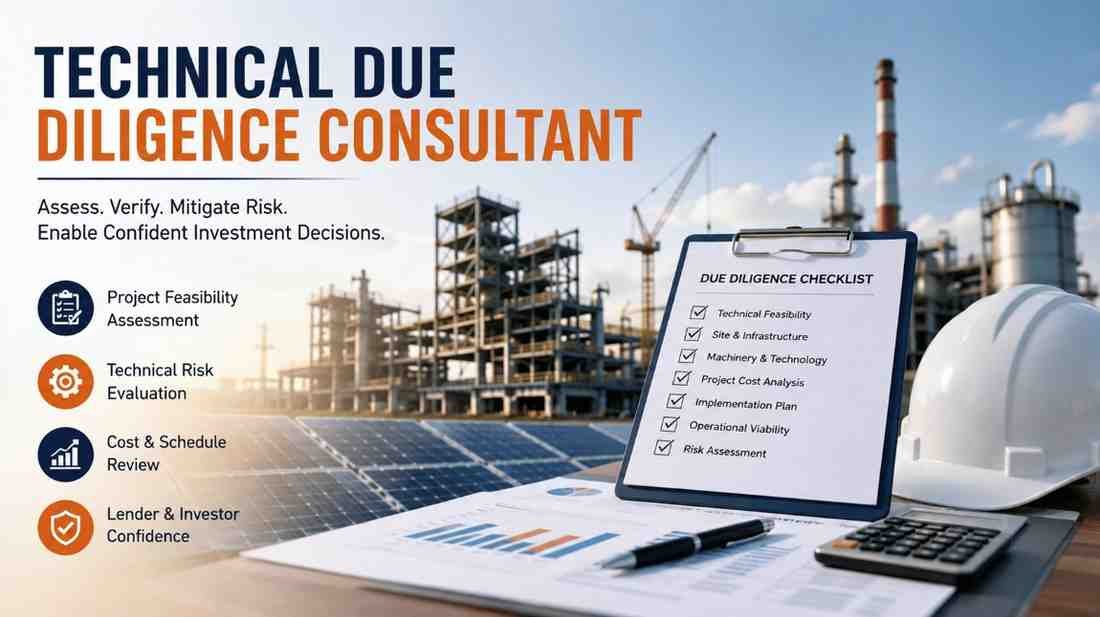
A Technical Due Diligence Consultant is
usually brought into a project when an investor, lender, promoter, or financial
institution wants an independent view of the technical condition and
feasibility of a project before committing money. The work goes well beyond
checking drawings or visiting a project site.
In practical terms, the consultant examines
whether the proposed project can actually be built, operated, and maintained in
the manner assumed in the project proposal. The review may cover technology,
project design, construction plans, equipment, capacity, land and site
conditions, implementation schedules, cost estimates, contracts, statutory
requirements, and operating assumptions.
This becomes particularly important when a
project involves substantial debt or long term investment. A promoter may have
prepared a Detailed Project Report with attractive financial projections, but
the lender still needs to understand whether the technical assumptions behind
those numbers are realistic.
For example, consider a manufacturing
company planning to add a new production line. The promoter may estimate that
the new line will increase production capacity by 40 percent. A Technical Due
Diligence Consultant would not simply accept that figure. The review may
involve checking the proposed machinery, plant layout, utilities, raw material
requirements, production cycle, power availability, installation schedule, and
whether the existing facility can actually support the expansion.
The same principle applies to a solar
project. The consultant may examine the proposed technology, site conditions,
equipment specifications, generation assumptions, evacuation arrangements,
construction schedule, operation and maintenance plans, and other technical
factors that can affect the project's ability to perform as projected.
The consultant's role is therefore partly
investigative. It is about finding gaps before those gaps become expensive
problems.
A proper technical review can also help
separate technical risks from commercial or financial risks. This distinction
matters because a project can be financially attractive on paper but still have
a technical weakness that could affect debt repayment.
Frontline Consultants works in this area as
part of its broader financial and project advisory services. Its experience
includes assignments involving project assessment, lender requirements,
Detailed Project Reports, Techno Economic Viability Reports, Lenders
Independent Engineer Services and other advisory work connected with project
funding.
The exact scope changes from one assignment
to another. A warehouse expansion does not require the same technical review as
a hospital, manufacturing plant, highway project or renewable energy facility.
That is one reason technical due diligence
should not be treated as a standard checklist exercise.
Why Technical Due Diligence Matters Before Project
Investment
Project investment decisions are often
based on a combination of projected revenue, estimated costs, market demand and
expected returns. But behind these financial figures are technical assumptions.
If those assumptions are weak, the
financial model can also become unreliable.
This is where technical due diligence
becomes useful.
Suppose an industrial unit is seeking
finance for a plant expansion. The promoter has already negotiated machinery
quotations and prepared a project report. The expected production volume
appears reasonable, and the projected sales look strong. During technical
review, however, it may emerge that the proposed machinery requires a
particular utility arrangement that the existing facility cannot provide
without additional investment.
That seemingly small point can change the
project cost and implementation schedule.
Another common situation occurs when
project costs are underestimated. A promoter may include the major equipment
but overlook installation, civil modifications, electrical work, testing,
commissioning, water systems, fire safety arrangements or other supporting infrastructure.
Each item may appear manageable individually, but together they can create a
meaningful funding gap.
A Technical Due Diligence Consultant helps
identify such issues before investment or lending decisions are finalised.
There is also a difference between what a
promoter believes can be achieved and what the existing infrastructure can
support.
An MSME seeking additional working capital
may have sufficient orders but inadequate production capacity. In another case,
the company may already have machinery installed but face bottlenecks in
utilities, manpower, maintenance or plant layout. The lender needs to
understand the actual operating position rather than relying only on management
projections.
For banks and financial institutions, this
review has another purpose. Lending decisions involve repayment risk. If a
project is delayed, underperforms or requires substantial additional capital,
the borrower's ability to service debt may come under pressure.
Technical due diligence does not remove
that risk. It gives lenders a clearer understanding of where the risk actually
sits.
This is especially relevant for
infrastructure projects, where delays can have a direct financial impact. A
road project, hospital, warehouse, industrial park or solar installation may
depend on multiple contractors, approvals, equipment suppliers and site
activities. A delay in one area can affect the entire implementation schedule.
Sometimes perfectly good projects get
delayed because documentation was prepared in the wrong sequence. It still
surprises me.
The review also helps investors negotiate
with greater clarity. If a technical consultant identifies deficiencies in
equipment specifications, construction estimates or project schedules, the
investor can ask questions before committing funds.
Many business owners believe that technical
due diligence is mainly required for large infrastructure projects. That is not
correct. It can be equally useful for manufacturing expansions, healthcare
facilities, warehouses, educational institutions, renewable energy projects and
other capital intensive ventures.
At the same time, this doesn't apply
everywhere. A small project with limited technical complexity may not require
an elaborate due diligence exercise. The depth of review should match the size,
complexity and risk of the investment.
How a Technical Due Diligence Consultant Assesses Project
Feasibility
Project feasibility is not determined by
one document or one calculation. A Technical Due Diligence Consultant generally
looks at several connected factors to understand whether the proposed project
can work in practice.
The first area is usually the project
concept itself.
What is being developed? What capacity is
proposed? What technology will be used? Is the proposed capacity consistent
with the available site, machinery, utilities and market requirements?
For a manufacturing project, the assessment
may start with the manufacturing process. The consultant reviews the production
flow, machinery configuration, raw material requirements and expected output.
If the promoter proposes a particular production capacity, that figure needs to
be tested against the actual equipment and operating conditions.
For example, a company may propose
operating a plant for 300 days a year with a particular production capacity.
That does not automatically mean the plant will achieve that output.
Maintenance shutdowns, changeover time, labour availability, utility
interruptions and production losses can affect actual utilisation.
A sensible technical assessment therefore
looks beyond installed capacity.
Site and Infrastructure Assessment
The physical site is another important part
of feasibility.
The consultant may review land
availability, site access, topography, existing structures, utilities, water supply,
power availability, drainage, storage facilities and other infrastructure
depending on the project.
For a warehouse expansion, for instance,
the proposed storage capacity may appear adequate on paper. But access roads,
loading arrangements, fire safety systems, power requirements and internal
movement of goods can influence whether the facility will operate efficiently.
For a hospital project, the assessment may
involve the proposed built-up area, departments, medical infrastructure,
utilities, equipment planning, fire safety provisions and implementation
requirements.
The objective is not to redesign the entire
project. It is to identify technical conditions that could affect cost,
implementation or operations.
Technology and Equipment Review
Technology selection can materially affect
project performance.
The consultant may examine whether the
proposed technology is suitable for the intended application, whether equipment
specifications match the required capacity, and whether the selected machinery is
supported by appropriate suppliers and service arrangements.
Equipment quotations also need careful
examination.
A project may include machinery costs based
on a quotation that excludes installation, commissioning or related
infrastructure. In other cases, the quoted equipment may not provide the
capacity assumed in the financial projections.
These differences matter when calculating
the total project cost and funding requirement.
Project Cost Assessment
Technical due diligence also connects
closely with project cost assessment.
A project cost is not simply the price of
the main machinery. Depending on the project, it can include land development,
civil construction, plant and machinery, electrical systems, utilities,
installation, engineering, pre-operative expenses, contingencies and other
components.
A Technical Due Diligence Consultant
reviews whether the estimated costs appear reasonable in relation to the
proposed scope.
This is particularly useful for lenders. If
the project cost is understated, the promoter may have to bring in additional
funds later. If the cost is substantially overstated, the funding structure and
project economics may also need reconsideration.
Implementation Schedule
The project schedule is another area where
practical judgement matters.
A promoter may assume that a plant can be
completed within eight months. The consultant examines whether procurement,
civil work, equipment delivery, installation, testing and commissioning can
realistically fit within that period.
For a solar project, the schedule may
depend on equipment procurement, site development, module and inverter
availability, transmission arrangements, construction activities and approvals.
A delay is not always a technical failure.
But the technical review can identify activities where the proposed timeline
appears unrealistic.
Operating and Maintenance Considerations
Feasibility does not end when construction
is complete.
The project must also operate properly
after commissioning.
The review may therefore consider maintenance
requirements, availability of spare parts, technical manpower, utility
requirements, expected equipment life and operating arrangements.
An industrial borrower might have modern
equipment but insufficient technical staff to operate it effectively. A
renewable energy project may have appropriate equipment but inadequate
arrangements for operation and maintenance.
These points may not immediately appear in
a financial projection, but they can influence actual performance.
Regulatory and Technical Approvals
Depending on the industry, statutory and
technical approvals can be important project dependencies.
The consultant may identify whether
required approvals, permissions, clearances or technical arrangements have been
considered in the project plan.
The exact requirements vary considerably
between industries, so the review needs to be project specific.
Identifying Technical Risks Before
Funding
The final objective is to understand the
risks that could affect project completion and performance.
A lender may be comfortable with a project
after understanding that a particular risk exists and that a practical
mitigation plan is available. The problem arises when important risks are not
identified at all.
That is where an independent Technical Due
Diligence Consultant can add value.
The consultant's findings may also support
other parts of the financing process. A lender may use the technical assessment
alongside financial projections, credit appraisal, valuation reports, promoter
information and other documents before taking a funding decision.
Frontline Consultants approaches such
assignments from this wider project and lending perspective. Its work across
financial consulting and project advisory includes Technical Due Diligence, TEV
Reports, Lenders Independent Engineer assignments, project reports, valuation,
credit syndication and bank liaison.
One personal observation from this kind of
work is that the most useful findings are not always the biggest ones.
Sometimes a small inconsistency between a machinery quotation and the project
report tells you more than several pages of polished projections.
And occasionally, you find a project where
most things are technically sound, but one missing assumption keeps appearing
in the documents. That is usually where the conversation becomes interesting.
A good technical review does not exist to
reject projects. Its real purpose is to make the decision clearer. If the
project is technically sound, the findings provide greater comfort. If
weaknesses exist, the promoter gets an opportunity to address them before those
weaknesses become much more expensive.
For banks, investors and business owners,
that distinction is important. The value of technical due diligence is not in
producing another report. It lies in understanding whether the project
described in the documents is actually capable of becoming the project being
financed.
Technical Due Diligence for Manufacturing and Industrial
Projects
Manufacturing projects often look
straightforward in a project report. There is land, a building, machinery,
production capacity, raw materials and projected sales. In practice, the
relationship between these elements can be much more complicated.
A Technical Due Diligence Consultant
examines whether the proposed manufacturing setup is technically capable of
delivering what the promoter has assumed.
Consider an MSME planning a plant
expansion. The promoter may have existing orders and a clear reason for adding
machinery. The project report may show that production will increase substantially
after expansion. The technical review would look at the proposed machinery,
production process, plant layout, utility requirements, installation
arrangements and available infrastructure.
One common issue is capacity assumptions.
Installed machinery capacity and actual production are not always the same.
Maintenance, product changeovers, labour availability, power interruptions and
process limitations can reduce utilisation. A lender therefore needs to
understand the practical production capacity rather than simply accepting the
maximum figure quoted by an equipment supplier.
The consultant may also examine whether the
existing facility can accommodate the expansion.
For example, a food processing company may
have enough floor space for new machinery but insufficient power capacity or
inadequate cold storage. A metal processing unit may have the machinery
required for expansion but need additional electrical infrastructure before the
equipment can operate.
These points can affect both project cost
and implementation time.
Equipment selection is another important
area. The consultant may review machinery quotations, technical specifications,
supplier information, expected output, installation requirements and
commissioning arrangements. If the project report assumes a certain production
capacity but the proposed machinery does not support that capacity under
realistic operating conditions, the financial projections need to be
reconsidered.
Project cost is also reviewed from a
technical perspective.
A promoter may include the cost of
machinery and civil construction but overlook electrical work, utility systems,
installation, testing, commissioning, fire safety arrangements or other
supporting infrastructure. Such omissions can create a funding gap after the
project has already started.
For banks, this matters because a borrower
may approach the lender for additional funding later. That can complicate the
original financing structure.
Industrial projects also require attention
to implementation sequencing. Civil work may need to be completed before
machinery installation. Certain machinery may have long procurement periods.
Utilities may need to be commissioned before production trials begin.
A Technical Due Diligence Consultant looks
at these dependencies rather than treating each project cost as an isolated
number.
For an existing industrial borrower, the
review can also help understand operational problems. A company may have
declining production despite having adequate installed capacity. The reasons
could include obsolete equipment, maintenance issues, bottlenecks in a
particular production stage or inadequate utilities.
In such situations, technical due diligence
provides a more realistic picture of the business than a simple review of
financial statements.
Technical Due Diligence for Infrastructure, Solar and
Renewable Energy Projects
Infrastructure and renewable energy
projects have a different risk profile because implementation depends on
several external and technical factors.
A solar project is a good example.
The financial model may be based on
expected generation, project cost, tariff assumptions and operating expenses.
But generation depends on the technical configuration of the project, site
conditions, equipment selection, grid connectivity and operating arrangements.
A Technical Due Diligence Consultant
reviews these underlying assumptions before a lender or investor makes a major
commitment.
Site assessment is an important starting
point. Depending on the project, this can involve reviewing land availability,
site access, topography, drainage, infrastructure and other physical
characteristics.
For a solar project, the consultant may
examine the proposed plant configuration, module technology, inverter capacity,
evacuation arrangements, transmission infrastructure and construction plan. The
objective is to determine whether the technical design supports the expected
project performance.
Equipment quality and specifications also
require attention.
A project may have a substantial equipment
budget, but the cost alone does not establish technical suitability. The
consultant considers whether the proposed equipment matches the project
requirements and whether the procurement and installation arrangements are
realistic.
The same principle applies to other
renewable energy projects.
For a wind project, technical assessment
may consider site characteristics, equipment specifications, infrastructure and
expected operating conditions. For a biomass project, fuel availability and
handling arrangements can become important. A small hydro project may require
detailed attention to site conditions, civil structures and equipment
configuration.
Infrastructure projects have their own
complexities.
A hospital project, for example, may
require detailed examination of the proposed building, medical infrastructure,
utilities, equipment planning and implementation schedule. A warehouse project
may involve assessment of storage design, loading systems, access, fire safety
and utilities.
A road or industrial infrastructure project
may have multiple packages, contractors and dependencies. Delays in one package
can affect the completion of the entire project.
This is why technical due diligence should
not be limited to checking whether construction has started.
The consultant needs to understand what has
been completed, what remains pending, what resources are required and whether
the proposed completion schedule is realistic.
For lenders, this information becomes
important when assessing whether the project can commence commercial operations
within the period assumed in the financing model.
A delay in a capital intensive project can
increase interest during construction, contractor costs and other expenses. It
can also postpone revenue generation.
In renewable energy projects, performance
after commissioning matters just as much as construction. The technical review
may therefore consider operation and maintenance arrangements, equipment
warranties, spare parts and long term maintenance requirements.
The purpose is not to predict every future
problem. That is impossible. It is to identify the major technical factors that
can influence project performance.
How Technical Due Diligence Supports Bank and Lender
Credit Appraisal
Banks and financial institutions do not
assess a project only on the basis of the promoter's business plan.
They want to know whether the project being
financed is technically feasible, whether the estimated cost is reasonable,
whether implementation is achievable and whether the underlying assets and
operations can support the proposed business model.
This is where a Technical Due Diligence
Consultant can support the credit appraisal process.
Credit appraisal looks at the overall
repayment capacity and risk of the borrower. Technical due diligence
contributes by testing the technical assumptions behind the financial
projections.
For example, a promoter may approach a bank
for a term loan to establish a new manufacturing unit. The project report may
estimate production of a certain volume from the second year onward. The lender
needs some comfort that the machinery, plant capacity, utilities and
implementation schedule can support that estimate.
If the technical assessment identifies a
major capacity limitation, the financial projections may need to be revised.
The same applies to project cost.
Suppose the promoter estimates that a new
facility will cost Rs 50 crore. During technical review, it becomes clear that
essential utility infrastructure and installation costs have not been fully
included. The actual project cost could therefore be higher.
This affects the debt requirement, promoter
contribution and financing structure.
Technical due diligence can also support
the lender's understanding of project progress.
For an ongoing project, an independent
assessment may help determine the percentage of work completed, major pending
activities, procurement status and likely completion timeline. This becomes
particularly relevant when lenders are releasing funds in stages.
A lender may also want an independent view
where the project is already experiencing delays.
For example, an infrastructure borrower may
have exhausted part of its sanctioned funding but still have substantial
construction work remaining. The technical review can help identify whether the
remaining funding is sufficient and whether the project can realistically reach
completion.
This information can feed into credit
decisions, restructuring discussions or additional funding assessments.
The technical report does not replace the
bank's credit appraisal. It supports it.
Many business owners believe that preparing
a good DPR is enough for getting a loan. In reality, that rarely happens. A DPR
explains the project, but lenders may still need independent confirmation of
technical feasibility, project cost, implementation progress and other risk
factors.
This distinction becomes even more
important when project funding is substantial.
For an industrial borrower facing financial
stress, a technical assessment may help determine whether the underlying
project remains viable or whether technical issues are contributing to poor
performance.
It can also help during debt restructuring
when the lender needs a clearer picture of the borrower's assets, operations
and future project requirements.
Key Areas Reviewed During a Technical Due Diligence
Assignment
The scope depends on the nature of the
assignment, but several areas commonly receive attention.
Project scope and configuration
The consultant first needs to understand
what is being proposed. This includes project capacity, major components,
technology and intended operating model.
Site and physical infrastructure
Land, site conditions, access, existing
structures, utilities and other physical infrastructure may be reviewed
depending on the project.
Technology and machinery
For manufacturing and industrial projects,
machinery specifications, production capacity, equipment configuration and
supplier details are important. For infrastructure and renewable projects, the
review may focus on the relevant technical systems and equipment.
Project cost
The consultant checks whether major
technical components have been properly considered in the cost estimate. This
can include civil work, machinery, utilities, installation and commissioning.
Implementation schedule
The review considers whether procurement,
construction, installation and commissioning activities can realistically be
completed within the proposed timeline.
Operational feasibility
The project should not only be capable of
being constructed. It should also be capable of operating at the expected
level. Production processes, maintenance, utilities, manpower and operating
arrangements may therefore be considered.
Statutory and technical requirements
Depending on the sector, the consultant may
review whether important technical permissions, approvals and compliance
requirements have been considered.
Contractual and vendor arrangements
Major equipment suppliers, contractors and
technical service arrangements can influence project execution. The consultant
may review relevant contracts and quotations where these form part of the
assignment.
Project risks
Finally, the consultant identifies
significant technical risks that could affect cost, schedule, performance or
completion.
The resulting findings can then be
considered alongside financial projections, valuation, credit appraisal and
other lender documentation.
Common Problems Identified During Technical Due Diligence
Technical due diligence often identifies
issues that were not obvious from the initial project report.
One common problem is underestimated
project cost.
This happens when supporting infrastructure
is left out or certain expenses are treated as minor. Installation, electrical
systems, utility development and commissioning expenses can collectively become
significant.
Another issue is unrealistic capacity
assumptions.
Promoters sometimes rely on the maximum
rated capacity of equipment when preparing projections. Actual production may
be lower because of downtime, maintenance, product changes or other operating
limitations.
A third problem is incomplete project
planning.
The promoter may have ordered machinery but
not completed the supporting civil or utility infrastructure. The project
therefore cannot become operational even though a large portion of the
equipment has already arrived.
Unrealistic implementation schedules are also common.
A project schedule prepared for financing
purposes may appear attractive but fail to account for procurement periods,
approvals, site preparation or commissioning requirements.
There can also be technology mismatch.
The proposed equipment may be technically
sound but unsuitable for the specific product, capacity or operating conditions
of the business.
For renewable projects, generation
assumptions can require closer examination. The financial model may assume
performance levels that need to be supported by the project's technical design
and site characteristics.
For existing industrial borrowers, operational
bottlenecks are another concern. A plant may have enough installed
machinery but still fail to achieve expected output because one stage of
production limits the entire process.
Poor documentation is perhaps the least technical problem but one of the most
frequent.
Machinery quotations may differ from the
project report. Equipment specifications may not match the assumptions used in
financial projections. Old drawings may continue to appear in current
submissions. Such inconsistencies create questions for lenders.
Sometimes the technical issue itself is
manageable, but the documentation makes it look much worse.
This is why proper documentation saves
time. When project costs, specifications, schedules and technical assumptions
are consistent, discussions with lenders tend to be much clearer.
A Technical Due Diligence Consultant does not
simply list these problems. The useful part of the assignment is understanding
their likely effect.
A minor documentation gap is different from
a major capacity limitation. A manageable construction delay is different from
a project that has no clear path to completion.
That judgement is important.
Frontline Consultants brings technical and
financial project advisory experience to such assignments, including Technical
Due Diligence, Techno Economic Viability Reports, Lenders Independent Engineer
Services, Detailed Project Reports, valuation, credit syndication, debt
restructuring and bank liaison.
For promoters, the value of this work often
comes before the lender even asks the difficult questions. It gives the
business an opportunity to identify weaknesses, correct documentation and
understand the technical position of the project before a financing decision
depends on it.
And yes, sometimes the findings are
frustrating. A project can have a strong market, an experienced promoter and
reasonable financial projections, yet one technical dependency can hold
everything up. That is part of project advisory work. Finding that dependency
early is far better than finding it after the money has been committed.
How to Choose the Right Technical Due Diligence Consultant
in India
Choosing a Technical Due Diligence
Consultant is not simply about finding a firm that can prepare a technical
report. The more important question is whether the consultant understands how
technical findings affect project cost, implementation, operations and lender
decisions.
This becomes particularly important when
the assignment is connected with project finance.
A manufacturing company seeking expansion
finance may already have a DPR, machinery quotations and projected financial
statements. A solar developer may have land, equipment proposals and a
financial model. An infrastructure company may have contracts and an
implementation schedule. In each case, the consultant needs to understand the
actual project rather than simply verify whether documents have been submitted.
One of the first things to check is relevant
sector experience.
A consultant who has worked extensively on
manufacturing projects may understand machinery, production capacity and
industrial utilities well. That does not automatically mean the same consultant
has the required experience for a solar, hospital or infrastructure assignment.
Ask what type of projects the consultant
has handled.
It is also worth asking whether the
consultant has worked on assignments connected with banks, NBFCs, financial
institutions and institutional investors. Technical due diligence for a lender
is somewhat different from a purely engineering inspection because the findings
have to connect with project funding, repayment capacity and financial risk.
The second factor is the scope of the
assignment.
Before appointing anyone, the promoter
should understand exactly what will be reviewed. Will the consultant assess the
site? Will machinery and equipment be examined? Will project costs be checked?
Will implementation progress be reviewed? Will the consultant examine the
project schedule and identify major technical risks?
A vague scope can create problems later.
For example, if a company expects an
independent assessment of project cost but the consultant's assignment only
covers equipment inspection, there may be a gap between what the promoter
expects and what is actually delivered.
The third consideration is independence.
A technical consultant should be able to
point out weaknesses even when the findings are uncomfortable for the promoter.
The purpose is not to make the project look attractive. It is to provide a
realistic technical assessment.
This matters particularly when a project is
being presented to a lender.
A good Technical Due Diligence Consultant
should be comfortable saying that a particular cost estimate appears low, that
a project schedule is unrealistic, or that additional infrastructure may be
required.
Experience with lender requirements
is another useful indicator.
Banks generally want clarity around project
cost, technical feasibility, implementation status and potential risks. A
consultant who understands this environment is more likely to prepare findings
that are useful during credit appraisal.
Frontline Consultants works across financial
and project advisory assignments involving Technical Due Diligence, Techno
Economic Viability Reports, Lenders Independent Engineer Services, Detailed
Project Reports, Enterprise Valuation, Asset Valuation, Credit Syndication,
Debt Restructuring, Bank Liaison and project advisory.
That combination of technical and financial
understanding can be useful where the technical review needs to connect with
the wider financing process.
Another point worth checking is the quality
of documentation.
A technically capable consultant should be
able to explain findings clearly. The report should distinguish between major
risks, minor observations and issues that can be addressed through normal
project execution.
Not every observation is a deal breaker.
A missing document may be easy to correct.
An underestimated project cost may require additional promoter contribution. A
fundamental technology issue may require a much deeper reconsideration.
The consultant should help the client
understand the difference.
It is also sensible to discuss the site
visit and verification process before appointing the consultant. For many
assignments, document review alone is not enough. Physical inspection can
reveal conditions that are difficult to understand from drawings or photographs.
For an existing manufacturing plant, for
example, a site visit may reveal equipment utilisation, plant layout
limitations, maintenance conditions or unfinished infrastructure. For a project
under construction, the consultant can compare actual progress with the
submitted project schedule.
Finally, look at the consultant's ability
to work with different stakeholders.
A technical due diligence assignment may
involve promoters, project teams, contractors, equipment suppliers, bankers and
financial advisors. The consultant needs to ask questions without turning the
exercise into a confrontation.
The right consultant is therefore not
necessarily the one who produces the longest report. It is the one who can
identify what matters, explain why it matters and help the lender or investor
make a better informed decision.
I might be wrong here, but in practice, the
most useful consultant is often the one who asks difficult questions early
rather than the one who produces a very polished report at the end.
Frequently Asked Questions About Technical Due Diligence
Consultants
What is a Technical Due Diligence
Consultant?
A Technical Due Diligence Consultant
independently reviews the technical aspects of a project to determine whether
the proposed or existing project is technically feasible and capable of
achieving its intended objectives.
The review may cover project design,
technology, machinery, site conditions, infrastructure, project costs,
implementation schedules, operating arrangements and technical risks.
The exact scope depends on the type and
stage of the project.
Why do banks require technical due
diligence?
Banks want to understand whether the
project being financed can actually be completed and operated as proposed.
A financial projection may show sufficient
revenue to repay debt, but those projections depend on technical assumptions
such as production capacity, project completion, equipment performance and
operating conditions.
Technical due diligence provides an
independent view of these assumptions and helps lenders assess project related
risks.
Is technical due diligence required only
for large projects?
No.
Large infrastructure and renewable energy
projects often require detailed technical assessment, but smaller manufacturing
expansions, warehouses, hospitals, educational projects and industrial units
can also benefit from it.
The depth of the review should be
appropriate to the size, complexity and risk of the project.
What documents does a Technical Due
Diligence Consultant usually require?
The documents vary according to the
assignment, but may include the DPR, project cost estimates, machinery
quotations, technical specifications, site information, drawings, project
schedules, contracts, equipment details, utility requirements and relevant
approvals.
For an existing project, the consultant may
also require information about installed machinery, production capacity,
maintenance and current project progress.
The consultant normally identifies the
exact document requirement after understanding the project.
Does technical due diligence replace a
Detailed Project Report?
No.
A Detailed Project Report explains the
proposed project, including its technical, commercial and financial aspects.
Technical due diligence provides an independent assessment of whether important
technical assumptions in the project are reasonable.
Both can serve different purposes.
A promoter may prepare a DPR before
approaching a lender, while the lender may seek independent technical
assessment before taking a financing decision.
Can a Technical Due Diligence Consultant
assess project cost?
Yes, where project cost assessment forms
part of the assignment.
The consultant may examine major components
such as civil works, plant and machinery, utilities, installation,
commissioning and other technical expenses.
The objective is to determine whether the
estimated cost is broadly consistent with the proposed project scope and
technical requirements.
What happens if the consultant finds
technical problems?
The finding does not automatically mean
that the project cannot be financed.
The importance of the problem depends on
its nature and likely impact.
For example, a documentation mismatch may
be easy to correct. An underestimated utility requirement may require
additional investment. A serious technology or capacity problem may require
changes to the project itself.
A good report should explain the
significance of the finding rather than simply listing observations.
Can technical due diligence be conducted
for a solar project?
Yes.
Solar projects can require detailed
technical review because project performance depends on site conditions, plant
configuration, equipment selection, evacuation arrangements, construction
planning and operation and maintenance arrangements.
The consultant may review whether the
technical assumptions support the generation and project performance
assumptions used in the financial model.
Is a site visit necessary for technical
due diligence?
Not in every assignment, but physical
inspection is often useful, particularly for existing or partially completed
projects.
A site visit can help the consultant
compare submitted information with actual conditions.
For example, an industrial project may show
a certain level of completion in its documents, while physical inspection
reveals that some utilities or supporting infrastructure are still pending.
How does technical due diligence help
promoters?
It allows promoters to identify technical
gaps before they become serious financing or implementation issues.
A promoter preparing to approach a bank may
discover that project costs need revision, machinery specifications require
clarification or the implementation schedule needs to be made more realistic.
Addressing such matters early can make
subsequent discussions with lenders more straightforward.
How long does a technical due diligence
assignment take?
There is no fixed duration.
A straightforward assignment involving an
existing facility may take considerably less time than a large infrastructure
or renewable energy project with multiple technical components.
The timeline depends on project size,
documentation, site requirements, complexity and the scope agreed with the
consultant.
What should I look for when hiring a
Technical Due Diligence Consultant in India?
Look for relevant sector experience,
understanding of lender requirements, independence, technical expertise,
quality of reporting and the ability to explain findings clearly.
It is also useful to understand whether the
consultant has experience working with banks, NBFCs, investors and promoters.
For complex projects, experience across
both technical and financial advisory can be particularly useful because
technical findings often have direct implications for project cost and funding.
Frontline Consultants provides financial
and project advisory services for businesses and projects that require
independent assessment, lender support and financing related documentation. Its
services include Technical Due Diligence, Techno Economic Viability Reports,
Lenders Independent Engineer Services, Detailed Project Reports, valuation,
credit syndication, debt restructuring and bank liaison.
The right consultant should ultimately help
answer a practical question: does the project described in the documents have a
realistic technical path to completion and operation?
That is what makes technical due diligence
useful to a promoter, lender or investor. The report is only the final
document. The real work happens in the questions asked before that report is
prepared.