
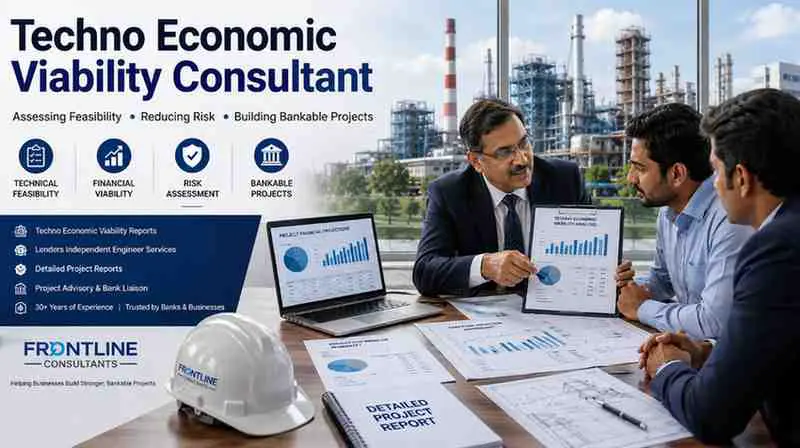
Every project begins with confidence. A business owner believes demand exists, land has been identified, machinery quotations have been collected, and funding discussions have already started. On paper, everything appears ready. Yet many projects slow down once lenders begin asking detailed questions. That is usually the stage where the role of a Techno Economic Viability Consultant becomes important.
A Techno Economic Viability Consultant evaluates whether a proposed project is practical from technical, financial, commercial, and operational perspectives. The objective is not simply to prepare another report. It is to determine whether the project can realistically generate enough returns to support the investment and repay borrowed funds within the expected period.
Banks, financial institutions, NBFCs, and investors often rely on independent assessments before committing significant capital. Even promoters who are investing their own funds benefit from understanding the strengths and weaknesses of a project before construction or expansion begins. A small correction during the planning stage is usually far less expensive than fixing a problem after the project has already been commissioned.
Many business owners believe preparing a DPR is enough for getting a loan. In reality, that rarely happens. A Detailed Project Report explains what the promoter intends to do, but lenders often require an independent review to verify whether those assumptions are reasonable. That is where a Techno Economic Viability Consultant provides value.
"No project can be absolutely risk-free. The analysis of the degree of technical risk and associated financial viability is to assist promoters, lenders, and regulatory bodies to take a view on the acceptability of risk levels and their implications." — Frontline Consultants Team
A proper techno economic viability assessment goes much deeper than checking projected profits. It examines the proposed technology, production process, raw material availability, market demand, plant capacity, implementation schedule, statutory approvals, environmental considerations, operating costs, revenue assumptions, and financial projections. All these factors influence whether a project deserves financing.
Consider a manufacturing company planning to expand its production capacity. The promoters may estimate that demand will double over the next five years. A Techno Economic Viability Consultant studies whether those projections match industry trends, whether additional machinery can operate efficiently, whether power and utility requirements have been adequately planned, and whether projected cash flows are sufficient to service the proposed debt.
I might be wrong here. Some smaller loans may not always require a detailed independent assessment. This doesn't apply everywhere. However, as project size increases and lender exposure becomes larger, independent techno economic evaluation becomes increasingly important because the financial risk also rises.
In my experience, one of the most overlooked areas is implementation planning. Sometimes perfectly good projects get delayed because documentation was prepared in the wrong sequence. It still surprises me. Land approvals, environmental clearances, machinery procurement, and financing often move at different speeds, creating avoidable delays that eventually affect project costs.
An experienced Techno Economic Viability Consultant also acts as a bridge between project promoters and lenders. Instead of presenting overly optimistic assumptions, the consultant identifies possible risks early and explains how they can be managed. Banks generally appreciate realistic projections more than aggressive estimates that cannot be justified later.
With more than three decades of experience, Frontline Consultants has worked across manufacturing, infrastructure, healthcare, renewable energy, education, logistics, and industrial sectors by preparing Techno Economic Viability Reports, Lenders Independent Engineer reports, Detailed Project Reports, Project Advisory documents, and other financial assessments that support informed lending decisions.
Ultimately, the work of a Techno Economic Viability Consultant is not about predicting success with certainty. It is about reducing uncertainty before large financial commitments are made. That distinction often makes all the difference during project appraisal.
When Businesses Should Engage a Techno Economic Viability Consultant
One question business owners frequently ask is whether they should appoint a Techno Economic Viability Consultant before approaching a bank or only after the lender requests a report. In most cases, engaging a consultant early produces better outcomes because planning decisions are still flexible.
Businesses generally think about techno economic viability studies only when loan documentation begins. By then, machinery quotations have been finalised, financial projections are complete, and project costs have already been estimated. If major issues are identified at that stage, revising the project can become both expensive and time consuming.
A manufacturing company planning a new production unit, for example, should ideally involve a Techno Economic Viability Consultant while finalising project capacity. Increasing production capacity may improve economies of scale, but it can also require additional infrastructure, utilities, skilled manpower, and higher working capital. These factors influence long term financial sustainability.
The same applies to hospital projects. A healthcare promoter may focus primarily on medical equipment and building design, while lenders also examine occupancy assumptions, patient demand, operational expenses, staffing requirements, regulatory approvals, and projected cash generation. A balanced techno economic assessment brings these aspects together before funding discussions begin.
Solar energy projects provide another practical example. Technical design alone is not enough. Lenders often examine irradiation data, technology selection, EPC capabilities, evacuation infrastructure, expected plant load factor, operation and maintenance costs, and revenue assumptions under applicable power purchase agreements. An experienced Techno Economic Viability Consultant evaluates how these elements work together instead of reviewing them separately.
Warehouse and logistics projects have also become more complex over the past few years. Demand forecasts, connectivity, warehouse utilisation, lease assumptions, automation requirements, and future expansion possibilities all influence viability. A detailed assessment helps both promoters and lenders understand whether projected returns justify the investment.
Businesses facing debt restructuring can also benefit from independent techno economic evaluation. If an industrial borrower experiences temporary financial stress, lenders need to determine whether operational improvements can restore viability or whether deeper restructuring measures are necessary. A carefully prepared assessment often provides valuable direction during such situations.
Interestingly, established companies also seek the services of a Techno Economic Viability Consultant even when external borrowing is limited. Internal investment committees, private investors, and corporate boards increasingly expect independent project validation before approving significant capital expenditure.
I have noticed that promoters sometimes become emotionally attached to their original project assumptions. That is understandable because they have invested months of effort into planning. An independent review introduces objectivity. It highlights risks without questioning the promoter's vision.
Frontline Consultants has supported businesses at different stages of project development by providing Techno Economic Viability Reports alongside project advisory, lender coordination, bank liaison, credit syndication, enterprise valuation, asset valuation, and business financial consulting services. The objective is not merely report preparation but helping projects move forward with stronger financial credibility.
What a Techno Economic Viability Study Covers Before a Bank Takes a Lending Decision
A lender does not approve project finance based only on projected profits. Banks evaluate whether the entire project is capable of operating successfully throughout the loan tenure. This is exactly why a Techno Economic Viability Consultant examines multiple aspects before a financing proposal reaches the credit committee.
The study usually begins with understanding the promoter's background and project objectives. Experience in the industry, management capability, existing operations, financial strength, and implementation track record provide useful context. Even an excellent project can face execution challenges if management systems are weak.
The technical evaluation then examines whether the proposed technology is suitable for the intended production process. Machinery selection, plant layout, production capacity, utility requirements, raw material availability, infrastructure support, environmental compliance, and implementation schedules are reviewed carefully. If the technology itself creates operational risks, future financial performance may also become uncertain.
Commercial feasibility is equally important. A Techno Economic Viability Consultant studies market demand, customer segments, industry competition, pricing assumptions, supply chain stability, procurement risks, and future growth opportunities. Revenue projections should reflect realistic market conditions rather than optimistic expectations alone.
Financial analysis forms another major part of the assessment.
Project cost estimates are verified, funding sources are examined, debt equity structure is reviewed, operating expenses are analysed, projected profitability is evaluated, and cash flow forecasts are tested under different business scenarios. Financial indicators such as Debt Service Coverage Ratio, Internal Rate of Return, Break Even Analysis, and repayment capacity help lenders understand whether the proposed financing structure remains sustainable over time.
Working capital assumptions also receive significant attention. Many otherwise profitable businesses encounter financial stress because day to day operating requirements were underestimated. Inventory cycles, receivables, creditor periods, seasonal demand variations, and cash conversion cycles all influence working capital requirements.
Risk assessment brings the different findings together. A Techno Economic Viability Consultant identifies operational, financial, regulatory, environmental, implementation, and market related risks while suggesting practical mitigation measures wherever possible. The purpose is not to eliminate every uncertainty because that is impossible. Instead, it is to ensure that decision makers understand the risks before funds are committed.
| Assessment Area | Why It Matters to Lenders |
|---|---|
| Technical Feasibility | Confirms that technology, capacity, and operations are practical. |
| Commercial Viability | Validates demand, competition, and revenue assumptions. |
| Financial Analysis | Evaluates profitability, cash flow, and repayment ability. |
| Implementation Review | Assesses project timelines and execution readiness. |
| Risk Assessment | Identifies factors that could affect project performance. |
By the time a lender receives a professionally prepared report from an experienced Techno Economic Viability Consultant, many important questions have already been addressed in advance. That often makes discussions more productive because both the promoter and the lender are working with the same set of verified assumptions.
This is one reason organisations such as Frontline Consultants, with more than 30 years of experience in Techno Economic Viability Reports, Lenders Independent Engineer Services, Agency for Special Monitoring, Detailed Project Reports, Enterprise Valuation, Asset Valuation, Credit Syndication, Debt Restructuring, Bank Liaison, and Project Advisory, continue to support businesses across diverse industries seeking structured project finance solutions.
Common Reasons Projects Face Delays Even After a Strong Business Proposal
One of the biggest misconceptions among project promoters is that a well-prepared business proposal automatically leads to faster loan approval and project implementation. Unfortunately, that is rarely how project finance works. A good proposal certainly helps, but lenders evaluate far more than projected profitability before they commit large amounts of money.
This is one reason businesses often engage a Techno Economic Viability Consultant before approaching banks. A detailed review identifies practical issues that may not be visible during internal planning.
Documentation gaps are perhaps the most common reason for delays. Financial projections may look convincing, but supporting documents such as land ownership records, statutory approvals, environmental clearances, machinery quotations, technical drawings, promoter contribution details, and project implementation schedules may still be incomplete. Banks cannot proceed confidently until these pieces fit together.
Another common issue involves unrealistic project costs. Promoters occasionally underestimate civil construction expenses, utility infrastructure, freight costs, installation charges, or contingency provisions. During appraisal, lenders compare project estimates with industry benchmarks. Significant differences immediately invite additional scrutiny.
Capacity assumptions also deserve attention. A manufacturing company may plan a production capacity based on expected future demand without considering raw material availability, logistics, workforce requirements, or power supply limitations. A Techno Economic Viability Consultant reviews these operational aspects because production targets should remain achievable under actual business conditions.
Sometimes delays arise from the financing structure itself. The proposed debt-equity ratio may not align with lender expectations, or promoter contribution may not be available according to the implementation schedule. Even profitable projects can slow down if the financing plan lacks balance.
Industrial projects involving imported machinery present another challenge. Equipment delivery timelines, foreign exchange fluctuations, customs procedures, installation support, and commissioning schedules influence project completion. These factors need realistic consideration while preparing techno economic viability assessments.
I have seen promoters spend months negotiating interest rates while overlooking implementation sequencing. Ironically, a two week delay in obtaining a regulatory approval can have a much larger financial impact than a small difference in borrowing cost.
An experienced Techno Economic Viability Consultant helps identify these issues before they become obstacles. That allows businesses to present more realistic proposals, reducing unnecessary questions during lender appraisal and improving the overall quality of project planning.
How Techno Economic Viability Consultants Support Manufacturing, Infrastructure, Healthcare, and Renewable Energy Projects
Every industry has its own operational realities. A manufacturing plant cannot be evaluated in exactly the same way as a hospital. Likewise, a solar power project requires a completely different technical assessment compared to a logistics warehouse. This is why an experienced Techno Economic Viability Consultant adapts the evaluation process according to the nature of each project rather than following a standard template.
Manufacturing projects often focus on production capacity, machinery selection, process efficiency, raw material availability, labour requirements, utility infrastructure, maintenance planning, and working capital needs. A lender wants confidence that the proposed facility can operate consistently while generating sufficient cash flow for debt repayment.
Infrastructure projects introduce another layer of complexity. Roads, industrial parks, commercial developments, water supply systems, and public infrastructure involve longer implementation periods, multiple contractors, regulatory approvals, land acquisition issues, and phased funding requirements. Here, a Techno Economic Viability Consultant carefully evaluates implementation schedules alongside financial feasibility because delays directly affect project economics.
Healthcare projects require a balanced understanding of both medical operations and financial sustainability. Hospital buildings, diagnostic equipment, specialised departments, staffing requirements, occupancy assumptions, regulatory compliance, and operating expenses all influence long term viability. Financial projections alone rarely tell the complete story.
Renewable energy projects, particularly solar power, have become increasingly important across India. These projects require assessment of site conditions, technology selection, irradiation data, plant performance, grid connectivity, operation and maintenance arrangements, revenue assumptions, and contractual obligations under power purchase agreements. Even small technical variations can influence long term project returns.
Educational institutions also approach a Techno Economic Viability Consultant while planning campuses, universities, skill development centres, or technical institutes. Student capacity, infrastructure planning, operational sustainability, fee assumptions, and future expansion plans become part of the evaluation.
Warehousing and logistics projects require careful review of location advantages, transportation connectivity, warehouse utilisation, tenant demand, lease structures, automation systems, and inventory management practices. The technical aspects and commercial assumptions are closely linked.
Frontline Consultants has worked across manufacturing, infrastructure, healthcare, renewable energy, education, logistics, and industrial sectors by providing Techno Economic Viability Reports, Lenders Independent Engineer Services, Detailed Project Reports, Enterprise Valuation, Asset Valuation, Bank Liaison, Debt Syndication, Project Advisory, and Business Financial Consulting, allowing businesses to present stronger project proposals before lenders and investors.
Practical Steps Involved in Preparing a Reliable Techno Economic Viability Report
A reliable report prepared by a Techno Economic Viability Consultant is rarely produced by simply compiling financial statements and machinery quotations. It develops through a structured review of technical information, commercial assumptions, financial analysis, and implementation planning.
The process usually begins with understanding the project itself. Discussions with promoters help clarify business objectives, project scope, proposed capacity, technology selection, funding requirements, implementation timelines, and expected commercial outcomes. These conversations often reveal practical concerns that never appear in written documentation.
The next stage involves collecting technical information. Plant layouts, engineering drawings, machinery specifications, production processes, utility requirements, land details, statutory approvals, vendor quotations, and implementation schedules provide the technical foundation for further evaluation.
Commercial assessment follows naturally. Industry demand, customer segments, pricing assumptions, competition, procurement arrangements, raw material availability, logistics, and future market conditions are examined to understand whether projected revenues remain realistic.
Financial evaluation then connects all earlier findings. A Techno Economic Viability Consultant reviews project costs, financing structure, debt requirements, promoter contribution, profitability projections, cash flow estimates, working capital assumptions, and repayment capacity. Different scenarios are often tested because business conditions rarely follow a single predictable path.
Site visits can be particularly valuable whenever existing facilities or proposed project locations are available. Observing operational conditions often provides insights that documents alone cannot capture.
Documentation is prepared only after these reviews have been completed. The report presents technical findings, financial analysis, commercial observations, identified risks, implementation recommendations, and an overall opinion regarding project viability.
A professionally prepared report allows decision makers to understand not only the strengths of a project but also the challenges that may require attention before implementation begins. This balanced approach increases the credibility of the assessment and supports better lending decisions.
How Lenders, Investors, and Financial Institutions Use Techno Economic Viability Assessments
Every lender wants to answer one basic question before financing a project. Can this business complete the project successfully and generate enough cash to repay the loan without creating unnecessary risk?
A Techno Economic Viability Consultant helps provide that answer through an independent assessment of technical, commercial, operational, and financial aspects of the proposed investment.
Banks use techno economic viability reports during credit appraisal because they provide a structured understanding of project feasibility. Credit officers review project costs, funding structure, implementation schedules, projected profitability, debt servicing capability, and identified risks before placing recommendations before sanctioning authorities.
Financial institutions financing large industrial projects frequently seek independent validation rather than relying entirely on promoter prepared documents. This additional review reduces uncertainty, particularly where project costs are substantial or specialised technology is involved.
NBFCs also use techno economic viability assessments while evaluating medium sized industrial borrowers, manufacturing units, logistics projects, healthcare facilities, renewable energy developments, and commercial infrastructure. Independent reports help improve consistency during credit evaluation.
Private investors examine these reports differently. Their primary interest usually lies in long term commercial sustainability, expected returns, implementation capability, management strength, and potential business risks. A Techno Economic Viability Consultant presents these factors in a manner that supports informed investment decisions.
Government supported funding programmes and consortium lending arrangements often require independent project evaluation because multiple stakeholders participate in financing. A common technical assessment helps establish confidence among participating institutions.
Frontline Consultants has supported banks, financial institutions, industrial borrowers, infrastructure developers, and corporate promoters through services including Techno Economic Viability Reports, Lenders Independent Engineer Services, Agency for Special Monitoring, Credit Syndication, Bank Liaison, Debt Restructuring, Enterprise Valuation, Asset Valuation, and Project Advisory across a wide range of industries.
Why Independent Evaluation Creates Confidence for Banks and Project Promoters
Project finance is built on confidence, but confidence alone cannot replace careful evaluation. Every stakeholder approaches a project with different expectations. Promoters focus on business opportunities. Banks focus on repayment capacity. Investors consider long term returns. Technical consultants examine implementation challenges. Bringing these perspectives together is one of the most valuable contributions of an experienced Techno Economic Viability Consultant.
Independent evaluation creates transparency. Instead of relying solely on internal projections, lenders receive an objective review prepared using technical analysis, commercial assessment, financial evaluation, and industry understanding. That independent perspective often makes discussions more productive because assumptions are supported with reason rather than optimism.
Promoters also benefit from the process. Weaknesses identified during project appraisal can usually be addressed before significant investments are made. Revising implementation schedules, adjusting project costs, improving funding structures, or strengthening documentation during the planning stage is considerably easier than making corrections after construction has started.
A Techno Economic Viability Consultant also helps different stakeholders communicate more effectively. Technical experts, finance teams, bankers, investors, project managers, and promoters often use different terminology. A well prepared techno economic viability report creates a common framework for discussion, reducing misunderstandings during appraisal.
Another important benefit is credibility. Independent assessments demonstrate that the promoter is willing to validate assumptions rather than relying entirely on internal estimates. That approach generally creates greater confidence among lenders, especially for larger projects involving substantial financial exposure.
With more than 30 years of experience, Frontline Consultants has built its reputation by helping businesses prepare practical, lender focused assessments through Techno Economic Viability Reports, Lenders Independent Engineer Services, Detailed Project Reports, Agency for Special Monitoring, Enterprise Valuation, Asset Valuation, Credit Syndication, Debt Restructuring, Bank Liaison, Project Advisory, and Business Financial Consulting.
Ultimately, the value of a Techno Economic Viability Consultant is not measured by the size of the report. It is measured by the quality of decisions that the report helps everyone make before significant financial commitments are undertaken.
How Frontline Consultants Helps Businesses Prepare Bank Ready Techno Economic Viability Reports
Preparing a report for internal planning is one thing. Preparing a report that satisfies the expectations of banks, financial institutions, NBFCs, and investors is something quite different. The difference usually lies in the quality of analysis, the practicality of assumptions, and the way technical as well as financial information is presented.
This is where Frontline Consultants has built long standing experience. With more than 30 years of working alongside businesses, lenders, and project promoters across India, the firm understands that every project has its own challenges. A manufacturing expansion requires a different approach from a solar power plant. A hospital project cannot be evaluated in the same way as a logistics warehouse or an educational institution.
Rather than preparing standard reports, the team studies the complete project environment before arriving at conclusions. A Techno Economic Viability Consultant at Frontline Consultants typically examines technical feasibility, market conditions, project costs, funding structure, implementation schedules, operating assumptions, projected cash flows, and repayment capacity. The objective is to prepare a report that answers the questions lenders are likely to ask during project appraisal.
The process generally starts with detailed discussions with the promoter. Understanding the business model, expansion plans, operational challenges, and funding requirements helps build a realistic picture of the project. Supporting documents are then reviewed carefully, including land records, statutory approvals, engineering information, machinery quotations, project cost estimates, financial statements, and implementation plans.
Where necessary, site visits provide additional clarity. Existing facilities, project locations, utility arrangements, logistics access, and operational readiness often reveal important practical observations that cannot be understood through documentation alone.
One aspect that businesses appreciate is the balanced approach. A Techno Economic Viability Consultant is not expected to make every project appear perfect. Banks usually recognise unrealistic optimism quite quickly. A credible report identifies both strengths and potential risks while explaining how those risks can be managed.
Frontline Consultants also understands lender expectations because its services extend beyond Techno Economic Viability Reports. Over the years, the organisation has provided Lenders Independent Engineer Services, Agency for Special Monitoring, Detailed Project Reports, Enterprise Valuation, Asset Valuation, Credit Syndication, Debt Restructuring, Bank Liaison, Project Advisory, and Business Financial Consulting for projects across manufacturing, infrastructure, renewable energy, healthcare, education, logistics, and several other industries.
Many clients approach the firm after receiving additional queries from lenders. Sometimes those queries relate to project costs. Sometimes they concern market assumptions, implementation schedules, or working capital requirements. Addressing these questions systematically often helps the appraisal process move more smoothly.
There is another benefit that is easy to overlook. A well prepared report also helps the promoter. During the review process, businesses often gain a clearer understanding of their own project assumptions. Small adjustments made before financial closure can improve implementation efficiency and reduce future complications.
Ultimately, a Techno Economic Viability Consultant adds value not because the report is lengthy, but because the analysis is reliable, practical, and relevant to the decisions that banks and investors need to make.
Frequently Asked Questions About Hiring a Techno Economic Viability Consultant
1. What does a Techno Economic Viability Consultant actually do?
A Techno Economic Viability Consultant evaluates whether a proposed project is technically feasible, commercially practical, and financially sustainable. The assessment helps banks, financial institutions, investors, and business owners understand whether the project is capable of achieving its objectives while supporting timely loan repayment.
2. When should I hire a Techno Economic Viability Consultant?
It is generally advisable to engage a Techno Economic Viability Consultant during the planning stage, before approaching lenders. Early evaluation allows businesses to strengthen project assumptions, improve documentation, and address potential concerns before loan appraisal begins.
3. Is a Detailed Project Report enough for bank finance?
Not always. A Detailed Project Report explains the proposed project, while lenders often seek an independent techno economic viability assessment to validate technical assumptions, financial projections, market feasibility, implementation plans, and project risks.
4. Which industries usually require techno economic viability reports?
Manufacturing companies, infrastructure developers, renewable energy projects, hospitals, educational institutions, logistics parks, warehouses, commercial real estate projects, industrial units, MSMEs, and large expansion projects commonly engage a Techno Economic Viability Consultant before seeking project finance.
5. Do all banks ask for a techno economic viability report?
Requirements differ between lenders and project sizes. Larger project finance proposals, consortium lending arrangements, infrastructure developments, and specialised industrial projects are more likely to require independent techno economic viability assessments.
6. What information is included in a techno economic viability report?
A typical report prepared by a Techno Economic Viability Consultant includes technical evaluation, commercial analysis, market assessment, project cost verification, funding structure, financial projections, cash flow analysis, working capital assessment, implementation schedule, risk analysis, and overall project viability.
7. How long does it take to prepare a techno economic viability report?
The timeline depends on project size, industry complexity, availability of documentation, and site conditions. Smaller projects may require only a few weeks, while large industrial or infrastructure projects often take longer because of detailed technical and financial reviews.
8. How can Frontline Consultants help with project finance?
With more than 30 years of experience, Frontline Consultants supports businesses through Techno Economic Viability Reports, Lenders Independent Engineer Services, Agency for Special Monitoring, Detailed Project Reports, Enterprise Valuation, Asset Valuation, Credit Syndication, Debt Restructuring, Bank Liaison, Project Advisory, and Business Financial Consulting. The firm's experience across multiple industries helps businesses prepare lender ready documentation while improving confidence among banks, financial institutions, investors, and project promoters.