
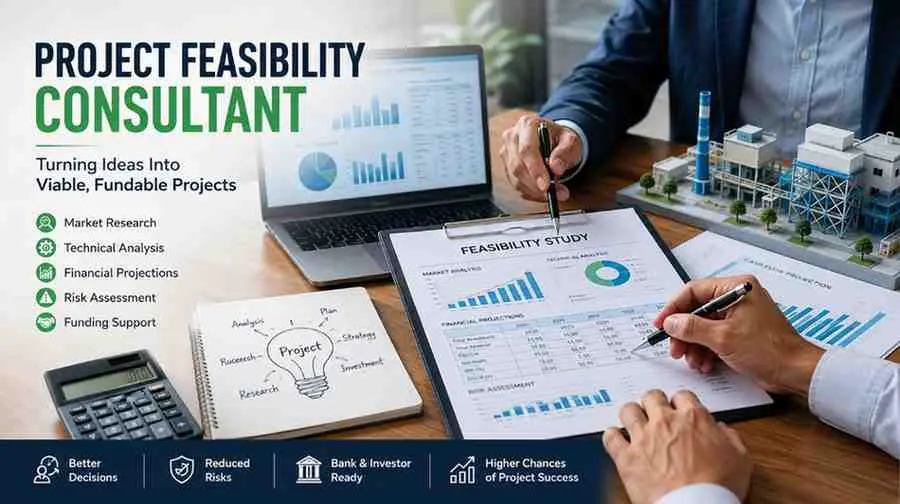
Every successful project begins with an idea, but not every idea is financially or commercially practical. This is where a Project Feasibility Consultant becomes valuable. Before investing significant capital, purchasing land, ordering machinery, or approaching a bank for finance, businesses need to know if the proposed project can actually deliver the expected returns under real market conditions.
A Project Feasibility Consultant studies every important aspect of the proposed investment instead of relying on assumptions. The objective is not simply to prepare another report but to answer a much more important question. Is this project worth pursuing in its present form?
That assessment involves much more than financial calculations. Market demand, technical requirements, project location, infrastructure availability, raw material sourcing, regulatory approvals, manpower requirements, operating costs, expected revenues, and possible risks all need to be examined together.
Many business owners assume that if demand exists for their product, the project is automatically feasible. In reality, that rarely happens. A manufacturing unit may have strong market demand but face high logistics costs. A hospital project may be commercially attractive but require much higher working capital than initially estimated. A solar power project may generate excellent returns only if the financing structure is designed correctly.
A Project Feasibility Consultant helps identify these practical issues before large investments are made.
"A Project Feasibility Consultant does not simply prepare reports. They answer a much more important question. Is this project worth pursuing in its present form?" — Frontline Consultants Team
For example, a manufacturing company planning to expand production may estimate that installing additional machinery will immediately increase profits. During the feasibility assessment, however, it may become clear that power availability, warehouse capacity, labour requirements, or transportation costs could reduce the expected profitability. Identifying such issues early allows promoters to modify the project before approaching lenders or investors.
Similarly, infrastructure projects often involve multiple approvals, long construction periods, and significant capital expenditure. Without a realistic feasibility assessment, even technically sound projects may experience delays, cost overruns, or funding challenges.
An experienced consultant also evaluates project risks from the perspective of lenders. Banks and financial institutions want confidence that the proposed project can generate sufficient cash flow to repay debt. Investors look for sustainable profitability rather than optimistic projections. A properly prepared feasibility study bridges this gap by presenting realistic assumptions supported by practical analysis.
This doesn't apply everywhere. Smaller projects funded entirely through internal resources may not require a detailed feasibility assessment of the same scale as large industrial or infrastructure developments. However, once external funding, multiple stakeholders, or significant investment is involved, professional feasibility analysis becomes increasingly important.
With more than three decades of experience, Frontline Consultants has supported businesses across manufacturing, healthcare, renewable energy, infrastructure, education, warehousing, and commercial sectors by preparing practical project feasibility studies that align with lender expectations while helping promoters make informed investment decisions.
When Should You Hire a Project Feasibility Consultant Before Investing in a New Project
One of the most common questions business owners ask is when they should involve a Project Feasibility Consultant. Surprisingly, many organisations seek professional advice only after finalising land, purchasing machinery, or even beginning construction. By then, changing the project design becomes expensive and sometimes impossible.
The ideal time to engage a Project Feasibility Consultant is during the planning stage, before major financial commitments are made.
Example: MSME Manufacturing Facility
Suppose an MSME plans to establish a new manufacturing facility. The promoter may already have identified the product, selected the location, and estimated the investment required. At this point, a feasibility study can validate whether market demand justifies the planned production capacity, whether the estimated project cost is realistic, and whether expected cash flows can comfortably service bank borrowings.
The same applies to businesses planning expansion. Adding another production line, setting up a warehouse, opening a healthcare facility, or investing in renewable energy should all be supported by careful feasibility analysis.
Example: Hospital Project
Hospital projects provide a good example. Construction costs, medical equipment, staffing requirements, regulatory approvals, and patient occupancy assumptions all influence financial viability. If occupancy projections are overly optimistic, the project may struggle despite offering quality healthcare services.
Example: Solar Project
Solar projects also require careful assessment. Generation estimates, power purchase agreements, financing costs, government policies, and maintenance expenses all affect long term returns. A well prepared feasibility study helps identify realistic expectations instead of relying solely on vendor estimates.
Sometimes perfectly good projects get delayed because documentation was prepared in the wrong sequence. It still surprises me.
A Project Feasibility Consultant also becomes valuable when businesses are approaching banks, NBFCs, investors, or private equity firms for funding. Financial institutions often seek independent validation of project assumptions before approving large loans. A professionally prepared feasibility report improves transparency and gives lenders greater confidence in the proposed investment.
Businesses undergoing debt restructuring or diversification can also benefit significantly. Expanding into a completely new industry without understanding market dynamics can expose promoters to unnecessary financial risk. Feasibility analysis helps compare different investment options before committing resources.
I might be wrong here, but in my experience, promoters who spend time validating their projects at the beginning usually face fewer surprises during execution than those who rush directly into implementation.
Key Components of a Professional Project Feasibility Study
A professional feasibility study is much more than a collection of financial projections. It is a structured assessment that brings together technical, commercial, operational, and financial aspects of a proposed project into one practical decision making document.
The first component is market analysis. This examines current demand, industry trends, customer segments, competition, pricing patterns, and future growth opportunities. The objective is to understand whether sufficient demand exists to support the proposed business over the long term.
Technical feasibility follows. Here, the Project Feasibility Consultant evaluates production technology, machinery selection, plant capacity, infrastructure requirements, utility availability, project location, raw material sourcing, environmental considerations, and implementation timelines. A technically efficient project often performs better operationally while reducing future costs.
Financial feasibility forms another critical section. Project costs, means of finance, projected revenue, operating expenses, profitability, cash flow, debt servicing capability, break even analysis, and financial ratios are carefully evaluated. Banks usually pay close attention to these projections because they indicate the borrower's repayment capacity.
Operational feasibility examines whether the business can realistically manage day to day operations after project completion. This includes manpower availability, supply chain arrangements, vendor support, maintenance planning, logistics, inventory management, and administrative capabilities.
Risk assessment is equally important. Every project faces uncertainties related to market fluctuations, raw material prices, construction delays, regulatory changes, technology upgrades, or financing costs. A good feasibility report identifies these risks and discusses practical ways to manage them rather than pretending they do not exist.
One area that often receives less attention is sensitivity analysis. Instead of assuming everything will go exactly as planned, experienced consultants test different scenarios. What happens if sales grow more slowly than expected? What if construction costs increase? What if interest rates rise? These questions help businesses prepare for real world conditions.
And then there is documentation.
Without complete project information, land records, statutory approvals, financial statements, quotations, technical details, and promoter inputs, even the best feasibility study cannot fully reflect the project's potential.
Frontline Consultants prepares comprehensive project feasibility studies by combining technical evaluation, financial analysis, lender expectations, and practical industry understanding gained from more than 30 years of working with manufacturing companies, infrastructure developers, healthcare institutions, renewable energy projects, educational organisations, and industrial businesses across India. Their objective is not simply to produce another report but to help businesses make confident investment decisions supported by realistic analysis.
How Banks, NBFCs, and Investors Use Feasibility Reports During Funding Decisions
When businesses apply for project finance, many promoters believe the lender's primary concern is the value of collateral. Security is certainly important, but it is rarely the only factor that determines whether funding will be approved. Banks, NBFCs, and investors want confidence that the proposed business can generate enough income to sustain operations and repay its financial obligations. This is exactly where the work of a Project Feasibility Consultant becomes relevant.
A feasibility report allows lenders to evaluate the project before committing funds. Instead of depending only on projections prepared by the promoter, they look for a balanced assessment that explains how the project is expected to perform under practical business conditions.
Example: Food Processing Unit
If a company plans to establish a new food processing unit, the bank will review whether the projected production capacity matches actual market demand. It will also examine raw material availability, power requirements, operating expenses, working capital needs, repayment schedules, and expected cash generation. A professionally prepared feasibility report presents these details in a structured manner, making the lender's evaluation much easier.
NBFCs often use feasibility studies in a similar way, particularly for equipment finance, commercial real estate, healthcare facilities, logistics businesses, and industrial expansion projects. Since many NBFCs finance growing businesses that may not have a long operating history, they rely heavily on realistic project assessments rather than optimistic assumptions.
Investors take a slightly different approach. Venture capital firms, private investors, and strategic partners usually focus on business scalability, future profitability, competitive positioning, and management capability. While they may accept higher business risks than banks, they still expect a Project Feasibility Consultant to present clear financial assumptions backed by practical reasoning.
I have also noticed something during discussions with lenders. They often ask questions that promoters never expected. Why has machinery utilisation been assumed at 85 percent during the first year? What happens if raw material prices increase by 10 percent? Is there enough working capital to manage delayed customer payments? A feasibility study prepared with these questions in mind creates far more confidence than one filled with attractive numbers.
Another important aspect is documentation. Financial institutions appreciate consistency between the Detailed Project Report, financial projections, statutory approvals, quotations, technical specifications, and promoter contributions. Even small inconsistencies can lead to additional queries and unnecessary delays.
Frontline Consultants has worked with banks, financial institutions, NBFCs, and businesses for more than 30 years, preparing feasibility reports that reflect lender expectations while remaining practical for project promoters. Their broader experience in Techno Economic Viability Reports, Detailed Project Reports, Credit Syndication, Bank Liaison, and Project Advisory helps businesses present projects with greater clarity during funding discussions.
Common Mistakes Businesses Make While Assessing Project Feasibility
Some project challenges are unavoidable. Others are entirely preventable.
One of the biggest mistakes businesses make is preparing financial projections first and trying to justify them later. A proper feasibility assessment should work in the opposite direction. Market demand, production capability, project costs, and operational capacity should shape the financial projections, not the other way around.
Another common issue is relying on overly optimistic assumptions.
Many promoters expect immediate production after project completion, full capacity utilisation within months, and steady sales growth from the beginning. Business rarely behaves that neatly. Machines require commissioning. Employees need training. Customers take time to build confidence in a new supplier. These realities should be reflected in every feasibility report.
Working capital is another area where businesses frequently underestimate requirements. A manufacturing company may calculate machinery costs accurately but overlook inventory holding periods, receivable cycles, or seasonal demand fluctuations. As a result, the project may begin operations with insufficient liquidity despite being technically sound.
Many business owners believe preparing a DPR is enough for getting a loan. In reality, that rarely happens. Banks often require additional technical validation, realistic financial assumptions, regulatory documentation, promoter background information, and sometimes independent assessments before approving larger funding proposals.
Another mistake involves selecting project locations based only on land availability. A lower land price may appear attractive initially, but poor transport connectivity, inadequate utilities, shortage of skilled labour, or higher logistics costs can reduce long term profitability.
Sometimes promoters also copy financial projections from similar projects without considering their own market conditions. Two factories producing the same product may have completely different operating costs depending on location, customer base, supply chain, financing structure, and production technology.
And then there are delays caused by incomplete documentation.
It sounds simple, but missing approvals, outdated quotations, inconsistent project costs, or incomplete statutory records often slow the entire funding process.
A Project Feasibility Consultant helps identify these issues early, giving businesses an opportunity to correct them before approaching lenders or investors.
Project Feasibility Across Manufacturing, Infrastructure, Healthcare, Renewable Energy, Warehousing, and Commercial Projects
Every industry has its own challenges, which is why a standard feasibility report rarely works across different sectors. An experienced Project Feasibility Consultant adapts the analysis according to the nature of the project instead of following a fixed template.
In manufacturing, the focus is usually on production capacity, machinery selection, raw material sourcing, labour availability, utility requirements, product demand, and operating efficiency. Whether the project involves engineering goods, pharmaceuticals, food processing, chemicals, packaging, or textiles, the feasibility study must examine whether the proposed investment matches realistic market opportunities.
Infrastructure projects involve much larger investments and longer execution periods. Roads, industrial parks, commercial complexes, water supply systems, logistics facilities, and public infrastructure projects require careful evaluation of implementation schedules, contractor capability, regulatory approvals, financing structures, and long term revenue generation.
Healthcare projects present a different set of considerations. Hospitals, diagnostic centres, speciality clinics, and medical colleges depend heavily on patient demand, qualified professionals, specialised equipment, operational costs, and regulatory compliance. Revenue projections need to be based on realistic occupancy and service utilisation rather than optimistic expectations.
Renewable energy projects, particularly solar installations, require detailed technical and financial assessment. Power generation estimates, equipment quality, transmission arrangements, maintenance costs, government policies, financing terms, and tariff assumptions all influence project viability. Even small changes in generation efficiency can affect long term financial performance.
Warehousing and logistics projects have gained importance because supply chains have become more organised across India. Here, a Project Feasibility Consultant evaluates storage demand, transport connectivity, tenant requirements, lease structures, inventory movement, automation possibilities, and future expansion opportunities.
Commercial projects such as office developments, retail centres, educational institutions, hotels, and mixed use developments require a careful balance between construction costs, occupancy expectations, operating expenses, financing arrangements, and long term revenue generation.
One thing that remains common across all these sectors is the need for realistic assumptions. Industry experience helps, but every project still deserves independent evaluation based on its own circumstances.
How a Project Feasibility Consultant Helps Reduce Financial, Technical, Operational, and Market Risks
No project can eliminate risk completely. Any consultant who promises that is probably setting unrealistic expectations. The objective is to identify possible challenges early enough so that businesses can make informed decisions before committing significant capital.
A Project Feasibility Consultant begins by identifying financial risks. These may include underestimated project costs, unrealistic sales forecasts, insufficient working capital, higher borrowing costs, or weak cash flow during the initial years. Understanding these risks allows promoters to adjust investment plans before financial stress develops.
Technical risks receive equal attention. Machinery compatibility, production processes, utility availability, technology selection, construction planning, implementation schedules, and vendor capability all influence project success. Small technical decisions made during planning often have long term financial consequences.
Operational risks are sometimes overlooked because they appear less dramatic than financial issues. However, supply chain disruptions, manpower shortages, inventory management problems, maintenance planning, and logistics challenges can gradually reduce project profitability if they are ignored during the planning stage.
Market risks require practical judgement rather than assumptions. Customer demand can change. Competitors may enter the market. Raw material prices can fluctuate. Government regulations may evolve. A good feasibility study considers these possibilities without becoming unnecessarily pessimistic.
This doesn't apply everywhere. Some industries operate in relatively stable markets, while others experience frequent changes influenced by technology, regulation, or consumer behaviour. The feasibility approach should reflect those differences instead of treating every project identically.
I still remember reviewing a warehouse expansion proposal where almost everything looked financially attractive. The numbers worked, the location was good, and funding seemed achievable. Only later did discussions reveal that future road connectivity around the proposed site remained uncertain. It was a small point during the meeting, yet it had the potential to affect long term logistics costs. Little details sometimes matter more than impressive spreadsheets.
An experienced Project Feasibility Consultant also helps businesses prepare for lender questions before formal appraisal begins. By validating assumptions, organising documentation, reviewing implementation plans, and testing financial sensitivity under different scenarios, businesses approach banks with greater confidence.
With more than 30 years of experience, Frontline Consultants supports businesses through Project Feasibility Studies, Techno Economic Viability Reports, Lenders Independent Engineer Services, Agency for Special Monitoring, Detailed Project Reports, Enterprise Valuation, Asset Valuation, Debt Restructuring, Credit Syndication, Bank Liaison, Project Advisory, and Business Financial Consulting. Their role is not simply to prepare reports but to help businesses understand their projects from the perspective of promoters, lenders, and long term financial sustainability.
Why Accurate Financial Projections and Practical Assumptions Matter More Than Optimistic Numbers
Almost every business owner wants to see attractive financial projections before investing in a new project. That is understandable. Higher revenues, faster growth, and stronger profits naturally make a project look more appealing. The problem begins when these numbers are prepared to impress rather than to reflect reality.
An experienced Project Feasibility Consultant knows that financial projections are not about predicting the future with certainty. They are about building a reasonable picture of what the project can realistically achieve based on available information.
Banks notice this difference very quickly.
Suppose a promoter assumes that a new manufacturing unit will operate at 90 percent capacity within the first year. On paper, the profitability may appear excellent. During appraisal, however, the lender may question whether customer orders, production stabilisation, labour availability, and distribution channels can actually support that level of utilisation. If the assumptions cannot be justified, confidence in the entire proposal may decline.
A good Project Feasibility Consultant develops financial projections only after understanding the commercial and operational realities of the project. Revenue estimates should match market demand. Operating costs should include actual expenses that businesses are likely to incur. Working capital should reflect realistic inventory levels and payment cycles instead of ideal situations.
Sensitivity analysis is another area that deserves attention. Projects rarely move exactly according to plan. Raw material prices may increase. Interest rates may change. Construction may take longer than expected. Customer demand may grow more slowly during the first year.
Instead of ignoring these possibilities, a professional feasibility study examines how the project performs under different situations. This gives promoters and lenders a much clearer understanding of financial resilience.
I might be wrong here, but conservative projections often create greater confidence than aggressive ones. Most experienced lenders would rather see realistic numbers that can be achieved than ambitious figures that raise unnecessary questions during appraisal.
There is also a misconception that larger projected profits automatically improve loan approval chances. In many cases, the opposite happens. If assumptions appear exaggerated or unsupported, banks may seek additional clarification, revise financial estimates, or ask for fresh documentation before proceeding.
Accurate projections help businesses beyond loan approval as well. They become a practical roadmap during implementation, allowing promoters to compare actual performance with planned performance and make timely decisions whenever deviations occur.
That is why the role of a Project Feasibility Consultant is not limited to preparing spreadsheets. It involves understanding the business well enough to ensure that every important assumption has a logical foundation.
How Frontline Consultants Supports Businesses with Reliable Project Feasibility Consulting and Financial Advisory
Preparing a feasibility report is only one part of the decision making process. Businesses often require guidance long before the report is written and continue seeking support after discussions with lenders begin. Every project has different priorities, different funding structures, and different documentation requirements.
With more than 30 years of experience, Frontline Consultants has worked with manufacturing companies, infrastructure developers, healthcare institutions, renewable energy businesses, educational organisations, logistics companies, commercial projects, and MSMEs across India. This experience allows the team to understand how projects are evaluated not only by promoters but also by banks, financial institutions, investors, and regulatory stakeholders.
As an experienced Project Feasibility Consultant, Frontline Consultants studies projects from multiple perspectives before recommending a course of action. Market conditions, technical requirements, project implementation, capital investment, operating expenses, financing structure, repayment capacity, and business risks are analysed together so that the final assessment reflects practical realities rather than assumptions.
Services Offered by Frontline Consultants
- Project Feasibility Studies
- Techno Economic Viability Reports
- Lenders Independent Engineer Services
- Agency for Special Monitoring
- Detailed Project Reports
- Enterprise Valuation
- Asset Valuation
- Credit Syndication
- Debt Restructuring
- Bank Liaison
- Project Advisory
- Business Financial Consulting
This integrated approach is particularly useful for businesses approaching lenders for expansion finance, restructuring existing borrowings, establishing new industrial units, developing infrastructure projects, or planning long term investments.
One strength that many promoters appreciate is consistency across documentation. Financial projections, project reports, technical assumptions, valuation exercises, and lender submissions are prepared with a common understanding of the project, reducing the chances of conflicting information during appraisal.
Of course, every project cannot be funded simply because a report has been prepared. External factors such as industry conditions, promoter background, regulatory approvals, lender policies, and overall economic circumstances also influence funding decisions. A professional Project Feasibility Consultant recognises these realities and prepares documentation that addresses genuine concerns instead of making unrealistic promises.
Ultimately, the objective is straightforward. Help businesses make informed investment decisions, present projects with confidence before lenders, and reduce avoidable risks before significant capital is committed.
Frequently Asked Questions About Hiring a Project Feasibility Consultant
What does a Project Feasibility Consultant do?
A Project Feasibility Consultant evaluates whether a proposed project is technically, financially, commercially, and operationally viable. The consultant studies market demand, project costs, financial projections, implementation requirements, risks, and funding suitability before the business makes major investment decisions.
When should I hire a Project Feasibility Consultant?
The best time is before purchasing major assets, starting construction, or applying for project finance. Early feasibility assessment helps identify risks, improve project planning, and avoid expensive changes later.
Is a feasibility study necessary for bank loans?
For many medium and large projects, yes. Banks and financial institutions often expect professionally prepared feasibility reports along with Detailed Project Reports and other supporting documents before evaluating funding proposals.
What industries can benefit from a Project Feasibility Consultant?
Manufacturing, infrastructure, healthcare, renewable energy, warehousing, logistics, education, hospitality, commercial real estate, industrial projects, and MSMEs can all benefit from professional feasibility assessment before making significant investments.
How is a feasibility study different from a Detailed Project Report?
A feasibility study focuses on determining whether the project should move forward by analysing viability, risks, and financial sustainability. A Detailed Project Report provides more comprehensive implementation details, technical specifications, project costs, financing arrangements, and execution planning. In many cases, both documents complement each other.
How long does it take to prepare a feasibility report?
The timeline depends on project size, industry, availability of documents, and the level of analysis required. Smaller projects may be completed within a few weeks, while large infrastructure or industrial projects usually require more detailed evaluation.
Can Frontline Consultants assist beyond preparing feasibility reports?
Yes. Along with working as an experienced Project Feasibility Consultant, Frontline Consultants offers Techno Economic Viability Reports, Lenders Independent Engineer Services, Agency for Special Monitoring, Detailed Project Reports, Enterprise Valuation, Asset Valuation, Credit Syndication, Debt Restructuring, Bank Liaison, Project Advisory, and Business Financial Consulting to support businesses throughout the project lifecycle.