
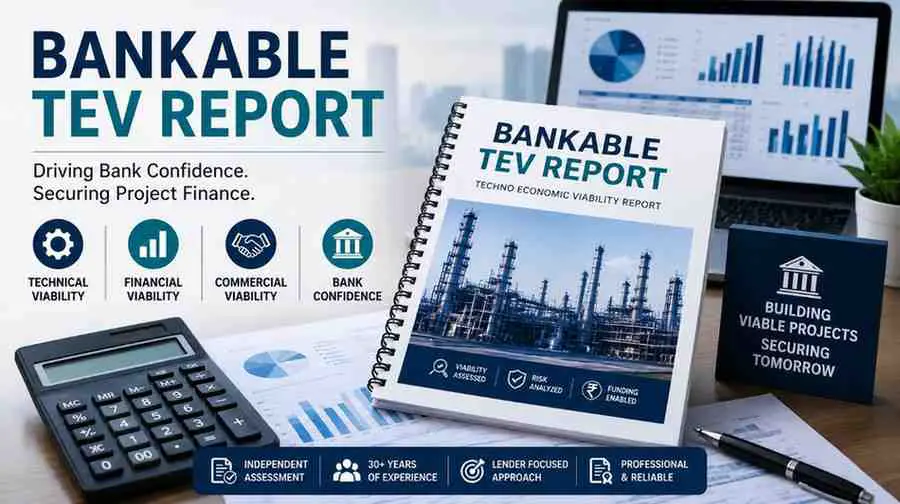
A TEV Report for Bank Loan is one of the most important documents that banks and financial institutions rely on before approving finance for large projects, business expansion, capacity enhancement, or new industrial ventures. TEV stands for Techno Economic Viability, which simply means assessing whether a project is technically feasible, financially sustainable, and commercially capable of generating enough returns to repay the proposed loan.
Many business owners believe that a detailed project report alone is enough to convince a bank. In reality, that rarely happens. A DPR explains the business idea and project plan, but a TEV Report for Bank Loan goes much deeper. It independently evaluates whether the assumptions made in the project are practical, whether projected revenues are realistic, whether technology selection is appropriate, and whether the overall project can withstand business and market risks.
Banks are not only financing a project. They are financing the borrower's ability to repay over several years. That is why they want an independent assessment rather than relying solely on projections prepared by the promoter.
A well-prepared TEV Report for Bank Loan generally answers questions such as:
- Is the proposed technology suitable for the intended production?
- Does the market have enough demand for the products or services?
- Are project costs reasonable and properly estimated?
- Can expected cash flows comfortably service the proposed debt?
- What are the major risks and how can they be managed?
This assessment gives lenders greater confidence before committing significant funds.
"A TEV Report for Bank Loan is not just another document. It is an independent assessment that helps banks understand whether a project is technically feasible, financially sustainable, and capable of generating enough returns to repay the proposed loan."— Frontline Consultants Team
Sometimes perfectly good projects get delayed because documentation was prepared in the wrong sequence. It still surprises me. In many cases, the business itself is financially sound, but inconsistent project assumptions, incomplete cost estimates, or unrealistic revenue forecasts raise concerns during credit appraisal.
A reliable TEV Report for Bank Loan also benefits the borrower. It often helps promoters identify financial gaps, optimise project costs, refine implementation timelines, and address potential concerns before discussions with lenders begin.
With more than three decades of experience, Frontline Consultants has worked with manufacturing companies, infrastructure developers, healthcare institutions, renewable energy projects, educational institutions, and MSMEs by preparing independent TEV Reports that meet lender expectations while helping businesses present realistic and bank-ready project proposals.
When Is a TEV Report for Bank Loan Required Across Different Industries?
A TEV Report for Bank Loan is generally required whenever banks are considering substantial financial exposure. While every lender follows its own internal policies, TEV studies are commonly requested for medium and large project finance proposals, expansion plans, restructuring cases, consortium lending, and infrastructure financing.
The requirement becomes even more important when projects involve significant capital investment, specialised technology, long implementation periods, or complex revenue assumptions.
Example: Manufacturing Company
A manufacturing company planning to install a new production line may require a TEV Report for Bank Loan to demonstrate that the proposed machinery is technically appropriate and capable of achieving the projected production capacity.
Example: Hospital Project
A hospital seeking finance for a new multi-specialty facility may need to establish patient demand, operational viability, staffing requirements, projected occupancy levels, and long-term financial sustainability before lenders are willing to extend credit.
Example: Solar Power Project
Solar power projects often undergo detailed technical and financial scrutiny because revenue depends on factors such as generation estimates, power purchase agreements, equipment efficiency, and regulatory considerations. In such situations, a comprehensive TEV Report for Bank Loan becomes a critical part of the lending process.
Warehouse developers, logistics parks, educational institutions, commercial real estate projects, hotels, industrial parks, food processing units, textile manufacturers, pharmaceutical companies, engineering businesses, and renewable energy developers frequently require similar evaluations.
An MSME seeking working capital enhancement may not always need a TEV study. This doesn't apply everywhere. Much depends on the size of the proposal, lender policy, industry risk, and the complexity of the project. Smaller facilities may proceed without one, while larger or more specialised projects often require independent technical and financial assessment.
Industrial restructuring cases also commonly involve a TEV Report for Bank Loan. When businesses face temporary financial stress, lenders need objective analysis to determine whether revival is possible, whether projected cash flows are achievable, and whether restructuring can realistically restore financial stability.
I might be wrong here, but many promoters wait until the bank specifically asks for a TEV report. In several situations, preparing the report earlier actually speeds up discussions because major concerns are identified and addressed before formal appraisal begins.
What Does a TEV Report for Bank Loan Typically Include?
Although the scope varies depending on the industry and lender requirements, a professionally prepared TEV Report for Bank Loan usually combines technical evaluation, commercial analysis, financial assessment, and project risk review into a single integrated document.
The report normally begins with an overview of the promoter, business background, project objectives, and financing requirements. Lenders want to understand not only the project but also the experience and execution capability of the management team.
The technical section evaluates whether the proposed manufacturing process, equipment selection, plant capacity, technology, utilities, infrastructure, and implementation schedule are practical. It also reviews whether the proposed assets are sufficient to achieve planned production levels.
The commercial analysis studies market demand, industry outlook, competition, customer profile, pricing assumptions, raw material availability, supply chain considerations, and sales strategy. Banks need confidence that sufficient market demand exists before financing expansion.
The financial assessment forms the core of the TEV Report for Bank Loan. It generally examines:
Depending on the assignment, the report may also include site visits, discussions with management, verification of project assumptions, review of statutory approvals, environmental considerations, implementation schedules, and observations regarding project execution risks.
One thing that often gets overlooked is the consistency between different financial assumptions. Revenue projections, production capacity, raw material consumption, working capital requirements, and repayment schedules all need to support each other. Even small inconsistencies can create questions during lender appraisal.
I still carry a notebook to project meetings. Most notes eventually end up in digital files anyway.
Experienced firms like Frontline Consultants prepare TEV Reports for Bank Loans by combining technical expertise, financial analysis, lender expectations, and practical project experience gained over more than 30 years of working with banks, financial institutions, industrial borrowers, infrastructure developers, healthcare projects, renewable energy companies, and manufacturing businesses across India. This balanced approach helps borrowers present well-supported proposals while giving lenders the independent assessment they require before making informed credit decisions.
How Banks and Financial Institutions Evaluate a TEV Report Before Sanctioning Finance
Once a TEV Report for Bank Loan is submitted, the lender does much more than simply verify whether the report is complete. Credit teams, technical officers, and risk managers carefully examine the assumptions behind the project before deciding whether the proposed financing is commercially viable and financially secure.
One of the first things banks review is the credibility of the project itself. They want to know whether the proposed investment genuinely matches market demand or whether the revenue projections are overly optimistic. A project may look attractive on paper, but if sales estimates are unrealistic, lenders immediately become cautious.
The technical evaluation is equally important. Banks assess whether the selected technology, machinery, production process, and implementation schedule are practical. For manufacturing projects, they often verify whether the proposed production capacity aligns with expected demand and whether the required utilities and infrastructure are sufficient.
Financial analysis receives the greatest attention. During the review of a TEV Report for Bank Loan, lenders generally examine:
Banks also compare projected financial statements with industry benchmarks wherever possible. If a new manufacturing unit claims significantly higher profit margins than comparable businesses without sufficient justification, additional clarification is usually requested.
Another area that often influences lending decisions is promoter capability. Even a technically sound project can face execution challenges if the management team lacks industry experience or has weak financial discipline.
Sometimes borrowers assume the TEV report is prepared only to satisfy documentation requirements. In practice, lenders rely on it while discussing credit proposals internally. Observations made in the report often become part of the overall credit appraisal and sanction process.
For this reason, businesses should treat a TEV Report for Bank Loan as a strategic planning document rather than just another compliance requirement.
Common Mistakes Businesses Make While Preparing a TEV Report for Bank Loan
Preparing a TEV Report for Bank Loan requires much more than collecting financial statements and preparing revenue projections. Many otherwise capable businesses unintentionally weaken their proposals because important details are overlooked during the preparation stage.
One of the most common mistakes is using unrealistic financial assumptions. Promoters sometimes project aggressive sales growth without supporting market research, customer commitments, or production capacity. Banks usually identify these inconsistencies during appraisal.
Another frequent issue is underestimating project costs. Machinery installation, statutory approvals, civil works, contingencies, interest during construction, and working capital are occasionally left out of the initial estimates. As the project progresses, funding gaps begin to appear.
Many businesses also prepare financial projections that are not connected with operational realities. Production capacity, manpower planning, raw material consumption, electricity requirements, and projected sales should all support one another. When these figures fail to match, lenders naturally raise questions.
Incomplete documentation creates unnecessary delays as well. Missing land records, quotations for machinery, statutory approvals, environmental clearances, promoter financial information, or technical specifications often lead to repeated queries from banks.
I might be wrong here, but businesses sometimes spend weeks negotiating loan terms before ensuring their project documentation is internally consistent. Addressing these issues earlier usually saves much more time.
Another misconception is that copying assumptions from an older project report is acceptable. Every project has its own commercial environment, technology, financing structure, and implementation timeline. A TEV Report for Bank Loan should always reflect current market conditions and project-specific realities.
Working with experienced consultants reduces these risks because the report is prepared after carefully reviewing technical, commercial, and financial information from multiple perspectives instead of focusing only on loan eligibility.
The Role of Technical, Financial, and Market Analysis in a Strong TEV Report
A reliable TEV Report for Bank Loan is never built on financial projections alone. It combines technical analysis, commercial assessment, and financial evaluation to provide lenders with a complete understanding of the proposed project.
Technical analysis focuses on whether the project can actually be executed as planned. This includes reviewing plant layout, production technology, machinery selection, utility requirements, construction schedules, implementation timelines, capacity utilisation, and operational efficiency.
Example: Food Processing Unit
Consider a food processing unit planning to double production capacity. Purchasing advanced machinery may appear attractive, but if the local supply of raw materials cannot support increased production, the investment may not generate expected returns. Technical analysis helps identify such issues before financing decisions are made.
Market analysis answers another critical question. Can the business sell what it intends to produce?
This part of the TEV Report for Bank Loan evaluates industry demand, customer segments, competition, pricing trends, distribution channels, and long-term business opportunities. Revenue projections become far more credible when they are supported by realistic market analysis instead of assumptions.
Financial analysis brings everything together. It examines project costs, financing arrangements, profitability, cash flows, working capital requirements, debt servicing capacity, and overall financial sustainability.
Sometimes businesses focus almost entirely on projected profits while ignoring cash flow timing. Banks generally pay much closer attention to whether loan repayments can be made comfortably throughout the project lifecycle.
Then there is sensitivity analysis.
A project should remain reasonably stable even if raw material prices increase, production starts later than expected, or sales grow more slowly during the initial years. These practical scenarios help lenders understand the resilience of the investment.
When technical feasibility, commercial demand, and financial viability all support each other, a TEV Report for Bank Loan becomes significantly more convincing during lender appraisal.
Industries That Commonly Need a TEV Report for Bank Loan
Although almost any business can benefit from an independent project assessment, certain industries regularly require a TEV Report for Bank Loan because of their investment size, operational complexity, or lender requirements.
- Manufacturing – Engineering companies, textile manufacturers, food processing units, pharmaceutical businesses, chemicals, plastics, paper mills, steel processing plants, and packaging companies
- Infrastructure – Roads, bridges, logistics parks, warehouses, industrial parks, water supply projects, commercial developments
- Renewable Energy – Solar parks, rooftop solar installations, biomass plants, wind energy projects, hybrid power systems
- Healthcare – Hospitals, diagnostic centres, medical colleges, healthcare facility expansions
- Education – Schools, universities, technical institutes, skill development centres
- Commercial Real Estate – Office buildings, shopping centres, mixed-use developments
- Logistics – Cold storage facilities, warehousing, distribution centres
- Industrial Borrowers – Debt restructuring, business revival, refinancing
This doesn't apply everywhere. Smaller borrowing proposals or routine working capital renewals may not always require a detailed TEV study, depending on lender policies and the nature of the business.
How Frontline Consultants Helps Businesses Prepare Reliable TEV Reports for Bank Loans
Preparing a TEV Report for Bank Loan involves much more than compiling financial data into a report. It requires understanding how lenders evaluate projects, what documentation supports financing decisions, and where potential concerns are likely to arise during credit appraisal.
Frontline Consultants has more than 30 years of experience working with businesses, banks, financial institutions, NBFCs, industrial promoters, and infrastructure developers across India. The firm's experience spans manufacturing, renewable energy, healthcare, education, logistics, real estate, infrastructure, and MSME projects.
Rather than approaching every assignment with a standard template, the team studies the commercial objectives, project scope, technical feasibility, financing structure, implementation schedule, industry outlook, and operational risks before preparing the TEV Report for Bank Loan.
Services Offered by Frontline Consultants
- Techno Economic Viability Reports
- Detailed Project Reports
- Lenders Independent Engineer Services
- Agency for Special Monitoring
- Enterprise Valuation
- Asset Valuation
- Credit Syndication
- Debt Restructuring
- Bank Liaison
- Project Advisory
- Business Financial Consulting
One practical advantage of working with experienced consultants is that potential issues are often identified before lenders point them out. Financial assumptions can be refined, project costs validated, implementation risks addressed, and supporting documentation strengthened before the proposal reaches the credit committee.
I have seen technically sound projects spend months answering avoidable lender queries simply because supporting information was incomplete. That part can be frustrating.
A well-prepared TEV Report for Bank Loan helps both borrowers and lenders make informed decisions. Borrowers gain greater clarity about project viability, while financial institutions receive an independent assessment that supports responsible lending. That balance is exactly what experienced advisory firms like Frontline Consultants aim to achieve through practical, objective, and lender-focused project evaluation.
Questions Every Borrower Should Ask Before Choosing a TEV Report Consultant
Selecting the right consultant for preparing a TEV Report for Bank Loan is almost as important as the report itself. Banks expect an independent, well-supported assessment that reflects the actual strengths and risks of the project. A report prepared without sufficient industry understanding may lead to repeated lender queries and unnecessary delays.
Before appointing a consultant, borrowers should ask a few practical questions instead of focusing only on the cost of the assignment.
Key Questions to Ask
- Does the consultant have experience in my industry? Preparing a TEV report for a textile unit is different from evaluating a hospital, a solar power project, or a logistics park. Industry knowledge helps the consultant assess technical, commercial, and financial factors more accurately.
- Has the consultant worked with banks and financial institutions? A consultant who understands how lenders evaluate projects is usually better placed to prepare a TEV Report for Bank Loan that addresses common credit appraisal concerns before they arise.
- Will the report be based on actual project analysis or standard templates? Every project has different funding requirements, implementation schedules, market conditions, and operational risks. A reliable report should reflect these differences instead of relying on generic assumptions.
- Does the consultant verify financial projections? Revenue estimates, production assumptions, project costs, working capital requirements, and cash flow projections should all be tested for consistency. Small inconsistencies can create avoidable questions during lender evaluation.
- Will the consultant visit the project site if required? For larger manufacturing, infrastructure, renewable energy, or industrial projects, site visits often provide valuable insights that cannot be obtained from documents alone.
- Can the consultant assist if lenders seek clarification later? Banks frequently request additional explanations during the appraisal process. Having a consultant who can respond to technical and financial queries makes the process much smoother.
Some borrowers compare consultants only on fees. That approach doesn't always work. A lower-cost report that generates multiple lender observations can ultimately consume far more time and resources than a professionally prepared assessment.
With over 30 years of experience, Frontline Consultants prepares TEV Reports for Bank Loans with a practical understanding of lender expectations, project financing, technical feasibility, commercial assessment, and financial analysis across multiple industries. The objective is not simply to prepare a report but to provide an evaluation that supports informed lending decisions.
Frequently Asked Questions About TEV Report for Bank Loan
What is a TEV Report for Bank Loan?
A TEV Report for Bank Loan is an independent assessment that evaluates the technical feasibility, commercial viability, and financial sustainability of a project before a bank or financial institution sanctions funding. It helps lenders understand whether the project is capable of generating sufficient returns to repay the proposed loan.
Is a TEV Report mandatory for every bank loan?
No. A TEV Report for Bank Loan is generally required for larger project finance proposals, industrial expansions, infrastructure projects, restructuring cases, consortium lending, or investments involving significant capital expenditure. Smaller working capital facilities may not always require one, depending on the lender's policy.
Who prepares a TEV Report for Bank Loan?
Experienced financial and project advisory firms prepare a TEV Report for Bank Loan. These consultants evaluate technical, commercial, and financial aspects of the project independently before submitting the report to lenders.
What information is required for preparing a TEV Report?
The consultant typically reviews project cost estimates, promoter details, financial statements, technical specifications, machinery quotations, implementation schedules, market information, funding plans, statutory approvals, and projected financial statements.
How long does it take to prepare a TEV Report for Bank Loan?
The timeline depends on the size and complexity of the project. Smaller assignments may take a few days, while large industrial, infrastructure, healthcare, or renewable energy projects may require several weeks because of technical analysis, financial evaluation, and document verification.
Can a good TEV Report guarantee bank loan approval?
No. A TEV Report for Bank Loan supports the lender's decision-making process, but the final approval depends on several factors, including the borrower's credit profile, collateral, internal bank policies, regulatory requirements, and overall risk assessment.
Which industries commonly require a TEV Report for Bank Loan?
Manufacturing companies, MSMEs, solar and renewable energy projects, healthcare institutions, educational institutions, logistics businesses, warehouses, infrastructure developers, commercial real estate projects, and industrial units commonly require a TEV Report for Bank Loan while seeking project finance or expansion funding.
Why do businesses choose Frontline Consultants for TEV Reports?
Frontline Consultants brings more than 30 years of experience in preparing TEV Reports for Bank Loans along with services such as Detailed Project Reports, Lenders Independent Engineer Services, Agency for Special Monitoring, Enterprise Valuation, Asset Valuation, Credit Syndication, Debt Restructuring, Bank Liaison, Project Advisory, and Business Financial Consulting. Their experience across manufacturing, infrastructure, healthcare, renewable energy, and industrial sectors helps businesses prepare lender-focused reports that support informed financing decisions.