
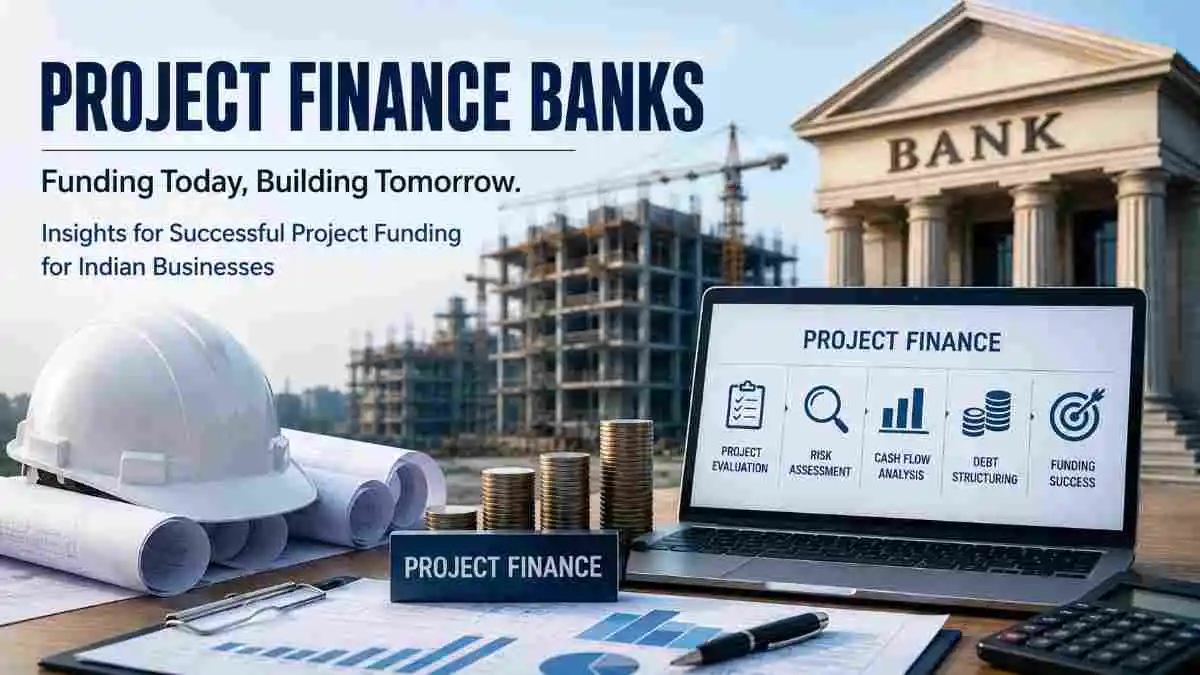
1. Understanding Project Finance Banks and Their Role in Project Funding
Project finance banks provide debt funding for projects
where repayment is expected primarily from the future cash flows generated by
the project. This is different from a simple business loan where the lender may
rely heavily on the existing balance sheet and established cash flows of the
borrower.
Consider a manufacturing company planning a new production
unit. The promoter may already operate a profitable business, but the proposed
plant has its own investment requirement, production capacity, revenue
assumptions and repayment schedule. The bank has to understand the proposed
unit separately before deciding how much debt can reasonably be sanctioned.
The same applies to a solar power project. The lender will
want to understand the project cost, power generation assumptions, power
purchase arrangements, operating costs, debt servicing ability and risks
affecting cash generation.
Project finance banks generally examine several connected
areas.
The first is project viability. Does the proposed activity
have a reasonable market? Is the installed capacity practical? Are the raw
materials available? Is the technology suitable? Does the project have the
required statutory approvals?
Then comes financial viability. What is the total project
cost? How much will the promoter contribute? How much debt is required? What
are the expected revenues and operating margins? Can the project generate
enough cash to repay the loan?
The promoter is also important. A technically sound project
can still face difficulty if the promoter has insufficient financial strength,
weak repayment history or inadequate experience in the proposed industry.
There is also security. Depending on the project and lending
structure, banks may examine land, buildings, plant and machinery, receivables,
guarantees and other available security.
This is why approaching a bank with only a loan requirement
is rarely enough. The bank needs a complete picture.
2. How Project Finance Banks Evaluate New and Expansion Projects
The assessment of a new project is usually different from
the assessment of an expansion project.
In a greenfield manufacturing project, there may be no
operating history for the proposed unit. The lender therefore has to rely more
heavily on the project report, promoter background, market assessment,
technical assumptions and projected financial statements.
An existing company seeking expansion has one advantage. It
can show actual financial performance. The bank can examine turnover,
profitability, existing debt servicing, working capital utilisation and past
banking conduct.
But an expansion proposal also creates another question. Can
the existing business comfortably support the additional debt?
For example, an MSME manufacturer may be operating at close
to full capacity and want to install another production line. The promoter may
expect turnover to increase substantially after expansion. That expectation has
to be supported by capacity utilisation assumptions, market demand, customer
orders, pricing and production economics.
Project finance banks usually examine the project from
several angles before arriving at a credit decision.
Technical feasibility
The technical side includes plant capacity, machinery,
production process, location, utilities, raw material requirements and
implementation schedule.
A project can look profitable on paper but still face
problems if the proposed machinery is unsuitable or the production capacity is
unrealistic.
Market feasibility
Banks need comfort that the projected products or services
can actually generate revenue.
For a hospital, this may involve understanding the proposed
location, bed capacity, speciality mix and expected patient volumes. For a
warehouse, the assessment may involve location, storage capacity, rental
assumptions and demand from industrial or logistics customers.
Financial feasibility
The lender studies projected profit and loss statements,
balance sheets, cash flows and debt servicing capacity.
One important point is that projected profitability alone
does not repay a bank loan. Cash flow does.
A business can report accounting profits and still struggle
to service debt if receivables are delayed or working capital requirements are
underestimated.
Implementation risk
Banks also consider whether the project can be completed
within the estimated cost and time.
Delays in land acquisition, statutory permissions, machinery
delivery or construction can increase project cost. Interest during
construction can also rise when implementation takes longer than expected.
I might be wrong here, but in my experience, promoters
sometimes spend too much time negotiating the interest rate before they have
properly tested the project assumptions. A small difference in pricing is often
less important than getting the project cost, implementation schedule and cash
flow estimates right.
3. Key Documents Required Before Approaching Project Finance Banks
A bank appraisal becomes easier when the documents are
prepared in the right sequence.
The exact requirement varies by project and lender, but a
typical proposal may include promoter KYC documents, constitutional documents
of the business, past financial statements, income tax records, existing loan
details, bank statements and details of existing assets and liabilities.
For a new project, the lender generally needs much more
project specific information.
This can include land documents, machinery quotations, civil
construction estimates, technology details, raw material arrangements,
projected production, market information and statutory approvals.
A Detailed Project Report is often central to the proposal.
A good DPR should not merely describe the project. It should connect the
technical plan with the financial plan.
For example, if a promoter proposes a production capacity of
10,000 units per month, the financial projections should reflect the machinery
requirement, raw material consumption, labour cost, electricity cost, sales
assumptions and working capital requirement associated with that capacity.
This connection is important.
Many business owners believe preparing a DPR is enough for
getting a loan. In reality, that rarely happens. The DPR is one part of the
credit appraisal. The lender will cross check the assumptions against financial
records, market conditions, promoter contribution and the proposed security
structure.
For a solar project, the documentation may include land
arrangements, equipment quotations, technical specifications, project
generation estimates and relevant power sale arrangements.
For a hospital, the proposal may require land and building
details, medical equipment quotations, project capacity, speciality details,
doctor arrangements and projected patient volumes.
An industrial borrower seeking restructuring will have a
different documentation requirement. The focus may be on existing debt, cash
flows, reasons for stress, repayment history and the viability of the revised
repayment structure.
Sometimes perfectly good projects get delayed because
documentation was prepared in the wrong sequence. It still surprises me.
4. Techno Economic Viability Reports and Bank Credit Appraisal
A Techno Economic Viability Report helps the lender assess
whether a proposed project is technically feasible and financially sustainable.
It brings together information that otherwise remains
scattered across quotations, assumptions, financial statements and project
plans.
For project finance banks, this assessment is useful because
lending decisions involve risk. The lender needs to know whether the proposed
investment can generate sufficient operating cash flow and whether the
underlying assumptions are reasonable.
Suppose a promoter proposes a warehouse project with a
substantial investment in land development, construction and material handling
equipment.
The report would examine the project cost, capacity,
location, expected occupancy, rental assumptions, operating expenses and
projected cash flows. The lender can then assess the repayment capacity of the
project.
A Techno Economic Viability assessment is not simply about
showing a positive profit figure.
The timing of cash flows matters. Debt repayment usually
starts according to the agreed repayment structure, while the project may take
time to reach stabilised operations.
This is particularly relevant for greenfield projects.
During construction, the project may not generate revenue at
all. After commissioning, capacity utilisation may gradually increase. The
financial model therefore needs to reflect a realistic ramp up rather than
assuming full capacity from the first month.
Banks may also examine sensitivity.
What happens if project cost increases? What if sales are
lower than expected? What if implementation is delayed? What if operating costs
rise?
A project that remains reasonably viable under moderate
stress is generally more comfortable for a lender than a project that works
only under perfect assumptions.
Credit appraisal goes beyond the project itself. The bank
also examines the promoter, existing liabilities, repayment conduct, banking
arrangements and overall financial position.
This is where proper professional advice can save
considerable time. If the financial model does not match the technical
assumptions, the mismatch may be identified during appraisal and the proposal
can go back and forth several times.
5. How Project Finance Banks Assess Promoter Contribution and Debt Capacity
Promoter contribution is one of the most important parts of
project funding.
Banks generally expect promoters to have their own financial
stake in the project. The exact structure varies according to the project,
lender, risk profile and applicable lending framework.
The underlying principle is simple. The promoter should have
meaningful financial commitment to the project.
Suppose a new manufacturing project requires substantial
investment and the promoter expects the bank to finance almost the entire
requirement. Even if the project appears profitable, the proposal may raise
questions about financial commitment and risk sharing.
Promoter contribution can come from available own funds and
other acceptable sources, subject to the lender's assessment.
Debt capacity is another matter.
A promoter may want a particular loan amount because that is
the amount needed to complete the project. The bank has to determine whether
the project can actually support that debt.
This is where projected cash flow becomes critical.
Debt service coverage is one of the measures used to
understand whether cash generated by the business is sufficient to meet
scheduled debt obligations. The exact ratios and assessment methods can differ
between lenders and project types.
Existing debt is also considered.
An MSME that already has significant term loans and working
capital facilities may not have the same borrowing capacity as a debt free
company with similar turnover.
The promoter's contribution should also be realistic.
Showing a large contribution in a project report without clearly demonstrating
its source can create unnecessary questions during appraisal.
Frontline Consultants works with businesses where this
financial structuring exercise becomes important before approaching lenders.
Its advisory work can include Detailed Project Reports, Techno Economic
Viability Reports, credit related advisory and bank liaison.
The objective should not be to show the highest possible
loan requirement. It should be to arrive at a structure that the project can
reasonably carry.
Working Capital, Cash Flow and Debt Repayment Assessment
A project may look profitable on paper and still struggle
after commercial operations begin. This is one of the areas where project
finance banks spend considerable time during appraisal.
The reason is simple. Profit and cash are not the same
thing.
Take a manufacturing company setting up an additional
production line. The promoter may have calculated the machinery cost, building
expenses and expected sales correctly. But if customers purchase on 60 or 90
day credit while raw materials have to be paid for much earlier, the business
will need funds to bridge that gap.
This is where working capital assessment becomes important.
Project finance banks look at inventory, receivables,
creditors, operating expenses and the overall working capital cycle. They want
to understand how much money will remain tied up in the business during normal
operations.
For a new industrial project, this requirement should be
estimated before finalising the funding structure. Underestimating working
capital can create pressure soon after commissioning. The promoter may have
enough money to complete the plant but not enough to operate it comfortably.
I have seen this happen with otherwise promising MSME
projects. The promoter focuses heavily on arranging term finance and treats
working capital as something that can be sorted out later. Sometimes it can.
Sometimes it becomes the first financial problem after production starts.
Cash flow projections therefore need to be realistic.
A bank will normally examine projected revenue, operating
expenses, taxes, interest, principal repayments and other cash commitments. The
timing of these cash movements matters just as much as the final annual profit.
For a hospital project, for example, patient volumes may
take time to build. A solar project may have predictable generation assumptions
but still depend on the structure and reliability of its revenue arrangements.
A warehouse may take several months to reach the occupancy level assumed in the
project report.
Debt repayment should be matched with this reality.
If the project needs time to reach stable operations, the
repayment structure should be considered accordingly. The exact structure
depends on the project, lender and applicable lending terms.
This is also why project finance banks examine debt service
capacity rather than simply accepting the loan amount requested by the
promoter.
A promoter may say that a project requires Rs 50 crore. The
lender's question is slightly different: can this project support Rs 50 crore
of debt?
That distinction is important.
Common Reasons Project Finance Proposals Face Delays or Rejection
Not every delayed proposal is a bad project. Quite often,
the problem is that the lender cannot get comfortable with the information
presented.
One common issue is unrealistic revenue projections.
A project report may assume that a new manufacturing unit
will operate at high capacity almost immediately. In reality, customer
acquisition, production stabilisation and operational issues may take time. If
the projections do not reflect this ramp up, the financial model becomes
difficult to defend.
The same thing happens with margins.
If an existing company has historically operated at a
particular margin and suddenly projects a much higher margin after expansion,
the lender will naturally ask why.
Another issue is inadequate promoter contribution.
A promoter may approach several project finance banks with a
large debt requirement but limited evidence of own funds. Even when the project
itself looks viable, the funding structure may not be acceptable.
Incomplete documentation causes another layer of delay.
Land records, machinery quotations, statutory approvals,
existing loan statements, financial statements and other documents need to be
consistent. If the project cost mentioned in the DPR does not match supplier
quotations, questions are bound to arise.
Existing liabilities also need to be disclosed properly.
Sometimes promoters focus so much on the proposed project
that they do not present the existing borrowing position clearly. Banks assess
the complete financial position of the borrower, not just the new project.
Implementation delays are another concern.
Suppose a factory is expected to be completed within 12
months but the land development, machinery delivery and approval process
realistically require 18 months. The project cost and interest during
construction could change considerably.
This is why project finance banks look beyond the headline
project cost.
There is also the issue of weak market assumptions. A
manufacturing project may have excellent machinery and experienced promoters,
but if there is insufficient demand for the proposed product, the financial
projections will remain questionable.
Many business owners think that having collateral solves
these problems. It does not.
Security is important, but a bank still needs confidence
that the project can generate cash and repay the borrowing.
Sometimes the frustration is understandable. A promoter may
have invested years of effort and substantial personal funds, yet the proposal
can remain stuck because one part of the documentation is incomplete. From the
promoter's perspective, it feels unnecessary. From the lender's perspective, it
is part of risk assessment.
Role of Frontline Consultants in Preparing Bank Ready Project Finance
Proposals
Frontline Consultants has more than 30 years of experience
in financial and project advisory services.
Its work covers Techno Economic Viability Reports, Lenders
Independent Engineer Services, Agency for Special Monitoring, Detailed Project
Reports, Enterprise Valuation, Asset Valuation, Credit Syndication, Debt
Restructuring, Bank Liaison, Project Advisory and Business Financial
Consulting.
For a business approaching project finance banks, the role
of a consultant is not simply to prepare a document and hand it over.
The project needs to be looked at as a financial
proposition.
Suppose an industrial company is planning a new
manufacturing unit. Before approaching lenders, the project cost, production
capacity, machinery requirement, working capital, sales assumptions and
projected cash flows need to make sense together.
If one assumption is unrealistic, it can affect several
other parts of the proposal.
For example, higher production capacity means higher
machinery investment, greater raw material requirements and potentially higher
working capital. It also means the business needs enough market demand to sell
the additional output.
A properly prepared Detailed Project Report connects these
pieces.
Frontline Consultants can assist businesses in preparing
project related documentation and financial assessments while also helping
promoters understand lender requirements. Its bank liaison services can support
communication during the appraisal process.
This becomes particularly useful when lenders raise
technical or financial queries.
A promoter may know the business extremely well but may not
be familiar with how a bank analyses DSCR, projected cash flows, repayment
capacity, project cost or funding structure.
An experienced consultant can explain what the lender is
actually asking and help the promoter respond with supporting information.
For larger projects, Techno Economic Viability assessment
can also provide an independent view of the technical and financial
assumptions.
Lenders Independent Engineer services have a different role.
They can involve monitoring project progress, assessing implementation and
reporting on technical matters relevant to the lender.
For stressed borrowers, the requirement may be different
again. Debt restructuring requires an understanding of the existing debt
position, cash generation, reasons for financial stress and the viability of
the proposed restructuring.
This is why one standard approach does not work for every
borrower.
A solar project, hospital expansion, warehouse project and
manufacturing unit each have different risks and cash flow characteristics.
The consultant's job should be to understand those
differences before preparing the proposal.
Choosing the Right Project Finance Banks for Different Industries
There is no universal list of the best project finance banks
for every business.
The right lender depends on the nature of the project, its
size, promoter background, industry, location, security position, repayment
capacity and the lender's appetite for that type of exposure.
A manufacturing project may be assessed differently from a
renewable energy project.
For instance, a manufacturing company may have significant
working capital requirements because of inventory and receivables. A solar
project may have comparatively predictable operating costs but depends heavily
on generation assumptions and the project's revenue arrangements.
A hospital has its own challenges.
Patient volumes, doctor availability, speciality mix,
location and operating costs can all influence cash flow. A new hospital may
also need time to reach stable occupancy.
Infrastructure projects can be more complicated because
implementation, approvals, contracts and project completion can have a
significant impact on the funding structure.
The same principle applies to warehouse expansion.
A promoter may have an attractive location and strong
demand, but the lender will still examine construction cost, occupancy
assumptions, rental income, operating expenses and debt repayment capacity.
This is where choosing project finance banks purely on
interest rate can be misleading.
Pricing matters, obviously. But it is not the only
consideration.
A lender's experience with the sector, security
expectations, repayment structure, documentation requirements, processing
approach and comfort with the project size can all affect the overall borrowing
experience.
Sometimes a slightly higher priced facility with a structure
that matches the project's cash flow may make more sense than a cheaper
facility with repayment terms that put unnecessary pressure on the business.
This does not apply everywhere. A large corporate borrower
with several financing options may have considerably more room to negotiate
than a small first time borrower.
Promoters should also consider whether the proposed lender
understands the nature of the project.
For an MSME expansion, an established banking relationship
may be valuable. For a large infrastructure project, experience with long
gestation projects may matter more. For renewable energy, lenders familiar with
the sector's technical and financial characteristics can ask more relevant
questions during appraisal.
A financial consultant can help the promoter compare the
funding requirement with the lender profile before approaching multiple
institutions.
That can save time.
Approaching too many lenders without a clear strategy can
sometimes create unnecessary confusion, particularly when different versions of
the project proposal are submitted.
The basic information should remain consistent regardless of
which lender is approached.
Frequently Asked Questions About Project Finance Banks
What are project finance banks?
Project finance banks are financial institutions that
provide funding for projects based on an assessment of project viability,
expected cash flows, promoter contribution, repayment capacity, security and
other credit considerations.
How do project finance banks evaluate a new project?
They may examine the technical feasibility, market
potential, project cost, promoter experience, funding pattern, projected
financial performance, working capital requirement, debt servicing ability,
statutory approvals and security.
Can an MSME approach project finance banks for expansion
finance?
Yes. An MSME can seek finance for capacity expansion,
modernisation, diversification or a new unit. The lender will generally examine
the company's existing financial position along with the proposed expansion.
What is the importance of promoter contribution?
Promoter contribution demonstrates the owner's financial
commitment to the project. It also reduces the amount of debt required. The
acceptable contribution depends on the project structure and lender assessment.
Why do banks examine working capital separately?
A project may require significant funds even after
construction is completed. Raw materials, inventory, receivables and operating
expenses can consume cash. Banks therefore need to understand whether
sufficient working capital will be available to operate the project.
Is a Detailed Project Report mandatory for every project?
The documentation requirement varies by project and lender.
However, a properly prepared DPR is often an important part of a project
finance proposal because it brings together the technical, commercial and
financial aspects of the project.
What is a Techno Economic Viability Report?
A Techno Economic Viability Report assesses the technical
feasibility and economic viability of a project. It helps lenders understand
the project cost, operating assumptions, expected revenue, cash generation and
debt servicing ability.
Can Frontline Consultants help with bank liaison?
Yes. Frontline Consultants provides bank liaison and project
advisory services. It can assist promoters with project documentation,
financial assessments and communication with lenders as required.
Can project finance be arranged for a solar project?
Solar projects can seek project financing, subject to the
lender's assessment of the project structure, technical assumptions, project
cost, revenue arrangements, promoter contribution, cash flows and other
relevant risks.
Why do project finance proposals get rejected even when
the business is profitable?
Profitability alone is not enough. A lender may have
concerns about debt capacity, working capital, promoter contribution, existing
liabilities, project implementation, market assumptions, documentation or
security.
Should a promoter approach banks before preparing the
project report?
It is usually better to understand the funding requirement
and prepare the core project documentation before making a formal approach.
Early discussions with potential lenders can still be useful, particularly for
larger or complex projects.