
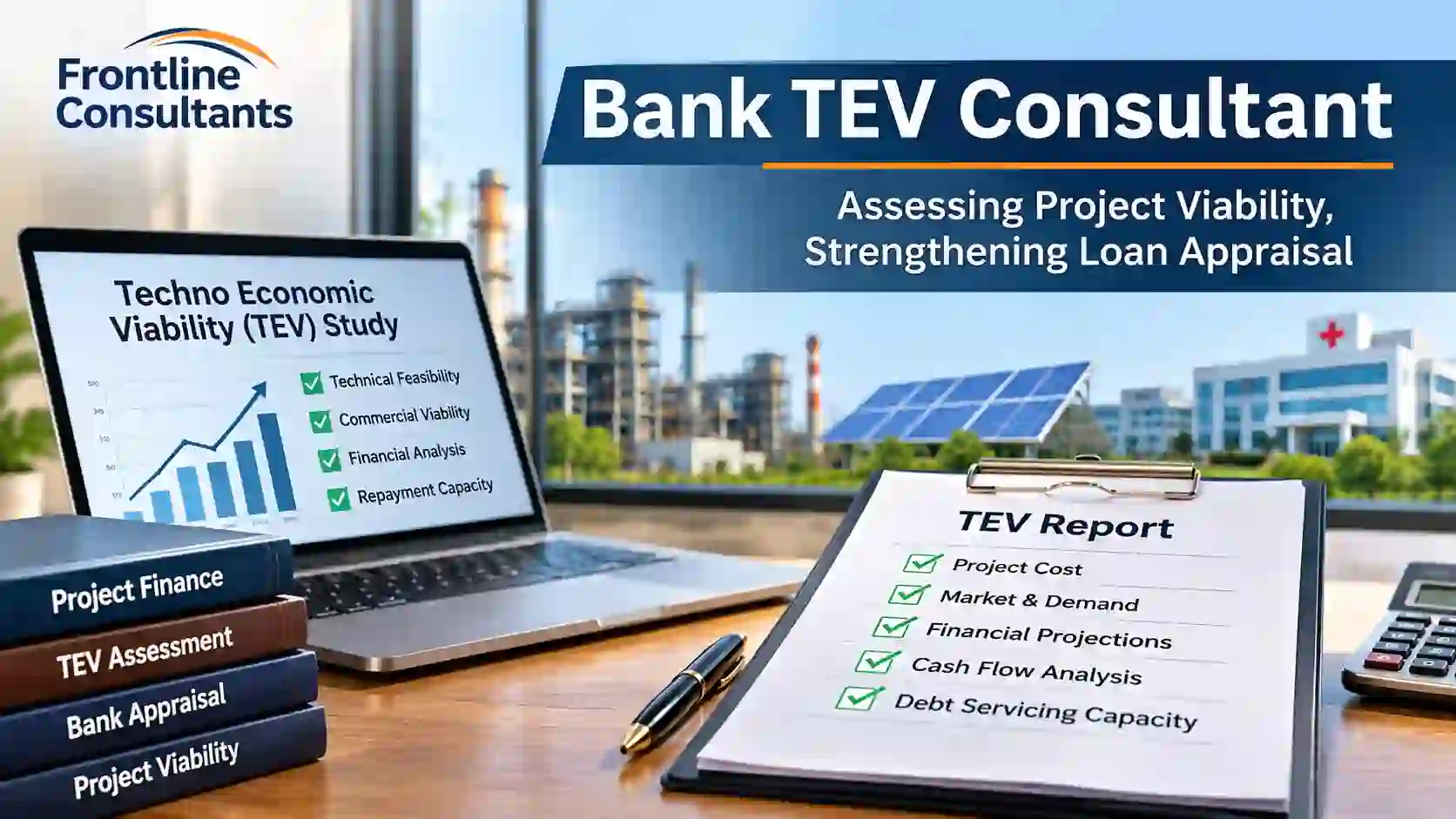
1. Understanding the Role of a Bank TEV Consultant in Project Financing
When a business approaches a bank for a term loan, the
discussion is rarely limited to the amount of money required. The bank wants to
understand what the borrower intends to do with the funds, whether the proposed
investment makes commercial sense, and how the business will repay the loan
over the coming years. This becomes particularly important in manufacturing,
infrastructure, healthcare, hospitality, renewable energy and other capital
intensive sectors, where project costs can run into crores and the repayment
period may extend over several years.
A bank TEV consultant plays an important role in this
assessment. A Techno Economic Viability study examines the technical
suitability and commercial viability of a proposed project. It helps the
lending institution understand whether the project can be implemented as planned,
whether the cost estimates are reasonable, and whether the expected revenue and
cash flows can support the proposed debt.
For a promoter, the process can sometimes feel like another
requirement imposed by the bank. But a properly conducted TEV assessment can
identify problems before the project reaches a stage where money has already
been committed. For example, a manufacturing unit may have finalised machinery
quotations without accounting for installation costs, electrical
infrastructure, working capital requirements or delays in commercial
production. These gaps may not be immediately visible in the promoter's initial
project report.
A bank TEV consultant looks at the project from a different
angle. The promoter is naturally focused on setting up the business and
achieving projected sales. The lender, on the other hand, needs to understand
the risks associated with implementation, operations and repayment. The
consultant helps bridge this gap by examining the project information,
financial assumptions, technical requirements and business plan in a structured
manner.
This does not mean a TEV report guarantees loan approval.
The final lending decision remains with the bank or financial institution. The
report provides an independent assessment that supports the credit appraisal
process and helps the lender make an informed decision.
2. Why Banks Require a Techno Economic Viability Assessment Before
Sanctioning Loans
Banks do not usually sanction large project loans simply
because a promoter has submitted a detailed project report or provided
attractive financial projections. They need to establish whether the proposed
investment is practical and whether the borrower has the capacity to meet
financial obligations after the project becomes operational.
This is where the assessment conducted by a bank TEV
consultant becomes important.
Consider a manufacturing company planning to expand its
existing production capacity. The promoter may have identified demand for
additional products and may already be negotiating with machinery suppliers.
The company approaches a bank for term finance to purchase equipment, construct
additional space and increase production.
At first glance, the expansion may appear straightforward.
But the bank needs answers to several questions.
Is the existing plant operating at a reasonable capacity?
Will the additional machinery actually increase production? Is there sufficient
demand for the proposed output? Will the company require additional working
capital after expansion? Are the projected sales based on actual market
conditions or simply on the expected production capacity?
These questions matter because project loans are generally
repaid from the cash generated by the business. If the project takes longer to
become operational or sales remain below expectations, the borrower may
struggle to meet instalments.
A TEV assessment helps the bank understand these risks
before committing substantial funds. It examines the relationship between
project investment, production capacity, operating expenses, expected revenue,
profitability and debt repayment.
The report also helps identify mismatches in the proposed
financing structure. For instance, a project may require substantial investment
in land development, civil construction, machinery installation and initial
operating expenses. If the promoter has arranged funds only for the major
machinery and construction components, the project may face a funding shortage
during implementation.
This is one reason banks place importance on independent
project assessment. A bank TEV consultant can examine the proposed investment
and identify whether the project cost and financing arrangement appear
sufficient for successful implementation.
The assessment is also useful when assumptions need to be
reviewed. A project may be viable at a certain production level, but if the
projected utilisation is too optimistic during the initial years, the repayment
schedule may become difficult to manage. The bank needs to understand what
happens under more realistic operating conditions.
3. Projects That Commonly Require a Bank TEV Consultant
The requirement for a TEV report generally depends on the
size, nature, complexity and financing structure of the project, along with the
lending institution's internal policies. Large capital investments and projects
involving significant implementation or operational risks are more likely to
require independent viability assessment.
A bank TEV consultant may be engaged for several types of
projects.
Manufacturing and industrial projects
Manufacturing projects frequently require TEV assessment
because investment involves machinery, plant infrastructure, utilities, raw
materials, manpower and production planning. A proposed manufacturing unit may
have a technically suitable production line but face difficulties due to
insufficient power availability, an unrealistic production schedule or
inadequate working capital.
For an existing manufacturing company seeking expansion
finance, the consultant may also examine the present operations before
assessing the proposed investment.
Solar and renewable energy projects
Solar projects require an assessment of generation
assumptions, project costs, equipment specifications, evacuation arrangements,
power purchase arrangements and expected revenue. A small change in generation
assumptions or project cost can affect the financial viability of the project.
The lender needs to understand whether the proposed project
is capable of generating the expected cash flows over its operating life.
Hospital and healthcare projects
Hospitals involve a combination of construction expenditure,
medical equipment investment, staffing costs, operating expenses and patient
revenue assumptions. A hospital project may look viable on paper, but the
projected revenue may depend heavily on occupancy levels, bed utilisation,
specialty services and the time required to establish the facility.
Hotels, warehouses and commercial infrastructure
Hotels, warehouses, logistics facilities and commercial
projects may require TEV assessment where substantial project financing is
involved. The consultant examines the expected utilisation, market demand,
operating costs and investment requirements.
Education and institutional projects
Schools, colleges, training institutions and other educational
projects may also require independent assessment. The analysis may consider
student enrolment assumptions, fee structure, infrastructure requirements,
operating expenses and the project's ability to service debt.
The exact scope differs from one project to another. A bank TEV consultant does not simply apply the same financial model to every project.
The assessment needs to reflect how the business will actually operate.
4. What Banks Examine During a Techno Economic Viability Study
A TEV study is not merely a financial calculation. It
involves examining the project from multiple angles, as a weakness in one area
can affect the overall viability.
The technical assessment generally examines whether the
proposed facilities, equipment, infrastructure and operating arrangements are
suitable for the intended activity. For a manufacturing unit, this may involve
reviewing machinery capacity, production processes, plant layout, utilities,
raw material requirements and implementation arrangements.
The project cost is another important area. Banks want to
understand whether the investment estimates are reasonable and whether
important components have been omitted. A machinery quotation may include the
equipment itself but exclude freight, installation, commissioning, electrical
work, supporting infrastructure or other expenses.
The consultant also examines the market and commercial
assumptions. This does not necessarily mean conducting a full market research
exercise in every case. The scope depends on the project and the lender's
requirements. However, the proposed capacity, expected sales, pricing
assumptions and competitive conditions need to be reasonably supported.
Financial analysis is equally important. The consultant
reviews the proposed capital structure, promoter contribution, term loan
requirement, operating expenses, revenue estimates, profitability and projected
cash flows.
The bank may also want to understand the implementation
schedule. Delays in construction, machinery delivery, approvals or
commissioning can affect the commencement of operations and the timing of
repayment.
For an existing business, the assessment may include
reviewing historical financial performance, existing borrowings, current
operations, capacity utilisation and the proposed expansion.
A bank TEV consultant brings these areas together so that
the lender can evaluate the project as a complete business investment rather
than viewing the machinery purchase or construction expenditure in isolation.
5. Financial Projections, Cash Flow Assessment and Debt Repayment Capacity
Financial projections are often the part of a project report
that promoters focus on most closely. However, projections are only useful when
the assumptions behind them are reasonable.
A project may show healthy profitability in its projected
income statement, but the bank is primarily concerned with whether sufficient
cash will be available to service the proposed debt.
For example, an industrial project may project sales of ₹20
crore after reaching full capacity. But the business may require two years to
stabilise production. During the initial period, it may face lower capacity
utilisation, higher fixed costs, additional marketing expenditure and delays in
receiving payments from customers.
If the repayment schedule begins before the project reaches
stable operations, cash flow pressure may arise.
The assessment therefore needs to consider the timing of
cash inflows and outflows, not just annual profitability.
A bank TEV consultant typically examines projected revenue,
operating expenses, working capital requirements, interest costs, depreciation,
taxes and debt servicing obligations. These assumptions are used to understand
the project's repayment capacity.
The Debt Service Coverage Ratio, commonly known as
DSCR, is one of the financial indicators used in this assessment. It compares
the cash available for debt servicing with the repayment obligations during a
particular period. A higher ratio generally indicates a greater cushion for servicing
debt, although the acceptable level depends on the project, lender policy and
financial structure.
Cash flow assessment also highlights the importance of
working capital. A business may generate sales but still face cash shortages
because customers take longer to pay while the company has to pay suppliers,
salaries, electricity bills and other operating expenses regularly.
This is particularly common in manufacturing and industrial
businesses. A company may need to purchase raw materials several weeks before
production and may receive payment from customers only after the finished goods
are delivered. The gap between expenditure and collection can become
significant as production increases.
Sometimes the promoter's projections assume that the
business will immediately operate at full capacity. This is rarely a practical
assumption for a newly established project. Production stabilisation takes
time, and the financial model should reflect a reasonable ramp up period.
A bank TEV consultant also reviews whether the proposed debt
is proportionate to the project's investment and whether the promoter
contribution is adequate. The repayment structure should broadly align with the
expected cash generation of the project.
The purpose is not to make the projections look attractive.
It is to understand what the project can reasonably support and whether the
proposed funding structure is likely to remain manageable once operations
begin.
6. Common Issues That Affect TEV Reports and Loan Appraisal
In many project finance cases, the difficulty is not that
the business idea is poor. The problem is that the information submitted to the
bank does not adequately support the proposed investment. A promoter may have a
good understanding of the business but may not have documented every assumption
in a way that the lender can independently evaluate.
This creates delays during loan appraisal.
One common issue is an unrealistic project cost. Machinery
quotations may be available, but expenses relating to installation,
transportation, civil work, electrical systems, utilities, testing and
commissioning may not have been properly considered. When these costs are
identified later, the promoter may have to arrange additional funds.
Another issue is overestimating sales during the initial
years. Promoters often prepare projections based on the production capacity of
the proposed plant. However, installed capacity and actual sales are two
different things. A factory may technically produce 10,000 units per month, but
achieving that level of production and selling the output consistently may take
time.
The working capital estimate can also become a problem.
Businesses sometimes focus heavily on term loan requirements while overlooking
the amount required for inventory, receivables, operating expenses and supplier
payments. A project may be technically complete but struggle to operate because
adequate working capital has not been arranged.
Documentation gaps are equally frustrating. Machinery
quotations may be outdated, land documents may not be complete, statutory
approvals may be pending, or the financial statements may not clearly support
the promoter's projections. In some cases, the promoter submits different
project cost figures to different parties, creating confusion during appraisal.
Sometimes perfectly good projects get delayed because
documentation was prepared in the wrong sequence. It still surprises me.
A bank TEV consultant can identify these issues during the
assessment itself. But the promoter also needs to cooperate by providing
accurate information and responding to queries. A consultant cannot
independently verify every operational detail without supporting records, site
access or information from the project team.
The most useful TEV reports are those that openly identify
risks and explain how they may affect the project. A report that ignores
weaknesses may appear favourable initially, but it does not help the bank make
a sound lending decision.
7. How a Bank TEV Consultant Helps Promoters Prepare for Lender Scrutiny
Promoters sometimes assume that the consultant's role begins
after the bank has formally asked for a TEV report. In practice, involving a
bank TEV consultant at an earlier stage can be useful, particularly when the
project is still being planned.
Take the case of an MSME planning to establish a new
manufacturing unit. The promoter may have identified the location, approached
machinery suppliers and estimated the investment. However, the project may
still have unresolved questions regarding production capacity, raw material
sourcing, utilities, market demand and financing requirements.
A preliminary assessment can help the promoter understand
whether the proposed investment is financially reasonable before approaching
multiple banks.
The consultant can review the project cost, identify missing
components, examine the projected revenue assumptions and assess whether the
proposed financing structure is practical. This can help the promoter avoid
preparing a project report that requires major revisions later.
For an existing company seeking expansion finance, the
consultant may examine the current financial position, existing debt
obligations and performance of the existing plant. The proposed expansion is
then considered in the context of the company's actual operating performance.
This is important because the expansion project may depend
on the existing business supporting additional debt. If the existing unit is
already facing cash flow pressure, the bank may want to understand how the
proposed expansion will address that situation.
A bank TEV consultant can also help promoters understand the
questions likely to arise during lender appraisal. These may relate to project
cost, promoter contribution, capacity utilisation, repayment assumptions,
working capital requirements, implementation timelines or the availability of
approvals.
There is a practical benefit here. Promoters can prepare
supporting documents before the bank raises repeated queries. Machinery
quotations, financial statements, land documents, project approvals, technical
information and operating assumptions can be organised properly.
This does not guarantee faster sanction. Banks have their
own appraisal processes, internal committees and credit policies. However,
better prepared information generally makes discussions more meaningful and
reduces avoidable confusion.
The consultant's role is not to teach the promoter how to
present a project favourably at any cost. It is to ensure that the project
information is consistent, reasonably supported and capable of being examined
by the lender.
8. Selecting the Right Bank TEV Consultant for Your Project
Choosing a consultant should not be based only on the quoted
fee or the promise of completing a report within a few days. A TEV assessment
involves technical understanding, financial analysis and familiarity with the
way banks examine project proposals. The consultant's experience with projects
similar to yours can make a difference in the quality of the assessment.
A manufacturing project and a hospital project have very
different operating structures. In manufacturing, the assessment may involve
production capacity, machinery selection, raw material consumption, power
requirements and manufacturing costs. In a hospital, the analysis may focus on
bed capacity, medical equipment, staffing, occupancy, specialty services and
patient revenue.
The first thing a promoter should check is whether the
consultant understands the industry. A consultant who has worked on similar
projects will generally know which assumptions require closer examination and
what information the lender may ask for.
The second consideration is experience with banks and
financial institutions. A bank TEV consultant should understand the purpose of
the assessment, the lender's expectations and the importance of supporting
assumptions with proper documentation. Where the bank has specific requirements
regarding the report format, scope or consultant eligibility, these should be
confirmed before the engagement begins.
The scope of work also deserves attention. Some promoters
assume that a TEV report includes a complete market study, detailed engineering
review, financial modelling, site inspection and every possible technical
verification. This may not always be the case. The scope depends on the
assignment and the requirements communicated by the lender.
It is better to clarify the deliverables, information
requirements, timelines, site visit requirements and responsibilities in
advance.
The promoter should also be comfortable discussing the
project's weaknesses with the consultant. If the project has a funding gap,
unrealistic sales assumptions or implementation risks, these issues should be
examined openly. A consultant who only agrees with the promoter's projections
may not provide the independent assessment the bank requires.
I might be wrong here, but promoters sometimes spend more
time negotiating the consultancy fee than checking whether the consultant has
actually handled projects of a similar nature. For a large project, the quality
of the assessment and the ability to identify potential problems before they
reach the lender can be far more valuable than a small difference in
professional fees.
9. How Frontline Consultants Supports Banks and Borrowers Through TEV
Assessment
Project financing involves several parties, and their
expectations are not always the same. The promoter wants the project to move
forward. The bank wants to understand the risk before extending finance. The
project team is concerned with implementation, while the financial model needs
to reflect the expected operating performance.
Frontline Consultants works in the area of financial
consulting and project advisory, supporting businesses, promoters, lenders and
financial institutions through different stages of project assessment and
financing.
With more than 30 years of experience in financial and
project advisory, the firm offers services including Techno Economic Viability
Reports, Lenders Independent Engineer Services, Agency for Special Monitoring,
Detailed Project Reports, Enterprise Valuation, Asset Valuation, Credit
Syndication, Debt Restructuring, Bank Liaison and Business Financial
Consulting.
For a TEV assignment, the work involves examining the
information available about the project and understanding its proposed
investment, technical configuration, implementation plan, commercial
assumptions and financial projections. The assessment needs to reflect the
nature of the business rather than treating every project as a similar
financial exercise.
For example, a proposed manufacturing expansion may require
examination of the existing plant's performance, additional machinery
requirements, capacity utilisation and the financial impact of the expansion. A
renewable energy project may require a different assessment involving project
cost, generation assumptions, operating arrangements and expected cash flow.
The report is prepared to provide the lender with an
independent assessment of the project's viability and the relevant risks. Where
issues or gaps are identified, they need to be clearly addressed rather than
ignored.
Frontline Consultants also provides other services that may
become relevant as a project progresses. A business preparing for bank finance
may require a Detailed Project Report before the TEV assessment. An existing
borrower facing financial pressure may require debt restructuring assistance. A
lender may need Lenders Independent Engineer Services or Agency for Special
Monitoring in connection with an ongoing project.
These services are connected, but their purpose is
different. A TEV report evaluates the viability of a proposed investment or
project. Lenders Independent Engineer Services generally involve independent
technical monitoring and assessment for lenders. Agency for Special Monitoring
assignments may involve monitoring the progress, utilisation of funds or other
aspects of a project based on the lender's requirements.
For promoters, the value of engaging an experienced bank TEV
consultant is not simply the report itself. It is the opportunity to understand
the project from the lender's perspective, identify potential gaps and prepare
the information required for a more meaningful financing discussion.
The final loan sanction remains the decision of the bank or
financial institution. However, a well prepared assessment can help both the
lender and borrower approach the financing process with a clearer understanding
of the project's assumptions, requirements and risks.
10. Frequently Asked Questions About Bank TEV Consultants
What does a bank TEV consultant do?
A bank TEV consultant evaluates the technical and financial
viability of a project proposed for bank financing. The assessment generally
examines project cost, technical requirements, market assumptions, financial
projections, cash flow, repayment capacity and implementation risks. The report
helps the lender assess whether the proposed investment is commercially and
financially viable.
Is a TEV report mandatory for every bank loan?
No. The requirement depends on the type of loan, project
size, nature of investment and the bank's internal lending policies. Large
capital expenditure projects, manufacturing units, infrastructure projects and
other significant investments may require a TEV assessment as part of the
credit appraisal process.
Can a TEV consultant guarantee loan approval?
No consultant can legitimately guarantee loan sanction. The
TEV report provides an independent assessment of the project, but the final
decision depends on the lender's credit policy, borrower eligibility, financial
position, security arrangements, documentation and other appraisal
considerations.
When should a promoter approach a bank TEV consultant?
Ideally, the consultant should be approached when the
project investment and financing plan are being developed or when the bank has
requested an independent viability assessment. Early involvement can help
identify gaps in project cost estimates, financial projections, working capital
planning and supporting documentation before the appraisal progresses.
What documents are generally required for a TEV
assessment?
Requirements vary depending on the project. Common documents
include the Detailed Project Report, machinery quotations, project cost
estimates, land and building details, financial statements, projected
financials, promoter information, existing loan details, production
assumptions, raw material information, statutory approvals and other project
specific documents. The bank or consultant may request additional information
during the assessment.
How do I select a bank TEV consultant for my project?
Look for relevant industry experience, familiarity with
lender requirements, clarity regarding the scope of work, understanding of
technical and financial aspects, and the ability to examine project assumptions
objectively. It is also important to confirm whether the consultant meets any
specific eligibility or empanelment requirements prescribed by the lending
institution.