
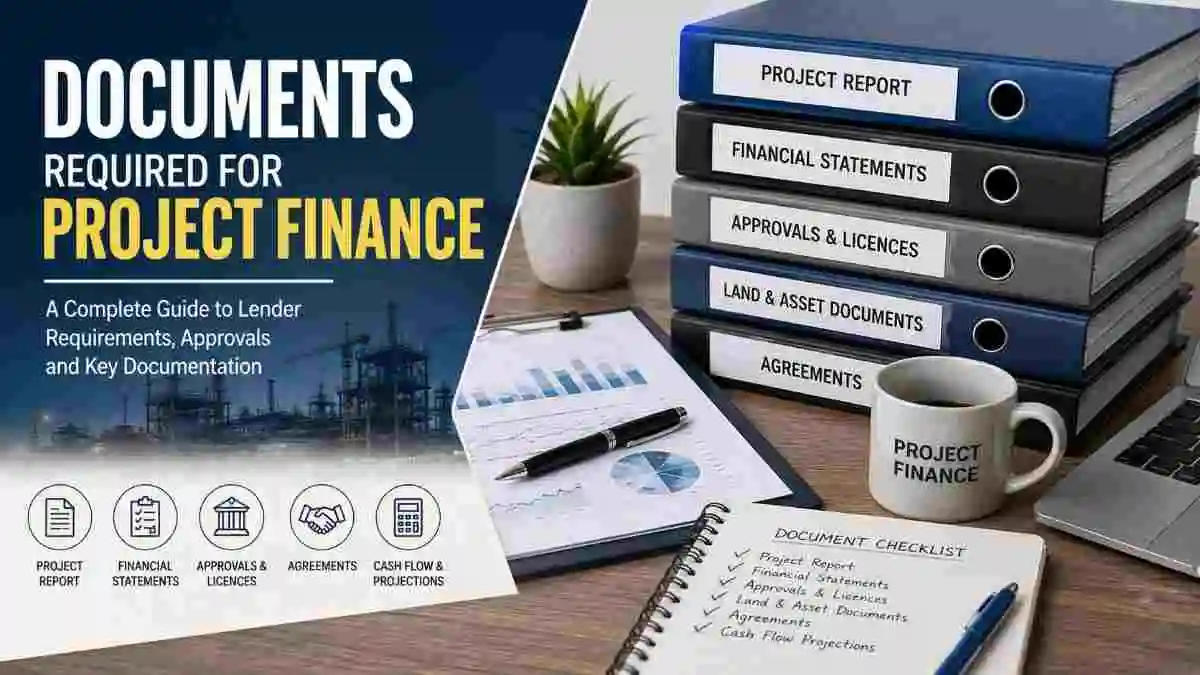
Understanding the Documents Required for Project Finance
When a business approaches a bank for project finance, the
first question is usually about the loan amount, interest rate, or repayment
period. The more important question often comes slightly later: can the
promoter provide the documents that allow the lender to understand, verify, and
assess the project properly?
The documents required for project finance are not simply a
collection of papers attached to a loan application. They form the basis of
credit appraisal. A lender uses them to understand the promoter, project cost,
means of finance, technical feasibility, projected cash flows, security,
statutory position, and repayment capacity.
This becomes particularly important when the proposed
borrowing is substantial. A manufacturing company setting up a new plant may
have land documents, machinery quotations, building estimates, approvals,
promoter financial statements, projected balance sheets and market information.
A solar project will have a different set of documents, including land
arrangements, evacuation approvals, power purchase arrangements, equipment
details and project implementation schedules. A hospital project may need building
plans, medical equipment quotations, registrations, licences and operational
projections.
So there is no single universal document checklist that
works for every project.
The core documents required for project finance generally
fall into a few broad categories. These include promoter and company documents,
technical project information, financial statements and projections, land and
asset documents, statutory approvals, and documents supporting the proposed
security structure.
Banks also look at the sequence and consistency of the
information. If the project report says the project cost is Rs. 50 crore, but
machinery quotations indicate a substantially different figure, questions will
naturally arise. If projected revenue is aggressive but the market assessment
does not support the assumed capacity utilisation, the financial projections
may be challenged.
This is where preparation matters.
Many business owners believe that having a strong business
idea and a good DPR is enough to obtain project finance. I disagree with that
view. A DPR is important, but lenders assess the complete borrowing proposal,
not just the report.
A promoter may have an economically viable project, but
incomplete land records or unclear contribution arrangements can delay the
appraisal. Sometimes perfectly good projects get delayed because documentation
was prepared in the wrong sequence. It still surprises me.
The objective should therefore be to prepare a complete and
internally consistent set of documents before approaching the lender.
Promoter and Company Documents Required by Lenders
The lender first needs to establish who is borrowing, who
owns the business and who is responsible for bringing the proposed project into
operation.
For an existing company, the basic corporate documents
generally include the certificate of incorporation, memorandum and articles of
association, PAN, GST registration, corporate identification details and other
applicable registrations. Depending on the nature of the business, lenders may
also ask for partnership deeds, LLP agreements, proprietorship documents or
trust and society records.
Promoter documentation is equally important.
Banks generally examine the identity and financial
background of promoters and directors. KYC documents, PAN, address proof, net
worth statements, income tax returns and details of existing investments or
liabilities may be required.
For larger projects, promoter contribution becomes a major
part of the assessment. The lender wants to know where the promoter's
contribution will come from and whether those funds are genuinely available.
For example, consider an MSME planning a manufacturing
expansion of Rs. 20 crore. The promoter proposes to contribute Rs. 6 crore
while seeking Rs. 14 crore from the bank. The bank may ask for evidence
supporting the promoter contribution. Bank statements, existing investments,
sale proceeds, unsecured loans from promoters, or other legitimate sources may
need to be documented.
This is different from simply writing "promoter
contribution Rs. 6 crore" in a project report.
Existing borrowing details are also important. The lender
may ask for sanction letters, loan statements, repayment schedules, security
details and details of outstanding liabilities with banks and financial
institutions.
If the company has existing term loans or working capital
facilities, those liabilities need to appear correctly in the financial model.
The lender may also review whether there have been delays in
repayment, restructuring, settlement arrangements or other credit-related
events. Such matters should not be hidden during documentation.
A practical rule is simple. If a lender is likely to find
something during its appraisal, it is better to disclose and explain it
properly rather than allow the issue to appear later.
The documents should tell one consistent story about the
promoter and the business.
Detailed Project Report and Technical Documents for Project Finance
Among the documents required for project finance, the
Detailed Project Report usually occupies a central position because it brings
the commercial and technical aspects of the proposal together.
A good DPR explains what the promoter intends to establish,
why the project is required, how much it will cost, how it will be implemented
and how the business is expected to generate sufficient cash flow to meet its
obligations.
For a manufacturing project, the DPR may cover installed
capacity, product mix, manufacturing process, raw materials, utilities,
machinery, manpower, production assumptions, market assessment, implementation
schedule and project economics.
Suppose a company is planning a new food processing plant.
The lender will want to understand the proposed capacity, machinery
configuration, raw material availability, expected sales, pricing assumptions
and implementation timeline. Simply stating that demand is strong is not
enough. The assumptions need to be supported by reasonable market and operating
information.
Technical documents may include machinery quotations,
supplier profiles, technology agreements, process descriptions, civil
construction estimates, plant layouts and engineering details.
Where a project requires specialised assessment, a Technical
Feasibility Report or Techno Economic Viability Report may also become
important.
A Techno Economic Viability assessment looks beyond the
basic project description. It examines whether the proposed project makes
technical and economic sense and whether the projected operating and financial
parameters are reasonable.
Banks may rely on independent technical or engineering
assessments for larger or more complex projects. This is where Lenders
Independent Engineer Services can become relevant. An independent engineer may
examine project progress, physical assets, technical specifications,
implementation status, cost estimates and other technical matters from the
lender's perspective.
The exact requirement depends on the project, lender and
loan structure.
A solar project illustrates this well. The lender may need
documents relating to land rights, site details, solar resource assessment,
module and inverter specifications, EPC arrangements, grid connectivity,
evacuation infrastructure, power purchase arrangements and project
implementation.
For a warehouse project, the technical documentation could
include building plans, construction estimates, location details, storage
capacity, equipment requirements and implementation schedules.
The DPR should therefore not be treated as a document
prepared only because the bank has asked for it. It should be the central
reference document from which many other financial and technical documents can
be cross checked.
There is another practical issue. Quotations attached to a
DPR should be current and realistic. Old quotations can create problems when
equipment prices have changed considerably. The lender may ask for fresh
quotations, which can lead to avoidable delays.
Financial Statements, Projections and Cash Flow Documents
Financial documents are among the most closely examined
documents required for project finance because ultimately the lender needs to
understand repayment capacity.
For an existing business, lenders generally review audited
financial statements for the available historical period. These may include the
balance sheet, profit and loss account, cash flow statement, audit reports and
relevant schedules.
Income tax returns, GST information, bank statements and
existing borrowing statements may also form part of the appraisal.
The lender is not only looking at profit.
Working capital levels, debtor days, creditor days,
inventory, operating margins, existing debt and cash generation all matter. A
company showing accounting profit but continuously facing cash shortages may
require closer examination.
For example, an industrial borrower may report annual
profits but have receivables outstanding for several months. If the proposed
project requires additional working capital, the lender will want to understand
whether the business can manage those receivables while servicing the new debt.
Projected financial statements are then prepared for the
proposed project.
These normally include projected profit and loss statements,
balance sheets, cash flow statements and debt repayment schedules. The
assumptions should correspond with the technical and commercial details in the
DPR.
If the proposed plant has a capacity of 10,000 units a year,
projected sales should not casually assume 20,000 units without explaining
additional capacity or outsourced production.
The same principle applies to pricing.
If a project assumes a selling price substantially higher
than the current market level, the promoter should be able to explain why. It
could be due to product differentiation, a long-term contract, higher
value-added products or another commercial reason.
Debt repayment capacity is also examined through projected
cash flows and relevant lending ratios. Depending on the lender and project,
assessments may include DSCR, interest coverage, debt equity ratio, current
ratio and other financial indicators.
These figures are useful only when the assumptions behind
them are sensible.
I might be wrong here, but in actual project discussions,
the biggest issue is often not the spreadsheet itself. It is the assumptions
behind the spreadsheet. A beautifully prepared financial model cannot
compensate for weak sales assumptions or an unrealistic implementation
schedule.
Working capital assessment is another area that needs
attention. A new manufacturing unit may require raw material stock, receivables
funding, cash expenses and operating liquidity even after the term loan is
sanctioned.
The project finance structure therefore needs to consider
both fixed project costs and the working capital requirement.
Banks may also request a CMA data set or similar financial
information depending on the proposed facility and lender requirements.
Existing banking arrangements, proposed limits and projected working capital
needs need to be presented consistently.
For an MSME seeking expansion finance, the financial
documents should clearly show what has happened historically and what is
expected after expansion.
If the historical business has stable sales but the
projection suddenly assumes a threefold increase without additional capacity,
distribution arrangements or market support, the lender will naturally question
the numbers.
Land, Property, Machinery and Asset Related Documents
Land and asset documentation can become one of the most
sensitive parts of project finance, particularly where the proposed project
involves significant fixed assets.
For a new industrial unit, lenders may ask for land
ownership documents, lease agreements, title documents, encumbrance details,
approved layouts and other property-related records.
The exact documents vary by state, property type and
ownership structure.
If the land is leased, the lender may examine the lease
tenure, permitted use, transfer provisions and mortgageability. If the land is
owned by a promoter rather than the borrowing company, the proposed security
arrangement needs to be understood clearly.
This is particularly relevant in manufacturing and
infrastructure projects where land represents a substantial part of the project
base.
Property valuation may also be required.
Asset Valuation is essentially an assessment of the value of
a property, plant, machinery or other asset based on the relevant valuation
methodology. Banks may use independent valuers to assess the value of security
offered by the borrower.
A promoter may believe that a factory building is worth Rs.
10 crore because a similar property was recently sold nearby. The bank's valuer
may arrive at a different figure after considering title, location,
construction, usage, marketability and other factors.
That difference can affect the security structure and
borrowing assessment.
Machinery documentation is equally important for capital
intensive projects. Quotations, proforma invoices, supplier details, technical
specifications, delivery schedules and payment terms may be reviewed.
For imported machinery, lenders may require additional
information relating to import costs, duties, foreign currency exposure and
supplier arrangements.
In an expansion project, the existing machinery and assets
may also be considered. The lender may want details of existing fixed assets,
previous purchase invoices, current loans secured against those assets and
available charge information.
The promoter should also be careful about double financing.
If an existing machine is already charged to another lender, it cannot simply
be shown as unencumbered security for a new loan.
This sounds obvious, but documentation gaps of this kind do
come up.
For a warehouse expansion, for instance, the bank may
examine the land title, building permissions, construction estimates, existing
mortgage, machinery or handling equipment requirements and projected revenue
from the expanded facility.
Where the project requires significant construction, civil
estimates should be supported by credible quotations or cost assessments. An
unrealistic construction budget can disturb the entire project cost and debt
requirement.
The broader point is that lenders need to establish what
assets are being created, who owns them, what they are worth, whether they are
legally usable for the proposed project and whether they can form part of the
security package.
Frontline Consultants works with businesses on this broader
documentation and project advisory process, including Detailed Project Reports,
Techno Economic Viability Reports, Lenders Independent Engineer Services, asset
valuation, credit syndication, bank liaison and related financial consulting.
The purpose is not simply to prepare paperwork. The documents need to support
the commercial case being presented to the lender.
A well prepared project finance proposal should allow a
banker to move from the promoter background to the project, from the project to
the cost, and from the cost to the proposed funding and repayment capacity
without repeatedly finding gaps.
That is usually where the real difference lies between a
proposal that is merely submitted and one that is ready for serious credit
appraisal.
Statutory Approvals, Licences and Regulatory Documents
A project may look financially attractive on paper, but
lenders also need to know whether it can legally and practically operate. This
is why statutory approvals, licences and regulatory documents form an important
part of the documents required for project finance.
The exact approvals depend on the industry, location,
project size and state regulations. A manufacturing unit may require factory
registration, pollution control approvals, fire safety clearance, electricity
connection, water permissions and local authority approvals. A hospital may
require healthcare related registrations, building permissions, fire approvals,
biomedical waste arrangements and other applicable licences.
Environmental compliance can become particularly important
for industrial projects. Depending on the nature of the activity, the promoter
may need Consent to Establish and later Consent to Operate from the relevant
pollution control authority.
Land use is another area that lenders examine. The land
should be suitable for the proposed activity and the relevant land conversion
or development permissions should be in place where applicable.
Construction related documents may include sanctioned
building plans, development permissions, commencement permissions and
completion certificates depending on the stage of the project.
For a solar project, the documentation can be quite
different. Land arrangements, grid connectivity, evacuation approvals, power
purchase arrangements, project agreements and equipment related documents may
become central to the lender's assessment.
The important point is that approvals should not be
collected at the last stage.
If a promoter approaches the bank for project finance while
a critical approval is still uncertain, the lender may treat that uncertainty
as a project risk. The bank may ask for clarification, additional conditions or
evidence that the approval is likely to be obtained.
This doesn't apply everywhere. Some approvals can
legitimately be obtained after financial sanction or during implementation,
depending on the project and lender's conditions. But the promoter should know
which approvals are critical before approaching the bank.
A proper document review helps separate approvals that are
already available from those that are pending, conditional or not yet
applicable.
Documents Required for Working Capital and Debt Assessment
Project finance is often discussed as if the term loan is
the entire funding requirement. In actual projects, working capital can become
equally important.
A new manufacturing facility may require funds for raw
materials, inventory, salaries, utilities, receivables and other operating
expenses. If these requirements are ignored, the project may become financially
strained even after the fixed assets have been created.
Documents required for project finance therefore often
include information needed for working capital assessment.
Existing businesses may need to provide stock statements,
debtor and creditor ageing, bank statements, existing working capital limits,
sanction letters and details of current banking arrangements.
The lender may also examine historical working capital
cycles. How quickly does the company collect money from customers? How long
does it hold inventory? What credit does it receive from suppliers?
These questions help determine whether the proposed working
capital requirement is reasonable.
Consider an MSME that has annual sales of Rs. 30 crore and
is seeking a new term loan for expansion. If customers generally take 90 days
to pay, the business may need considerable funds tied up in receivables. A
projection that assumes immediate customer payments would make the cash flow
look much stronger than reality.
Debt assessment follows a similar logic.
Existing loan statements, sanction letters, repayment
schedules, interest obligations and security details help the lender understand
the current debt burden. If the borrower already has several facilities, the
new proposal must account for those obligations.
The lender may assess debt service capacity through
projected cash flows and ratios such as DSCR. The calculation itself is
straightforward. The difficult part is deciding whether the projected cash flow
is realistic.
For borrowers undergoing restructuring, the documentation
becomes more sensitive. An industrial borrower facing temporary financial
stress may need to provide details of existing facilities, overdue amounts,
reasons for stress, revised cash flows, promoter contribution and the proposed
restructuring plan.
Debt Restructuring is not simply an extension of repayment.
The lender needs to understand why the business faced stress and whether the
revised structure gives the company a reasonable chance of recovery.
Similarly, Credit Appraisal involves looking at the overall
borrowing proposal, including business performance, management capability,
project viability, security, repayment capacity and risks.
This is why submitting only a loan application form rarely
moves a complicated project forward.
Additional Documents Required for Manufacturing, Infrastructure, Solar and
Healthcare Projects
The documents required for project finance change
considerably depending on the nature of the project.
A manufacturing project usually requires detailed
information about the manufacturing process, machinery, production capacity,
raw materials, utilities, manpower, product mix and proposed market. Machinery
quotations and supplier details become particularly important when the project
cost is heavily dependent on imported or specialised equipment.
The lender may also examine existing production capacity and
utilisation if the project is an expansion.
For example, if an existing industrial unit is operating at
85 percent capacity and wants to add another production line, the proposal may
be commercially understandable. But if the existing plant is operating at only
35 percent capacity, the lender may ask why additional capacity is required.
That does not automatically make the proposal unacceptable.
There may be product mix issues, new customer contracts or technical
limitations in the existing plant. Those reasons simply need to be documented.
Infrastructure projects require another level of
documentation. Concession agreements, EPC contracts, project implementation
schedules, government approvals, land arrangements, technical reports,
contractor credentials and revenue arrangements may become important.
The lender needs visibility over both construction risk and
operating risk.
Solar projects have their own documentation requirements.
Land ownership or lease arrangements, evacuation plans, grid connectivity,
equipment specifications, EPC agreements, power purchase agreements and
financial projections can all influence the appraisal.
A solar project may have predictable revenue under a strong
power purchase arrangement, but the lender still needs to examine
implementation and counterparty risks.
Healthcare projects also require careful documentation.
A proposed hospital may need land and building documents,
approved plans, medical equipment quotations, project cost estimates,
registrations, staffing plans and revenue projections. The promoter's
experience can matter because healthcare projects involve both capital
investment and operational management.
An established hospital expanding into a new location may be
assessed differently from a first time promoter establishing a large hospital.
Educational institutions and real estate developments
similarly require project specific documents. Land title, approvals,
construction plans, sales assumptions, project costs and cash flow timing
become particularly important.
The common principle is simple. The documentation should
reflect the actual risk profile of the project.
Common Documentation Mistakes That Delay Project Finance Approval
A surprisingly large number of project finance delays have
nothing to do with the basic business idea. They happen because information is
incomplete, inconsistent or submitted at the wrong stage.
One common mistake is providing different project costs in
different documents. The DPR may show one number, machinery quotations another,
and the financial projections may use a third figure.
Banks notice these differences.
Another common issue is outdated financial information.
Promoters sometimes submit old audited statements even when more recent
financial results, GST information or bank statements are available.
Land documentation is another frequent source of difficulty.
Ownership names may differ between documents. Lease arrangements may have
restrictions. Existing mortgages may not be clearly disclosed.
Sometimes promoters assume that because the land belongs to
the family, there is no documentation issue. From a lender's perspective,
ownership and security rights still need to be established properly.
Unrealistic projections create another problem.
A project report may assume very high capacity utilisation
from the first year, strong margins and rapid revenue growth. If these
assumptions are not supported by market conditions, customer orders, historical
performance or other evidence, the lender may ask for revised projections.
The same problem occurs with promoter contribution.
Writing a promoter contribution figure in the DPR is not
evidence that the money is available. The source of funds needs to be credible
and documentable.
Another mistake is failing to disclose existing liabilities.
An MSME may have loans from multiple banks, unsecured loans,
equipment finance or other obligations. If these are missing from the initial
proposal, the lender may question the completeness of the application when they
appear later.
I have also seen projects where the technical documents were
prepared independently from the financial model. The machinery list says one
capacity, while the financial projection assumes another. This creates
unnecessary questions.
And then there is the basic issue of sequencing.
A promoter may spend weeks preparing a polished DPR before
checking whether the land can actually be used for the proposed activity. That
is not the best order of work.
Sometimes the frustration is justified because the business
may genuinely have a good project. But banks are expected to verify risk before
committing funds. Documentation is part of that process.
A practical document checklist should therefore be prepared
before submission, with each item marked as available, pending, not applicable
or requiring clarification.
How Frontline Consultants Helps Prepare Documents Required for Project
Finance
Preparing documents required for project finance is not only
about collecting certificates and attaching financial statements. The documents
need to work together as one borrowing proposal.
Frontline Consultants works with promoters, MSMEs,
manufacturing companies, infrastructure businesses, solar projects, healthcare
projects and other organisations that require structured financial and project
advisory support.
The process can begin with understanding the proposed
project, promoter background, investment requirement and existing financial
position. From there, the documentation requirement can be mapped according to
the project and lender's expectations.
For a new manufacturing unit, this may involve preparing a
Detailed Project Report, reviewing project cost estimates, organising machinery
quotations, assessing projected working capital and developing financial
projections.
For a project requiring deeper technical and economic
assessment, Frontline Consultants provides Techno Economic Viability Reports.
These reports help present the project's technical assumptions, commercial
rationale, financial viability and key risks in a form suitable for lender
evaluation.
Lenders Independent Engineer Services may also be relevant
for larger projects where an independent technical assessment is required. Such
work can help lenders and project stakeholders understand physical progress,
project implementation and technical aspects of the investment.
The firm also provides Enterprise Valuation and Asset
Valuation services where valuation is relevant to the transaction, financing or
restructuring requirement.
For borrowers looking for funding from multiple lenders,
Credit Syndication can be considered where the size or structure of the
requirement makes a single lender arrangement unsuitable.
Bank Liaison is another practical part of the process. A
promoter may understand the business extremely well but may not always know how
a credit proposal will be viewed during appraisal. Presenting the information
in a clear sequence can reduce avoidable back and forth.
Frontline Consultants also works on Debt Restructuring,
Agency for Special Monitoring, project advisory and business financial
consulting where the circumstances require broader financial support.
The value of this work is often seen in small details. A
project cost is reconciled before submission. A missing approval is identified
early. A promoter contribution is supported with evidence. Historical
liabilities are properly reflected. Financial projections are checked against
actual operating assumptions.
None of these things sound particularly dramatic.
They matter because lenders are making decisions based on
the information placed before them.
The documents required for project finance should ultimately
answer five basic questions for the lender. Who is behind the project? What
exactly is being created? How much will it cost? How will the project generate
cash? And what gives the lender reasonable comfort that its money will be
repaid?
When those answers are supported by consistent financial,
technical, legal and commercial documentation, the project becomes much easier
to assess.
That does not guarantee approval. No genuine consultant can
promise that. Credit decisions depend on the lender, project economics,
promoter profile, security, market conditions and several other factors.
But proper documentation can prevent a viable project from
being held back simply because the lender could not get a clear picture of the
proposal.
And that, in practice, is one of the most useful reasons to
prepare the project finance documentation properly from the beginning.