
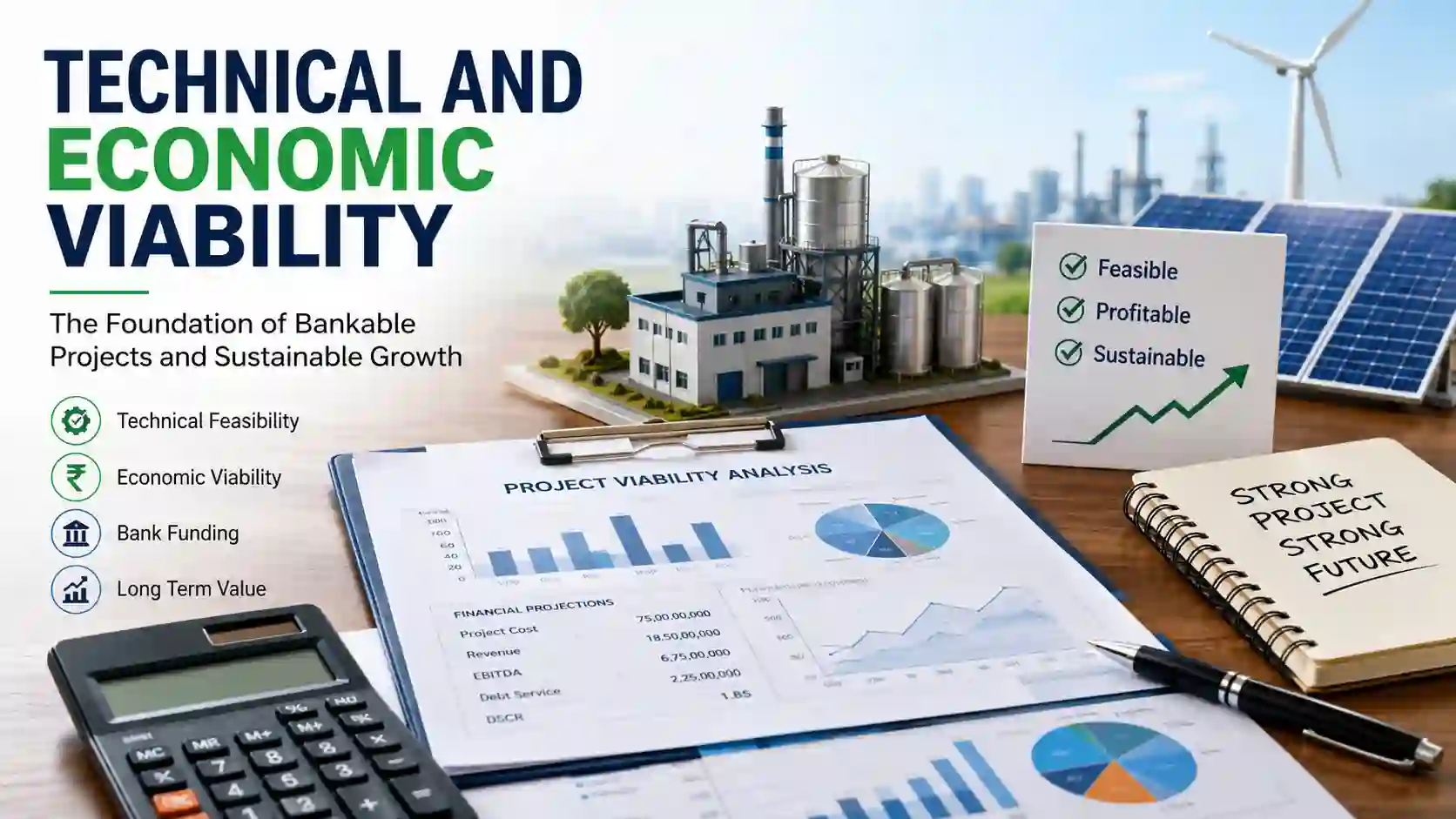
1. What Is Technical and Economic Viability and Why Does It Matter?
Technical and economic viability is essentially about
answering two questions before substantial money is committed to a project.
First, can the proposed project actually be implemented from a technical point
of view? Second, does the project make enough economic and financial sense to
justify the investment and proposed borrowing?
This sounds straightforward, but in actual project finance
discussions, these two questions involve a lot more than checking whether a
project is profitable on paper.
A manufacturing unit may have a strong market but an
unsuitable plant location. A solar project may have attractive tariffs but face
evacuation or land related issues. A hospital expansion may show good projected
revenue, but the promoter may have underestimated the time required to build
occupancy. These issues can materially change the viability of a project.
A proper technical and economic viability assessment brings
these matters together before lenders or investors make a major commitment.
The technical side generally examines aspects such as land,
location, plant layout, machinery, production capacity, technology, utilities,
raw materials, infrastructure, implementation schedule and operating
arrangements. The economic side looks at project cost, funding pattern, revenue
assumptions, operating expenses, profitability, cash generation, debt servicing
capacity and returns.
For banks, this assessment becomes particularly important
because lending decisions are not based only on the promoter's business plan.
The lender needs reasonable comfort that the proposed asset can be created as
planned and that the business will generate sufficient cash flow to service the
debt.
This is where a technical and economic viability report
becomes useful.
Suppose an engineering company wants to establish a new
manufacturing line costing ₹40 crore. The promoter may estimate that the unit
will reach 80 percent capacity utilisation within two years. A lender will want
to understand why that assumption is reasonable. Is there an existing customer
base? Are orders available? Is the machinery suitable for the intended
production? Is the power requirement properly assessed? Has working capital
been included?
A technically sound project with weak economics is still a
problem. The reverse is also true.
Many business owners believe that if the projected profit is
attractive, the project is viable. That is not necessarily correct. Banks look
closely at whether those profits can actually turn into cash available for debt
servicing.
A technical and economic viability assessment therefore acts
as a bridge between the promoter's project proposal and the lender's credit
appraisal process.
Frontline Consultants works in this space by examining the
technical, commercial and financial aspects of projects and preparing reports
that can support discussions with banks and financial institutions. Its
experience across manufacturing, infrastructure, healthcare, renewable energy
and other sectors is particularly relevant when a project has several moving
parts that need to be assessed together.
There is also a practical benefit for promoters. Problems
identified before financial closure are generally easier and cheaper to address
than problems discovered after loan disbursement and project implementation.
2. When Should a Business Prepare a Technical and Economic Viability
Report?
The ideal time is before approaching lenders with a final
funding proposal, not after the bank has already raised several questions.
A technical and economic viability report can be relevant
when a company is setting up a new unit, expanding an existing facility,
installing additional production capacity, developing infrastructure,
establishing a solar project, expanding a hospital or undertaking another
capital intensive project.
Consider an MSME planning a ₹15 crore expansion. The
promoter may already have land and machinery quotations and may believe the
project is ready for financing. During assessment, however, it may become clear
that the proposed machinery requires additional power infrastructure and that
the working capital requirement has been underestimated.
If the promoter approaches the bank without identifying
these issues, the proposal can go through several rounds of clarification.
The same applies to a warehouse expansion. A developer may
calculate construction costs but overlook fire safety infrastructure, access
roads, utility connections or the actual ramp up period for occupancy. These
details matter because they affect both project cost and revenue timing.
A technical and economic viability report is also useful
when an existing borrower is seeking substantial additional finance. Banks may
want to understand whether the expansion will genuinely improve operating cash
flow or simply increase the company's debt burden.
In stressed situations, the analysis becomes even more
important. An industrial borrower facing restructuring may need a fresh
assessment of installed capacity, market demand, operating margins, repayment
capacity and the realistic prospects of revival.
The report is therefore not limited to new projects.
It can support project finance, expansion finance,
refinancing discussions, restructuring proposals, lender consortium
requirements and investment decisions.
One practical observation from financial consulting work is
that promoters often start preparing the DPR, machinery quotations and
projections independently, and only later try to make all the numbers
consistent. That sequence creates avoidable problems. The project cost in one
document may differ from the financial model, while the implementation schedule
may not match the projected date of commercial production.
Sometimes perfectly good projects get delayed because
documentation was prepared in the wrong sequence. It still surprises me.
3. How Banks Assess Technical and Economic Viability Before Funding
Banks do not normally assess viability by looking at a
single ratio or one projected profit figure.
The credit team usually considers the project from several
angles.
The first question is whether the project itself is
technically feasible. If the proposed technology is unproven, the machinery
configuration is inappropriate or the site has major infrastructure
limitations, the lender may have concerns before even getting to the financial
projections.
The second question is whether the market can support the
projected sales.
A promoter may project ₹100 crore revenue within three
years, but the bank will want some basis for that assumption. Existing sales,
customer contracts, industry demand, capacity utilisation trends and
competitive conditions can all become relevant.
The third area is project cost.
Banks examine whether the estimated cost is realistic and
sufficiently supported by quotations, civil estimates, equipment specifications
and other available documentation. Underestimating project cost can create a
funding gap during implementation.
The funding pattern is equally important. The lender looks
at promoter contribution, term debt, working capital requirements and other
sources of funding.
Then comes cash flow.
This is where technical and economic viability connects
directly with credit appraisal. The bank wants to know whether the project can
generate enough operating cash to meet interest and principal obligations after
accounting for normal business expenses and working capital requirements.
Debt service coverage is one commonly examined measure. In
simple terms, it indicates how comfortably the project's cash generation can
cover scheduled debt obligations.
But ratios should not be viewed in isolation.
A project may show acceptable coverage based on optimistic
assumptions, while a modest delay in commissioning or lower capacity
utilisation could materially change the result. Experienced lenders therefore
test assumptions and may examine different scenarios.
For example, a solar project may have a reasonable base
case, but the lender may still examine generation assumptions, tariff
arrangements, evacuation infrastructure, land status, construction timeline and
counterparty risks.
For a hospital, the focus may include bed capacity,
occupancy assumptions, speciality mix, doctor availability, location, project
cost and the expected ramp up in patient volumes.
The bank is essentially asking, "If things do not go
exactly according to the promoter's plan, does the project still remain
serviceable?"
That question often matters more than the headline
profitability.
4. Key Components Covered in a Technical and Economic Viability Assessment
There is no single format that fits every project. The scope
depends on the industry, size, funding structure and lender requirements.
Still, a well prepared technical and economic viability
assessment generally covers several important areas.
Project background and promoter assessment
The report begins with the project, promoter background,
existing operations, experience, group structure and proposed investment. For
an existing company, historical financial performance can provide useful
context.
Technical feasibility
This examines the proposed location, land, site development,
plant layout, machinery, technology, production process, utilities, raw
materials, manpower and implementation schedule.
For a manufacturing unit, machinery capacity should
correspond with the proposed production volume. It is surprisingly common to
find projections that assume output levels which do not match the installed
equipment.
Market and commercial assessment
The report considers demand, customer segments, competition,
pricing, sales strategy and the basis for projected revenue.
For a new product, assumptions need more support because
historical company sales may not provide a reliable benchmark.
Project cost and means of finance
This covers land, civil works, plant and machinery, pre
operative expenses, contingencies and other relevant costs.
The funding structure then shows how the project will be
financed.
Operating assumptions
Raw material costs, labour, power, maintenance,
administrative expenses and other operating costs influence the financial
outcome.
Financial projections
Projected profit and loss, cash flow and balance sheet
statements are generally examined over an appropriate period. The analysis may
also include break even levels, debt servicing capacity and sensitivity
testing.
Implementation schedule
The timing of land development, machinery procurement,
installation, trial production and commercial operations can directly affect
interest during construction and the start of repayment.
Risk assessment
Technical delays, cost overruns, market risks, raw material
availability, regulatory matters and debt servicing risks should be considered.
A good report does not hide risks. It explains them and,
where possible, identifies how they can be managed.
This is one reason banks value independent assessment. A
promoter's projections naturally present the project from an optimistic
perspective. An independent consultant is expected to question assumptions that
may otherwise pass without proper examination.
5. Technical and Economic Viability for Manufacturing and Industrial
Projects
Manufacturing projects are a good example of why technical
and economic assessment needs to be practical rather than purely financial.
Suppose an existing auto component manufacturer wants to add
a new production line. The promoter may have confirmed machinery suppliers and
identified additional customers. On the surface, the proposal may look
straightforward.
But the assessment needs to examine whether the existing
electrical load is adequate, whether additional utilities are required, whether
the plant layout can accommodate the new line and whether the production cycle
matches the proposed capacity.
Then comes the commercial side.
If the new line is intended to supply a few large customers,
customer concentration becomes relevant. If the company expects to enter a new
market, the projected sales ramp up needs closer examination.
Working capital is another area where industrial projects
often face trouble.
A company may secure a term loan for machinery but
underestimate the funds required for raw materials, inventory and receivables.
Once production starts, cash gets tied up in the operating cycle. The business
may then need additional working capital at precisely the time when debt
servicing has also started.
This is not unusual in expanding MSMEs.
For a textile unit, for instance, higher production may
require larger yarn and fabric inventories while customers take longer to pay.
For an engineering company, a large order book may sound positive, but long
execution periods can create substantial receivables before payment is
received.
Technical and economic viability needs to capture this
reality.
For industrial projects, capacity utilisation assumptions
deserve particular attention. A new plant rarely starts at full capacity from
the first month. There may be installation issues, trial runs, recruitment
challenges, customer approvals and production stabilisation.
A realistic ramp up is therefore generally more useful than
an aggressive projection.
I might be wrong here, but in my experience promoters often
spend more time negotiating machinery prices than testing the revenue
assumptions behind the project. The machinery quotation is visible and easy to
discuss. The assumptions around customer acquisition and capacity utilisation
are harder to challenge.
The assessment should also consider the promoter's
contribution. A technically strong project can still face funding problems if
the promoter has insufficient funds to bring in the required equity or margin
money.
Frontline Consultants can assist promoters and lenders by
bringing technical, financial and commercial aspects together in the assessment
process. Its work in Techno Economic Viability Reports, Detailed Project
Reports, Lenders Independent Engineer Services and related project advisory
assignments can be particularly useful when the project requires independent
examination before financial closure.
This doesn't apply everywhere. The depth of assessment
depends on the project and the lender. A small expansion of an established unit
may not require the same level of analysis as a new ₹200 crore industrial
project.
What remains consistent is the basic principle. Before a
business borrows substantial money for a project, it should have a realistic
understanding of what is being built, how much it will cost, when it can start
generating revenue and whether the resulting cash flow can comfortably support
the proposed debt.
That is ultimately what technical and economic viability is
trying to establish.
6. Role of Technical and Economic Viability in Solar and Infrastructure
Projects
Solar and infrastructure projects usually involve
significant upfront investment, long implementation periods and repayment
obligations that begin before the project has fully stabilised. That makes
technical and economic viability particularly important.
Take a solar power project. A promoter may have identified
suitable land and secured a power purchase arrangement, but that alone does not
establish viability. The assessment needs to look at solar resource, proposed
technology, module and inverter specifications, land status, evacuation
arrangements, transmission infrastructure, construction schedule and expected
generation.
Generation assumptions deserve careful attention. A small
difference between the expected and actual generation can affect revenue
throughout the project period. The assessment therefore needs to examine the
technical basis behind the projected output rather than simply accepting the
numbers provided by the developer.
The same principle applies to infrastructure projects.
For a road, warehouse, logistics facility or industrial
infrastructure project, location, access, construction cost, implementation
schedule, utilisation assumptions and operating arrangements can materially
affect project cash flow.
Consider a warehouse expansion where the promoter expects
occupancy shortly after completion. If construction takes six months longer
than expected, the project may incur additional interest and delay rental or
operating income. The financial model needs to recognise this possibility.
Healthcare infrastructure has similar issues. A hospital may
have an excellent location and a technically suitable building, but projected
patient volumes can take time to develop. Staff availability, medical equipment
commissioning and doctor engagement can affect the revenue ramp up.
Technical and economic viability helps lenders understand
these practical issues before committing funds.
For infrastructure borrowers, the assessment can also
support monitoring after financial closure. Lenders may need independent
confirmation about physical progress, project costs and whether implementation
is broadly following the approved plan. This is where services such as Lenders
Independent Engineer assignments and Agency for Special Monitoring can become
relevant.
The important point is that viability does not end when the
loan is sanctioned. During implementation, actual developments should still be
compared with the assumptions on which the original funding decision was based.
7. Common Mistakes That Can Weaken a Technical and Economic Viability
Report
A technically correct report can still be weak if the
underlying information is incomplete or unrealistic.
One common mistake is using overly optimistic revenue
projections. A new manufacturing unit may assume high capacity utilisation from
the first year because the machinery is capable of producing that volume. But
production capacity and actual sales are two different things.
Another issue is underestimating project costs.
Promoters sometimes focus on the machinery quotation and
forget supporting expenses such as civil work, electrical installation,
utilities, transportation, insurance, pre operative expenses and contingencies.
Once implementation starts, these costs appear and the promoter has to find
additional funds.
Working capital is another frequent problem.
A project can be adequately funded from a term loan
perspective and still struggle after commercial production begins. Raw material
purchases, inventory holding and customer credit can absorb substantial cash.
The implementation schedule also gets underestimated. Land
approvals, equipment delivery, installation and trial production can take
longer than initially expected.
There are also documentation issues.
For example, a promoter may provide one project cost in the
DPR and another figure in the financial projections. Machinery quotations may
not match the technical specifications. Projected production volumes may not
correspond with installed capacity. These inconsistencies immediately create
questions during lender appraisal.
Market assumptions can be another weak point. Statements
such as "demand is strong" are not enough for a lender. Existing
customer relationships, purchase orders, historical sales, industry conditions
and pricing assumptions provide a stronger basis.
A common misconception is that a detailed DPR automatically
means the project will receive funding. It does not. A DPR explains the
project, but the lender still has to independently assess repayment capacity,
security, promoter contribution, risks and overall creditworthiness.
This is why technical and economic viability should not be
treated as a document preparation exercise.
It should be treated as a serious review of whether the
proposed project makes sense.
Sometimes the difficult part is not finding a problem. It is
convincing a promoter that an assumption needs to be changed. That can be
uncomfortable in the beginning, but it is usually better to have that
discussion before approaching the lender.
8. How Frontline Consultants Approaches Technical and Economic Viability
Assessments
Frontline Consultants approaches technical and economicviability by looking at the project as a lender is likely to see it, while also
understanding the promoter's commercial objectives.
The starting point is normally the project itself. What is
being proposed, why is the investment required and what is the promoter trying
to achieve?
For an existing manufacturing company, this could mean
expansion of production capacity. For a solar developer, it may involve a new
generation project. For a hospital, it could be construction of a new facility
or expansion of an existing one.
The next step is to examine the technical assumptions.
Land, location, plant and machinery, technology, production
process, utilities, manpower and implementation timelines need to be consistent
with the proposed scale of operations.
Financial assumptions are then considered alongside the
technical findings.
This is important because technical and financial sections
cannot really be reviewed independently. If the machinery can produce 10,000
units but the financial model assumes 15,000 units, something needs to be
questioned. If the project is expected to start commercial operations in April
but equipment procurement itself requires eight months, the projected cash
flows need to reflect that.
Frontline Consultants has more than 30 years of experience
in financial and project advisory assignments. Its services include Techno
Economic Viability Reports, Detailed Project Reports, Lenders Independent
Engineer Services, Agency for Special Monitoring, Enterprise Valuation, Asset
Valuation, Credit Syndication, Debt Restructuring, Bank Liaison and Project
Advisory.
This range matters because projects rarely fit neatly into
one category.
A borrower preparing a funding proposal may need a DPR
initially and later require lender coordination. An industrial borrower facing
financial stress may need viability reassessment along with restructuring
support. A lender may require independent technical monitoring before releasing
further funds.
The assessment therefore needs to consider where the project
stands today and what the lender or investor is likely to ask next.
There is also a practical distinction between preparing a
report and preparing a report that can withstand questions.
A lender may challenge the projected sales, ask why a
particular cost has been excluded, question the promoter contribution or seek
clarification on the implementation schedule. A useful technical and economic
viability report should provide enough reasoning and supporting information for
those questions to be addressed properly.
I might be wrong here, but I have always felt that the
strongest project reports are not necessarily the longest ones. They are the
ones where the important assumptions can be traced back to something practical.
9. How Technical and Economic Viability Supports Project Finance and Credit
Appraisal
Project finance decisions involve more than determining
whether a project appears profitable.
Banks need to understand how the project will be
implemented, how much it will cost, where the money will come from and how the
debt will ultimately be repaid.
Technical and economic viability provides a structured basis
for that assessment.
For project finance, the technical side helps establish
whether the proposed asset can realistically be created within the estimated
cost and timeline. The economic side then examines whether the completed
project can generate adequate revenue and cash flow.
This becomes particularly important when debt repayment
depends largely on future project cash flows.
Suppose a company proposes a ₹75 crore industrial project
funded partly through term debt. The lender needs to understand not only the
promoter's existing financial position but also the economics of the proposed
project.
If construction is delayed by a year, what happens to
interest during the implementation period?
If capacity utilisation reaches only 60 percent instead of
the projected 80 percent, can debt still be serviced?
If raw material prices increase, how much pressure will that
put on margins?
If customer payments are delayed, will working capital
remain adequate?
These questions form part of sensible credit appraisal.
The viability assessment can also help lenders identify
areas requiring conditions before or during disbursement. These may relate to
promoter contribution, approvals, insurance, project implementation, technical
specifications or other project specific matters.
For existing businesses seeking expansion finance,
historical performance becomes an additional reference point. A company with
stable sales, reasonable margins and established customers may provide a
stronger basis for projecting the performance of an expansion.
But even then, the new project needs to stand on its own
assumptions.
Credit appraisal also considers security, promoter
background, existing liabilities and repayment history. Technical and economic
viability does not replace these checks. Instead, it forms one important part
of the broader lending assessment.
For NBFC borrowers and companies approaching multiple
lenders, the report can also help create a common understanding of the project.
This becomes useful during Credit Syndication, where several financial
institutions may be involved in funding.
In restructuring situations, the analysis takes a slightly
different direction. The question may be whether the underlying business
remains viable and whether revised repayment terms can realistically be
supported by future cash generation.
A good assessment should therefore distinguish between a
temporary liquidity problem and a fundamentally weak business model.
That distinction can have serious consequences for both
borrower and lender.
10. Frequently Asked Questions About Technical and Economic Viability
What is technical and economic viability?
Technical and economic viability is an assessment of whether
a proposed project can be implemented successfully from a technical perspective
and whether it makes sufficient economic and financial sense. It normally
considers technology, capacity, project cost, market assumptions, operating
expenses, cash flows and debt servicing capacity.
Why do banks require technical and economic viability
reports?
Banks use these reports to independently examine the
assumptions behind a project proposal. The assessment helps them understand
project costs, implementation risks, technical feasibility, expected revenues
and the project's ability to generate cash for repayment.
Is a technical and economic viability report the same as
a DPR?
No. A Detailed Project Report generally provides detailed
information about the proposed project, including technical specifications,
project cost, implementation plans and financial projections. A technical and
economic viability assessment places greater emphasis on whether the project
assumptions are reasonable and whether the project is viable from technical and
economic perspectives.
In some assignments, the two can overlap considerably.
Which projects require technical and economic viability
assessment?
It can be relevant for manufacturing units, industrial
expansions, solar power projects, infrastructure developments, hospitals,
warehouses, educational institutions and other capital intensive projects.
The exact requirement depends on the size, nature and
funding structure of the project and the lender's requirements.
Can an existing business require a technical and economic
viability assessment?
Yes. An established company may need one when undertaking a
major expansion, installing new machinery, entering a new product segment,
refinancing project debt or seeking restructuring support.
Historical financial performance can provide useful
information, but the proposed investment still needs to be assessed
independently.
What happens if the projections in the report are too
optimistic?
Unrealistic projections can raise questions during credit
appraisal and may result in requests for clarification or changes to the
funding structure. More importantly, unrealistic assumptions can create a
funding shortage after implementation begins.
A conservative and properly supported projection is
generally more useful than an aggressive one that cannot be explained.
How does Frontline Consultants help with technical and
economic viability?
Frontline Consultants provides project and financial
advisory services covering Techno Economic Viability Reports, Detailed Project
Reports, Lenders Independent Engineer Services, Agency for Special Monitoring,
Credit Syndication, Enterprise Valuation, Asset Valuation, Debt Restructuring
and Bank Liaison.
Its role can vary depending on whether the requirement comes
from a promoter, lender, investor or financial institution.
How early should a promoter prepare the report?
Ideally, the assessment should be initiated before
finalising the funding proposal and approaching lenders. This gives the
promoter an opportunity to identify gaps in project cost, technical
assumptions, working capital, implementation timelines and repayment capacity
before these issues become part of the lender's queries.