
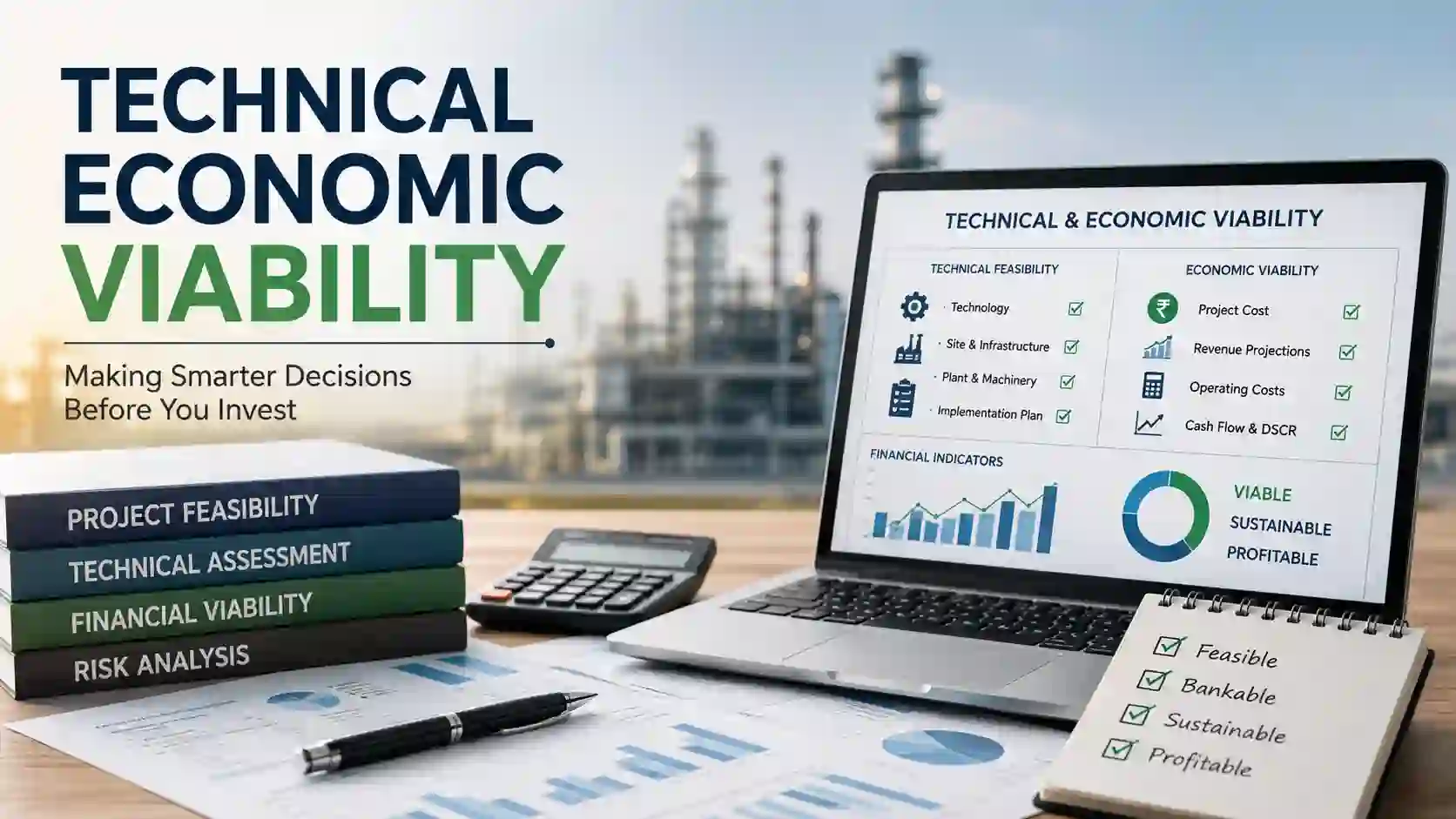
A project can look excellent on paper and still become
difficult once money starts getting spent. This is something promoters usually
realise after taking a few steps too far. The machinery quotation is available,
land has been identified, projected sales look encouraging, and the promoter
has even discussed a loan with the bank. Yet one basic question remains. Does
the project actually make technical and economic sense when all the pieces are
examined together?
That is where technical economic viability becomes
important.
It is not simply another report prepared for a bank file. A
proper technical economic viability assessment brings together the practical
side of the project and the financial side. It looks at whether the proposed
plant, equipment, technology, location, capacity and implementation plan can
work in reality, and then checks whether the resulting project can generate
enough cash to justify the investment and service the proposed debt.
Indian lenders have long placed importance on technical
feasibility, financial viability and bankability while examining project
finance proposals. RBI guidance has specifically recognised the need for credit
appraisal that considers technical feasibility and financial viability, with
risk and sensitivity analysis forming part of project assessment.
That distinction matters because a promoter may be convinced
about a project while a lender remains unconvinced about its repayment
capacity.
What Does Technical Economic Viability Mean for a Project?
Technical economic viability is essentially an assessment of
whether a proposed project is workable from both technical and economic
perspectives.
The technical side asks practical questions. Can the
selected technology deliver the proposed output? Is the plant size reasonable?
Is the machinery suitable? Does the site support the intended activity? Are
utilities such as power and water available? Is the proposed implementation
schedule realistic? What could go wrong during construction or commissioning?
The economic side moves to another set of questions. What
will the project cost? How much revenue can reasonably be generated? What are
the operating expenses? How much debt is required? Can the project service
interest and principal? Does the expected return justify the capital invested?
The two cannot really be separated.
Consider a manufacturing company planning a new production
line. The promoter may have strong market demand and existing customers. But
suppose the selected machinery requires more power than the site can reliably
supply, or imported components have a long lead time. The project may be
financially attractive in the spreadsheet but technically weak in execution.
The reverse can happen too. A technically sound plant may be
capable of producing the product efficiently, but if the selling price
assumptions are too optimistic or working capital requirements have been
underestimated, the project may not generate enough cash.
This is why a serious technical economic viability
assessment is more useful than simply checking whether a DPR has been prepared.
A government appraisal process can also involve
multidisciplinary scrutiny of project proposals. For example, the Central Water
Commission describes techno economic appraisal as a multidisciplinary exercise
and examines projects at both preliminary and DPR stages before viability is
established.
The exact process differs by sector, project size and
lender, but the underlying principle remains similar.
A project has to work in the real world first. Then the
numbers have to support that reality.
Why Technical Economic Viability Matters Before Project Investment
Promoters often approach this exercise after major decisions
have already been made. Land has been purchased. Machinery has been ordered.
Advance payments have been released. Then the bank raises questions around
cost, capacity, debt servicing or promoter contribution.
It would have been much easier to address those questions
before committing money.
A technical economic viability study helps identify
weaknesses while the project can still be changed.
Take a proposed hospital project. The promoter may estimate
occupancy based on the catchment population and nearby residential development.
But the feasibility assessment may show that the project is too large for the
initial phase, that staffing costs have been understated, or that medical
equipment expenditure has been calculated only on purchase price without
considering installation and related infrastructure.
Similarly, in a solar project, the technical assessment may
examine site conditions, generation assumptions, evacuation arrangements,
equipment specifications and implementation requirements. The economic
assessment then considers project cost, tariffs or contracted revenue,
operating expenses, financing structure and debt servicing.
A lender is not merely asking, “Is this a good idea?”
The lender is asking something more uncomfortable.
“What happens to the loan if revenue is lower than
projected, costs rise, commissioning is delayed, or interest rates move?”
That is why sensitivity analysis matters. RBI material
relating to infrastructure lending has specifically referred to lender
appraisal expertise in technical feasibility, financial viability and
bankability, including risk analysis and sensitivity analysis.
I have seen promoters become frustrated at this stage
because they feel the bank is asking the same question repeatedly in different
forms. Usually the issue is not the number of questions. It is that the
underlying assumptions have not been connected properly.
One small personal observation here. Some of the strongest
project discussions happen around a table covered with old printouts, revised
quotations and handwritten notes. The spreadsheets are useful, but the
difficult questions often appear elsewhere.
How Technical Feasibility Is Examined During the Assessment
Technical feasibility is not about proving that machinery
exists in the market. It is about establishing whether the proposed setup makes
practical sense for the particular project.
A technical review may look at the production process, plant
capacity, machinery, layout, utilities, raw material requirements, manpower,
location, infrastructure, implementation schedule and operating assumptions.
For a manufacturing expansion, capacity deserves particular
attention.
Suppose an MSME currently produces 5,000 units a month and
proposes capacity of 20,000 units after expansion. The technical assessment
should not simply accept the 20,000 unit figure from the promoter's projection.
It should examine the machinery capacity, production cycle, shift pattern,
downtime, manpower, power consumption and bottlenecks.
A machine rated for a certain output does not automatically
mean the factory will achieve that output.
This sounds obvious, yet it becomes a problem surprisingly
often.
The assessment may also examine whether the promoter has
chosen the right technology for the intended scale. Overly sophisticated
machinery can create unnecessary capital expenditure and maintenance
complexity. Outdated machinery may reduce efficiency and affect product
quality.
For industrial projects, utilities can become a hidden
issue. Power availability, transformer capacity, water supply, fuel
arrangements, waste treatment and logistics can influence the actual operating
capability of the plant.
Location is another area that deserves more attention than
it usually receives. A factory located far from raw material suppliers may face
higher freight costs. A warehouse in a technically suitable location may still
be commercially weak if access roads, labour availability or customer
connectivity are poor.
For infrastructure projects, the review may go much deeper
into construction assumptions, contracts, site conditions, approvals, technical
standards and implementation milestones.
For a solar project, technical assessment could include the
proposed capacity, technology, site conditions, expected generation,
degradation assumptions, grid connectivity and evacuation arrangements.
For a hospital, the examination can involve bed capacity,
clinical departments, equipment plans, staffing and phased implementation.
This is where a Detailed Project Report and a technical
economic viability assessment can complement each other. A DPR describes the
proposed project in detail. The viability assessment asks whether those
proposals hold together from a technical and financial standpoint.
The distinction is subtle but important.
Economic Viability and the Financial Questions Behind a Project
Economic viability is where the project gets tested against
money.
A project may have an excellent product, a good location and
competent management. But the numbers still have to answer some hard questions.
What is the total project cost?
How much will the promoter contribute?
How much borrowing is required?
What revenue can reasonably be expected?
What will raw materials, salaries, power, maintenance,
administration and other costs look like?
How much working capital will be needed?
When does the project start generating cash?
Can the cash generated by operations meet debt servicing
obligations?
These are not merely accounting questions.
Suppose an industrial borrower plans an expansion with a
total cost of ₹40 crore. The promoter expects 25 percent equity and the balance
through debt. On the surface, the structure may seem reasonable. But if the
expansion takes nine months longer than expected, interest during construction
increases and commercial operations start later. At the same time, the promoter
may need additional working capital once production begins.
The original funding requirement could therefore be
materially higher.
This is why financial modelling under technical economicviability should reflect the actual project sequence rather than simply
applying annual growth percentages to revenue.
Debt servicing is particularly important.
Banks examine metrics such as the Debt Service Coverage
Ratio, or DSCR, because it provides an indication of whether the project's cash
flows are sufficient to service debt. Interest coverage, project IRR, return on
investment, break even and cash flow patterns may also be considered depending
on the project and lender.
Government project appraisal frameworks also use financial
parameters such as IRR and DSCR in assessing economic viability.
Still, I would caution against treating any single ratio as
a magic number.
This doesn't apply everywhere.
A project with a lower early year DSCR may still be workable
if the revenue ramp up is structurally delayed and the overall repayment
profile is appropriate. On the other hand, a project showing attractive ratios
on paper may still be risky if the assumptions are weak.
Many business owners believe a DPR is enough for getting a
loan. In reality, that rarely happens. The lender has to be satisfied that the
underlying assumptions, funding structure, repayment ability and project risks
are credible.
Key Factors That Can Make or Break Technical Economic Viability
Some issues appear repeatedly across sectors.
Project cost that is too optimistic
Underestimating civil work, machinery installation,
electrical systems, contingencies, pre operative expenses or interest during
construction can create a funding gap.
A warehouse expansion, for example, may begin with a
construction quotation but later require additional expenditure for fire safety
systems, electrical work, internal roads or utility upgrades.
Revenue assumptions based on hope
Projected sales should be tied to realistic market
conditions, customer arrangements, capacity and pricing.
A manufacturer saying that demand is very strong is not the
same thing as demonstrating how the proposed additional output will be sold.
Working capital ignored during project planning
This is one of the more common problems in MSME projects.
A promoter may arrange term finance for machinery but
underestimate stock, receivables and operating cash requirements. The plant
gets commissioned, but cash gets trapped in the operating cycle.
Implementation delays
Every month of delay can affect interest during
construction, revenue commencement and debt repayment.
Sometimes perfectly good projects get delayed because
documentation was prepared in the wrong sequence. It still surprises me.
Promoter contribution and funding structure
The promoter's ability to bring in the required contribution
matters. So does the source of that contribution.
A project should not be presented as fully funded when the
equity component itself depends on another uncertain borrowing arrangement.
Technology and operational capability
A technically unsuitable process or an unrealistic
production ramp up can damage viability even where demand exists.
Market and concentration risks
A project dependent on one major customer, one supplier or
one narrow product category needs closer examination.
Sensitivity to adverse conditions
A sound assessment should ask what happens if sales fall,
costs rise, project implementation is delayed or interest rates change.
That is closer to how lenders think about risk.
How Banks and Lenders Use Technical Economic Viability in Credit Appraisal
A lender rarely looks at a project only from the promoter's
point of view. The promoter is naturally focused on what the project can
become. The bank is equally concerned with what could prevent the loan from
being repaid.
This is where technical economic viability becomes useful
during credit appraisal.
When a bank examines a new project, expansion, modernisation
proposal or infrastructure facility, it needs confidence that the underlying
project assumptions are realistic. The technical side helps the lender
understand whether the proposed plant, machinery, process, site, capacity and
implementation schedule make sense. The economic side then examines whether
those assets can generate sufficient operating cash flow.
Take a manufacturing company seeking a ₹25 crore expansion
loan. The promoter may submit machinery quotations, projected sales and a
proposed repayment schedule. A lender will still want to know whether the
machinery can actually deliver the proposed capacity, whether the production
ramp up is realistic and whether there is enough market demand to absorb the
additional output.
The financial projections are then looked at in that
context.
If sales are projected to rise by 40 percent, the question
is not simply whether the spreadsheet produces a healthy profit. It is whether
the factory has the capacity, customers, working capital and operational
capability to support that growth.
This is one reason banks often ask detailed questions around
project cost.
A project may have been estimated at ₹50 crore initially,
but the lender may find that certain civil works, electrical systems,
installation expenses, interest during construction or contingency provisions
have not been adequately considered. The apparent debt requirement then
changes.
The same applies to repayment capacity.
A technically sound project can still become a weak credit
proposal if the debt is too high compared with expected cash flows. That is why
lenders examine projected cash flow, DSCR, interest coverage, break even levels
and debt servicing under different conditions.
RBI guidance for project finance has repeatedly emphasised
technical feasibility, financial viability, risk assessment and sensitivity
analysis as important parts of project appraisal.
The lender is effectively asking a few uncomfortable
questions.
What happens if commissioning is delayed?
What happens if raw material costs rise?
What happens if the selling price is lower than projected?
What happens if capacity utilisation takes longer to build?
These questions do not necessarily mean the lender considers
the project bad. They are part of understanding repayment risk.
For an MSME seeking working capital, the assessment may
focus more closely on the operating cycle. A business can show profits in its
accounts and still face pressure because receivables take 90 days while
suppliers demand payment within 30 days.
That gap has to be financed somehow.
For a solar project, technical economic viability may
involve examination of generation assumptions, project cost, tariff or
contracted revenue, operating expenses and debt repayment. For a hospital, the
lender may pay attention to the phased increase in occupancy and revenue rather
than assuming full utilisation from the first year.
Credit appraisal therefore becomes much stronger when the
technical and economic sides tell the same story.
Common Mistakes That Weaken a Technical Economic Viability Assessment
Most weak assessments do not fail because somebody cannot
calculate a ratio. They usually become weak because the assumptions are
disconnected from what is actually happening in the business.
One common mistake is starting with the desired loan amount
and building the project around it.
A promoter may think, “I need ₹30 crore from the bank,” and
then the project cost, equity contribution and financial projections get
adjusted to make that amount appear reasonable.
The better approach is to determine the genuine project
requirement first.
Another common problem is excessive optimism about revenue.
A new manufacturing unit may assume that it will operate at
80 or 90 percent capacity almost immediately. In reality, customer acquisition,
production stabilisation, quality approvals and working capital constraints may
make the initial months much slower.
The same issue comes up in healthcare.
A hospital may have an excellent location and modern
equipment, but patient volumes often take time to build. Assuming mature
occupancy in the opening year can make the financial projections look much
stronger than they really are.
Underestimating working capital is another serious weakness.
Suppose a food processing company expands capacity and
invests heavily in machinery. The promoter has arranged term finance but has
not adequately accounted for inventory holding and dealer credit. Production
rises, but cash remains locked in stock and receivables.
The machinery is not the problem.
The funding structure is.
Technical assumptions can also be poorly supported. A
machine supplier may quote a rated capacity, but actual output can depend on
raw material quality, operating shifts, maintenance downtime, labour skills and
product mix.
A project report that simply copies catalogue specifications
does not tell the lender much about real operating capability.
There can also be mistakes in project implementation
schedules. Civil construction, equipment delivery, installation, testing,
utility connection and statutory approvals may each take time. Compressing all
of them into an unrealistically short schedule creates an understated interest
burden and an unrealistic commercial operation date.
Documentation is another area where otherwise viable
projects become unnecessarily difficult.
Land records, quotations, approvals, promoter contribution
details, existing borrowing information, projected financial statements and
supporting agreements need to be consistent. Contradictions between the DPR and
financial projections raise questions during appraisal.
Sometimes the issue is not even the project itself.
The information has simply been presented in the wrong
sequence.
I have seen promoters become frustrated when a lender keeps
asking for clarification on figures that appeared to be perfectly clear to
them. Usually, there is a mismatch somewhere between the operating assumptions
and the financial model.
One more misconception deserves to be challenged. Some
businesses assume that a higher projected profit automatically makes a project
more bankable.
It does not.
A lender is concerned with cash generation and repayment
capacity, not just accounting profit. A company can report healthy margins and
still have inadequate cash flow because money is tied up in receivables,
inventory or other commitments.
That distinction becomes especially important in project
finance.
Technical Economic Viability for Manufacturing, Infrastructure, Solar and
Healthcare Projects
The application of technical economic viability changes
considerably from one sector to another.
Manufacturing projects
In manufacturing, the assessment usually has to connect
capacity with actual production economics.
The review may cover process technology, machinery, plant
layout, utilities, raw material availability, production volumes, manpower,
maintenance and implementation.
Suppose an engineering company plans to double production.
The project should not be assessed only on the basis of the proposed machinery.
Existing bottlenecks need to be understood too.
Additional machines may increase machining capacity, but if
finishing, inspection or dispatch remains constrained, the claimed increase in
output may not be achievable.
The financial model has to reflect the actual operating
setup.
Infrastructure projects
Infrastructure projects often involve higher capital
expenditure, longer implementation periods and greater exposure to execution
risk.
The assessment may need to consider construction contracts,
site conditions, project approvals, implementation schedules, escalation
assumptions, concession arrangements, traffic or usage assumptions and funding
requirements.
A road, logistics, industrial park or infrastructure
facility may be technically feasible but financially stressed if execution
delays push commercial operations far beyond the original schedule.
For these projects, the timing of cash flow can be nearly as
important as the total amount of projected cash flow.
Solar projects
Solar projects require careful attention to both technical
and commercial assumptions.
Generation estimates, site characteristics, technology
selection, degradation, evacuation arrangements, equipment cost, operations and
maintenance expenses and revenue arrangements all feed into project economics.
A small change in the generation assumption can affect the
projected revenue and debt servicing position. That is why lenders normally
want technical assumptions to be supported rather than merely stated.
Healthcare projects
Healthcare projects present a different challenge.
A hospital may have excellent medical infrastructure and
experienced professionals, but financial viability depends heavily on patient
volumes, case mix, tariffs, staffing costs and the time required to establish
the facility.
Equipment expenditure also needs careful treatment. Buying
advanced equipment does not by itself guarantee sufficient utilisation to
justify the investment.
The financial model should therefore reflect a realistic
ramp up.
The same principle can apply to diagnostic centres, nursing
facilities and specialised healthcare units.
Warehousing and real estate projects
In warehousing, industrial sheds and certain real estate
developments, viability can depend heavily on occupancy, rental assumptions,
construction cost and financing structure.
A warehouse expansion may appear attractive because market
rentals are strong. But if land cost has been excessive and debt repayment
starts before expected occupancy, the financial position can become tight.
This is why sector specific assumptions matter.
There is no single technical economic viability format that
works equally well for every project.
How Frontline Consultants Approaches Technical Economic Viability
Assessments
Frontline Consultants approaches these assignments by
looking at the project as a connected proposition rather than treating
technical and financial sections as separate documents.
With more than 30 years of experience in financial and
project advisory work, the firm works across areas such as Techno Economic
Viability Reports, Lenders Independent Engineer Services, Agency for Special
Monitoring, Detailed Project Reports, Enterprise Valuation, Asset Valuation,
Credit Syndication, Debt Restructuring, Bank Liaison, Project Advisory and
Business Financial Consulting.
The starting point is usually understanding what the
promoter is actually proposing.
That sounds obvious, but it matters.
A project that looks like a simple expansion on paper may
actually involve a major change in product mix, technology or market strategy.
A lender needs to understand that before assessing the financial implications.
The technical review then looks at the project
configuration, capacity, machinery, implementation plan, utilities,
infrastructure and other operational requirements relevant to the sector.
The financial side is developed around realistic
assumptions.
Project cost is reviewed against available quotations,
implementation requirements and related expenses. Means of finance are examined
to see whether the proposed promoter contribution and borrowing structure are
practical. Revenue and operating cost assumptions are linked with the technical
capacity rather than developed independently.
Working capital also deserves attention, especially for
manufacturing and trading businesses where the operating cycle can change
significantly after expansion.
Where required, sensitivity analysis can be used to test how
the project behaves under less favourable conditions.
For example, what happens if sales are 10 percent lower?
What happens if project implementation takes another six
months?
What happens if operating costs rise?
The exact scenarios depend on the project.
Frontline Consultants may also be involved after the initial
report stage through lender related technical assignments, monitoring,
valuation or restructuring support. In such cases, the requirement is often
broader than preparing one document.
For an industrial borrower facing financial stress, for
example, a revised business plan needs to be supported by realistic operating
projections and a repayment structure that the business can actually manage.
For a promoter preparing a DPR before approaching a bank,
early review can identify weaknesses before those weaknesses become lender
objections.
The important point is that technical economic viability
should not be treated as a certificate saying that a project is good.
A useful report should help answer where the project stands,
which assumptions support it, which risks require attention and what changes
may be needed before financial closure.
Frequently Asked Questions About Technical Economic Viability
What does technical economic viability assess?
It assesses whether a proposed project is technically
workable and economically sustainable. The review generally connects project
configuration, cost, operations, revenues, financing and repayment capacity.
Why do banks consider technical economic viability?
Banks need confidence that the proposed project can be
implemented as planned and generate enough cash to meet its financial
obligations. Technical economic viability helps connect project assumptions
with credit risk.
Is a technical economic viability report necessary for
every loan?
Not necessarily. The requirement depends on the lender, loan
structure, sector, project size and nature of financing. Larger project finance
proposals usually involve deeper technical and financial appraisal.
Can technical economic viability be assessed for an
existing business?
Yes. It can be relevant for expansion, modernisation,
diversification, restructuring, rehabilitation and other situations where
future investment or revised financing needs to be assessed.
What information is normally required?
Depending on the project, information can include project
details, land and site information, machinery quotations, implementation
schedules, existing financial statements, projected sales, operating costs,
funding requirements, promoter contribution and details of existing debt.
How is technical economic viability different from
valuation?
Valuation attempts to determine the value of a business,
asset or enterprise using appropriate valuation approaches. Technical economic
viability focuses on whether a project or proposed investment is technically
workable and financially sustainable.
Does a favourable report guarantee bank finance?
No. Credit decisions remain with the lender and depend on
several factors, including promoter profile, banking track record, security,
financial strength, project risk and internal credit policy.
When should a promoter commission the assessment?
It is generally more useful to undertake the assessment
before major project commitments are made and before the funding proposal is
finalised. This gives the promoter greater scope to address weak assumptions.
Can a viability assessment help during debt
restructuring?
Yes. For a stressed industrial borrower, the exercise can
help evaluate revised operating projections, cash generation, repayment
capacity and the practicality of a proposed restructuring plan.