
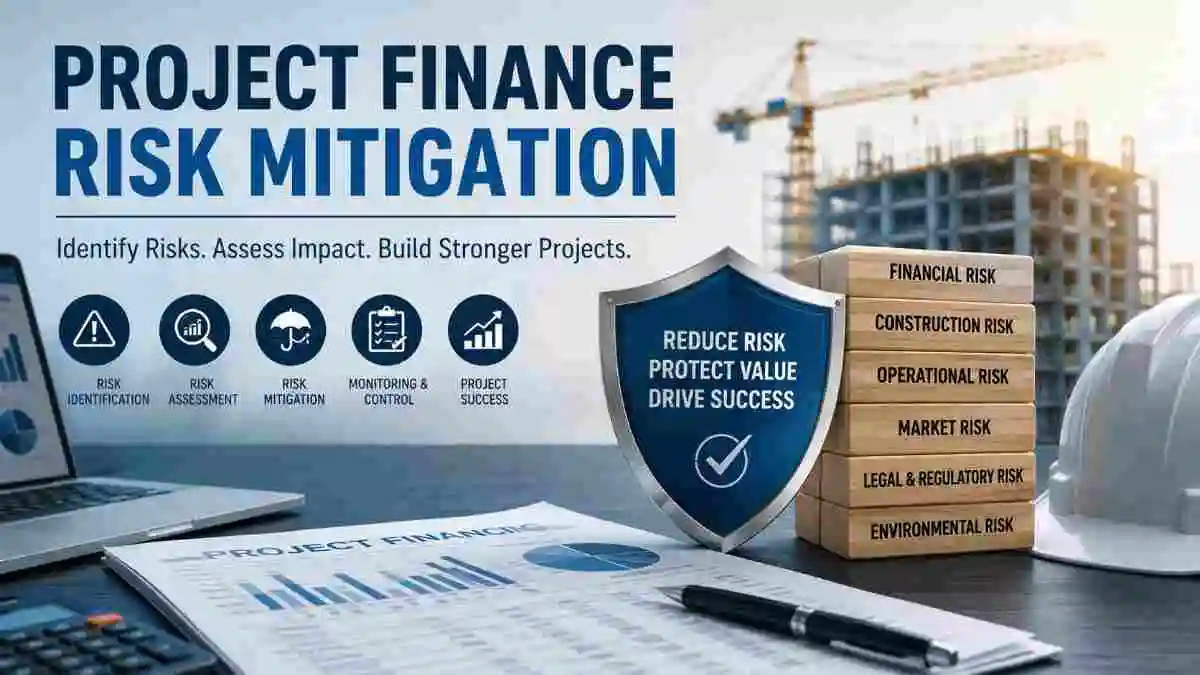
Understanding Project Finance Risk Mitigation and Its Importance
Project finance involves much more than arranging a loan for
a new project. A lender is putting money into an activity that may take months
or years before it generates stable cash flows. During that period, several
things can go wrong. Construction costs may increase, approvals may take longer
than expected, demand may not develop as projected, or the promoter may face a
shortage of working capital.
This is where project finance risk mitigation becomes
important. It is the process of identifying possible risks before financial
closure and putting practical measures in place to reduce their effect on the
project and its lenders.
For example, consider a manufacturing company planning a new
production unit. The promoter may have land, machinery quotations and a strong
order pipeline. On paper, the proposal can look attractive. But a bank will
also want to know what happens if machinery delivery is delayed by six months,
project cost increases by 10 percent, or customer payments take longer than
expected.
Project finance risk mitigation brings these questions into
the financial assessment itself. It connects the technical, commercial and
financial sides of the project rather than looking at the loan requirement in
isolation.
I have seen situations where a promoter has spent
considerable time preparing a business proposal but has not examined the risks
from a lender's point of view. The project may still be viable, but the
financing structure becomes difficult to defend. Sometimes perfectly good
projects get delayed because documentation was prepared in the wrong sequence.
It still surprises me.
A sensible risk mitigation exercise does not mean trying to
remove every possible risk. That is neither realistic nor necessary. The
objective is to identify material risks, understand their financial
consequences and establish enough safeguards for the project to remain workable
under reasonable stress conditions.
This matters particularly in infrastructure, renewable
energy, manufacturing, healthcare, warehousing and other capital intensive
sectors. A solar project, for instance, depends on construction schedules,
equipment availability, power generation assumptions, evacuation arrangements
and payment arrangements. A hospital project has a different risk profile
because occupancy, pricing, operating expenses, staffing and ramp up periods
become important.
Project finance risk mitigation therefore starts much before
a bank sanction. It begins when the project assumptions are being developed.
Identifying Major Risks in Project Finance
Every project has risks, but they are not all of the same
nature. One of the first tasks in project finance risk mitigation is to
separate these risks and understand which ones can materially affect repayment.
A manufacturing expansion may face construction risk,
technology risk, raw material price risk, market risk and working capital
pressure. An infrastructure project may be more exposed to land acquisition,
statutory approvals, contractor performance and traffic or revenue assumptions.
A hospital may have a different challenge altogether, particularly during the
initial operating period when occupancy is still building.
The first broad category is project development risk. This
includes land availability, statutory approvals, environmental permissions,
utility connections and other conditions required before construction can
proceed. If these matters are not clear, lenders may hesitate to commit funds
even when the underlying business idea is sound.
Construction risk is another major concern. A project that
is delayed by six months does not simply lose six months of time. Interest
during construction can increase, commercial operations may be postponed and
the promoter may have to support additional expenses.
Then comes cost risk. Machinery quotations may change, civil
construction costs may rise and certain expenses may not have been included
properly in the original project cost. This is why lenders examine the project
cost estimate carefully instead of relying only on the promoter's calculation.
Market risk also requires serious attention. A project may
have a technically sound design but still struggle if the expected demand does
not materialise. A new warehouse, for example, may be based on an assumed
occupancy level that looks reasonable during preparation. If actual leasing
takes longer, the cash flow available for debt repayment can be affected.
Operational risk begins once the project starts functioning.
Production losses, maintenance problems, shortage of skilled employees,
inefficient processes or higher operating expenses can reduce the expected cash
surplus.
There are also financial risks. Interest rates may change,
receivables may stretch and working capital requirements may become higher than
initially estimated. An MSME that receives a term loan for expansion can still
face stress if the additional working capital requirement has not been properly
assessed.
Regulatory and legal risks should not be treated as
paperwork issues. A missing approval or unresolved legal matter can delay
disbursement or project implementation.
The important point is that these risks are interconnected.
A construction delay can create additional interest costs. Additional interest
can affect cash flow. Weak cash flow can reduce debt service coverage. Lower
debt service coverage can then create concerns during lender appraisal.
That is why project finance risk mitigation needs to
consider the complete chain rather than treating each risk as a separate
checklist item.
Financial Risks and Cash Flow Management in Project Funding
For lenders, repayment capacity ultimately comes back to
cash flow. A project may have valuable assets and a capable promoter, but if
the operating cash flow is insufficient to service debt, the financing
structure needs another look.
Financial risk assessment therefore forms a major part of
project finance risk mitigation.
One common mistake is to prepare revenue projections that
are optimistic while keeping expenses relatively conservative. A promoter may
assume full production capacity from the first year, immediate customer
payments and stable raw material prices. Actual projects rarely behave so
neatly.
Take a manufacturing company expanding from one production
line to three. The promoter may expect the new capacity to generate revenue
quickly. But the first year could involve lower utilisation, additional
manpower costs, marketing expenses and higher inventory requirements. If these
factors are missing from the financial model, the projected cash flow can look
stronger than what the project is likely to generate.
Banks usually examine indicators such as DSCR, IRR and NPV
along with projected cash flows, debt repayment schedules and working capital
requirements.
DSCR indicates the ability of the project to meet its debt
servicing obligations from available cash flow. It is particularly important
because a project can report accounting profits while still facing cash
shortages.
IRR helps assess the expected return from the investment,
while NPV considers the present value of future cash flows against the
investment involved. These indicators do not replace professional judgement.
They support it.
Working capital assessment is equally important. A business
may need to maintain inventory before selling its products and may have to wait
several weeks or months for customer payments. The gap between paying suppliers
and collecting receivables creates a funding requirement.
I have seen promoters focus heavily on term loan
requirements while giving less attention to working capital. That can create
problems after commercial operations begin. The machinery may be installed, but
the company still struggles to purchase raw materials or manage receivables.
Good project finance risk mitigation therefore considers
both long term and short term funding needs.
Sensitivity analysis is another practical tool. Instead of
asking only whether the project works under the base case, the financial model
can examine what happens when sales are lower, costs are higher, project
implementation is delayed or interest rates increase.
This does not mean that every possible negative scenario
needs to be modelled. The exercise should focus on realistic risks that could
materially change repayment capacity.
Promoter contribution also matters. A reasonable promoter
contribution gives lenders greater comfort that the sponsor has meaningful
financial exposure to the project. However, the promoter's contribution should
be assessed alongside liquidity. Putting every available rupee into fixed
assets and leaving no working capital cushion can create a different problem.
In practice, good project finance risk mitigation is often
about getting the financing structure right rather than simply reducing the
loan amount.
Construction, Cost Overrun and Project Completion Risks
Construction risk is one of the most visible risks in
project finance because lenders are funding an asset that may not yet exist.
A warehouse expansion provides a simple example. The
promoter may have completed the design and obtained initial approvals, but
civil work, electrical installation, fire safety requirements and equipment
installation can still take longer than planned. Every month of delay can
affect the project's financial position.
Cost overruns are closely connected with construction
delays. Cement, steel, equipment, labour and transportation costs can change
between the preparation of the project report and actual procurement. Imported
machinery can introduce another layer of uncertainty through exchange rate
movements and shipping delays.
Project finance risk mitigation begins with realistic
project costing. Machinery quotations should be current where possible. Civil
construction estimates should reflect the actual location and specifications.
Contingency provisions should be reasonable rather than inserted merely to make
the project look comfortable.
Contractor selection also matters. A low quotation is not
necessarily the safest option if the contractor lacks the capacity to complete
the work. Lenders may examine contractor experience, execution capability and
the proposed construction schedule as part of their appraisal.
The promoter also needs to understand the difference between
an estimated project cost and the final amount required to make the project
operational.
Suppose a project report estimates machinery at Rs. 8 crore
and civil work at Rs. 4 crore. If installation, electrical work, testing,
preoperative expenses and other necessary components are not properly
considered, the actual requirement can be higher. The promoter then approaches
the bank for additional funding after the project has already started. That is
usually a difficult stage to renegotiate.
A properly prepared Detailed Project Report can help
identify these requirements before financial closure. For larger or technically
complex projects, a Techno Economic Viability assessment can provide an
independent view of technical feasibility, market assumptions, project cost and
financial viability.
The role of the Lenders Independent Engineer becomes
particularly relevant in larger projects. The LIE can assess physical progress,
technical implementation and whether project execution is broadly aligned with
the approved plan.
This kind of monitoring is not merely a lender formality. It
can identify delays early enough for corrective action.
There should also be clarity around contingency funding. If
the project faces a moderate cost increase, the promoter and lender should know
where the additional funds will come from. Depending on the structure, this may
involve additional promoter contribution, available contingency, internal
accruals or other approved funding arrangements.
A common misconception is that sanctioning a project loan
means the lender has accepted all project risks. That is not how project
finance works. The lender is assessing whether the risks have been understood
and whether sufficient safeguards exist.
This doesn't apply everywhere, because every lender and
every project has its own appraisal approach. But the underlying principle
remains useful.
Market, Revenue and Operational Risks in Project Finance
A project cannot repay debt simply because the asset has
been constructed. It needs to generate adequate operating cash flow.
Market and revenue risks therefore deserve the same
attention as construction risks in project finance risk mitigation.
Consider a new hospital being developed in a growing city.
The promoter may have a strong medical team, a suitable location and modern
equipment. Yet the financial model may assume that the hospital will reach a
high occupancy level quickly. In reality, patient acquisition can take time.
Doctors may need to build their practice, referral networks may develop
gradually and operating expenses may be high during the initial period.
The financial model should reflect this ramp up rather than
assuming immediate maturity.
The same applies to manufacturing. A new plant may have
installed capacity of 50,000 units per month, but producing at full capacity
does not mean selling at full capacity. Customer approvals, market acceptance,
pricing pressure and competition all influence actual utilisation.
Revenue assumptions should therefore be supported by
something more concrete than general statements about market demand. Existing
purchase orders, customer discussions, historical sales, industry conditions
and promoter experience can provide useful support depending on the project.
For infrastructure projects, revenue assumptions can be even
more sensitive. Traffic volumes, user charges, contracted revenues or
availability payments may form the basis of the financial model. Any weakness
in these assumptions can materially affect debt repayment.
Operational risks emerge once the project starts. A plant
may face lower production efficiency, equipment breakdowns, higher maintenance
expenses or shortages of skilled operators. A solar project may face generation
issues, equipment performance concerns or delays connected with evacuation
arrangements.
Risk mitigation measures need to match the actual project.
Maintenance contracts, insurance, experienced operating personnel, technology
support and appropriate supplier arrangements can all have a role.
Another area that is sometimes overlooked is concentration
risk. If a manufacturing unit depends heavily on one customer, the loss or
delay of that customer can affect cash flows sharply. Similarly, depending on a
single supplier for a critical raw material can create operational
vulnerability.
There is no universal formula for dealing with these issues.
The promoter's experience, industry structure, location, technology and
customer base all matter.
What matters from a lender's perspective is whether the
project team has thought through these risks before asking the bank to finance
the project.
This is where project finance risk mitigation becomes more
than a financial exercise. It connects the assumptions in the project report
with what is actually likely to happen on the ground.
Frontline Consultants approaches such assignments by looking
at the project from both the business and lender perspective. Its work across
areas such as Techno Economic Viability Reports, Detailed Project Reports,
Lenders Independent Engineer Services, project advisory and business financial
consulting can help promoters identify gaps before these become lender
objections.
A promoter preparing a DPR for a new industrial unit, for
example, may initially focus on project cost and expected turnover. During a
deeper assessment, questions around working capital, implementation timelines,
market absorption and debt servicing may become equally important. Addressing
these matters early usually makes the financing discussion more practical.
One personal observation may sound insignificant, but
project meetings often reveal more than spreadsheets do. A five minute
discussion about how a company actually buys raw material can sometimes explain
a cash flow problem that several pages of projections failed to show.
Project finance risk mitigation works best when those
practical realities are brought into the financial assessment before the lender
has to point them out.
Regulatory, Legal and Environmental Risks Affecting Project Funding
Regulatory and legal risks can affect a project long before
the first instalment of a loan is disbursed. In many cases, the issue is not
that a project is commercially weak. The problem is that a critical approval,
land document, licence or statutory permission is still unclear.
This is particularly relevant for manufacturing units,
infrastructure projects, hospitals, solar projects and large warehouses. Each
sector has its own regulatory requirements, and lenders want to understand
whether the project can legally and practically reach commercial operations.
Land ownership and land use are among the first areas that
require attention. A promoter may have acquired land for a proposed industrial
project, but the lender may still need clarity regarding title, permissible
land use, encumbrances and applicable approvals. If these matters are
unresolved, the financing process can slow down considerably.
Environmental requirements can also influence project
timelines. Depending on the nature and scale of the project, environmental
clearances, consent requirements, pollution control approvals and other
permissions may be relevant. A project that ignores these requirements at the
planning stage can face delays after financial closure.
For example, a manufacturing company may prepare its entire
project cost and financing structure but discover later that an important
consent is required before construction or commercial production. The resulting
delay can increase interest during construction and disturb the original
repayment schedule.
Solar and infrastructure projects can have their own
regulatory concerns. Land arrangements, grid connectivity, evacuation
infrastructure, permits and contractual approvals may all affect
implementation. A lender is naturally cautious if the project depends on an
approval that has not yet been obtained or if the responsibility for obtaining
it is unclear.
Legal agreements also deserve attention. EPC contracts,
power purchase agreements, lease agreements, supply arrangements, off take
contracts and other commercial documents can affect the risk profile of the
project.
Project finance risk mitigation therefore involves checking
not only whether documents exist, but whether they support the assumptions made
in the financial model.
I might be wrong here, but in many projects the promoters
usually do not underestimate the importance of the business opportunity. They
underestimate how long certain approvals can take.
That distinction matters. A two month delay may not sound
serious when a project is being discussed, but when a large debt facility is
involved, the financial effect can be meaningful.
Insurance, statutory compliance and contractual protections
can also form part of the risk mitigation framework. The objective is not to
create unnecessary paperwork. It is to make sure that major legal and
regulatory risks are identified before they become financial problems.
Role of DPR, TEV Reports and Lenders Independent Engineer in Risk
Assessment
A Detailed Project Report, or DPR, is often the document
that brings the technical, commercial and financial aspects of a project
together. It generally explains the project concept, promoter background,
proposed investment, technology, production capacity, market, implementation
plan and financial projections.
For a promoter approaching a bank for project finance, the
DPR provides a structured basis for discussion. But preparing a DPR does not
automatically make a project financeable.
Many business owners believe preparing a DPR is enough for
getting a loan. In reality, that rarely happens.
The lender will examine whether the assumptions in the DPR
are reasonable and whether the project can generate sufficient cash flow to
service the proposed debt.
A Techno Economic Viability Report goes a step deeper in
assessing whether the proposed project makes technical and economic sense. The
assessment can cover project cost, technology, capacity, market conditions,
operating assumptions, implementation schedule and financial viability.
For instance, suppose an industrial borrower proposes a new
plant with a particular production capacity. The TEV assessment may examine
whether the selected technology is appropriate, whether the proposed capacity
is commercially justified and whether the projected revenue is realistic.
The Lenders Independent Engineer has a somewhat different
role. The LIE provides independent technical assessment and monitoring from the
lender's perspective. This can become particularly important once a project
moves from planning into execution.
A large infrastructure project may have several construction
packages, contractors and milestones. The LIE can assess progress against the
approved plan and identify issues relating to construction, equipment
installation, quality and project completion.
These three areas therefore address different parts of the
lending process.
|
Assessment |
Main purpose |
|
DPR |
Presents the overall project, business plan and financial
structure |
|
TEV Report |
Examines technical and economic viability |
|
LIE Services |
Provides independent technical assessment and project
monitoring |
They also support project finance risk mitigation in
different ways.
A DPR can identify project assumptions. A TEV report can
test those assumptions. LIE monitoring can then examine whether the project is
actually progressing as planned.
This sequence is particularly useful for lenders because
project risk changes as the project moves forward. A project that appears
viable at the planning stage still needs proper monitoring during construction.
Frontline Consultants provides services in these areas,
including Techno Economic Viability Reports, Detailed Project Reports and
Lenders Independent Engineer Services. The value is not simply in preparing a
report. The practical purpose is to identify issues that could affect funding,
implementation or repayment.
How Banks and Lenders Evaluate Project Finance Risk Mitigation
Banks do not evaluate project finance risk mitigation as a
standalone document. They look at how risk is reflected across the entire
proposal.
The credit team may examine the promoter, project cost,
funding structure, market assumptions, technical feasibility, cash flows,
security, repayment capacity and statutory position. Each part contributes to
the overall credit assessment.
Promoter capability is an important consideration. A
technically sound project can still face concerns if the promoter has limited
experience in the relevant industry or does not have adequate financial
capacity to support the project during difficult periods.
Promoter contribution is therefore examined carefully. Banks
want to know how much the promoter is investing and whether the contribution is
genuinely available.
Project cost is another major area. The lender may verify
machinery quotations, civil construction estimates, land costs, preliminary
expenses and other components. If the cost appears understated, the entire
funding structure can become unreliable.
The debt structure is assessed alongside projected cash
flows. This is where DSCR becomes important. If the project is expected to
generate Rs. 5 crore of annual cash available for debt servicing while the
annual debt obligation is very high, the lender will naturally question the
assumptions.
The bank may also examine sensitivity cases. What happens if
revenue falls by 10 percent? What happens if the project is delayed? What
happens if operating costs rise? The answers can indicate how much financial
cushion the project actually has.
Working capital is another common area of concern.
Consider an MSME that is expanding its manufacturing
capacity. The promoter may request Rs. 15 crore as a term loan for machinery
and building expansion. But if the additional production requires Rs. 4 crore
of inventory and receivables funding, ignoring that requirement can create
stress soon after commissioning.
Banks also consider security and collateral depending on the
nature and structure of the facility. However, strong collateral does not
necessarily compensate for a fundamentally weak project cash flow.
This is one area where promoters and lenders sometimes look
at the same proposal differently. A promoter may think, "I have enough
property to secure the loan." A lender may respond, "But how will the
project repay the loan?"
Both questions are relevant, but repayment capacity remains
central to project finance risk mitigation.
Banks also consider documentation quality. Inconsistent
turnover figures, unexplained differences between GST records and financial
statements, unclear promoter contribution or outdated project costs can create
avoidable questions.
Sometimes the problem is not the project. It is the
presentation of the project.
A well prepared financial model and supporting documentation
can make lender appraisal easier because the assumptions can be traced and
challenged properly.
How Frontline Consultants Supports Project Finance Risk Mitigation
Project finance risk mitigation requires an understanding of
both business realities and lender expectations. This is where an experienced
financial and project advisory firm can be useful.
Frontline Consultants has more than 30 years of experience
in financial consulting and project advisory. Its services include Techno
Economic Viability Reports, Lenders Independent Engineer Services, Agency for
Special Monitoring, Detailed Project Reports, Enterprise Valuation, Asset
Valuation, Credit Syndication, Debt Restructuring, Bank Liaison, Project
Advisory and Business Financial Consulting.
The requirement is different for every project.
A manufacturing company seeking expansion finance may need
support in establishing realistic project costs, working capital requirements
and repayment projections. A solar developer may require technical and
financial assessment before approaching lenders. A hospital project may need
careful evaluation of construction costs, equipment, operating expenses and
occupancy assumptions.
The same approach cannot be applied mechanically to all of
them.
Frontline Consultants can assist promoters in examining the
project before it reaches the lender's desk. This can involve reviewing project
assumptions, assessing financial viability, identifying documentation gaps and
understanding where lender concerns are likely to arise.
For larger projects, TEV assessment can provide an
independent examination of technical and economic viability. DPR preparation
can bring the project information into a structured format. LIE services can
support technical monitoring during implementation.
The firm also works in areas such as credit syndication and
bank liaison, where understanding lender expectations becomes particularly
relevant.
Debt restructuring is another situation where risk
assessment takes a different form. An industrial borrower facing repayment
pressure may need to examine why the stress occurred, whether the underlying
business remains viable and what financing structure could realistically
support recovery.
Similarly, enterprise valuation and asset valuation can
become relevant when lenders, investors or promoters need an independent
understanding of business or asset values.
One practical point is worth mentioning. Risk mitigation
should begin before the loan application, not after a lender raises objections.
If a promoter waits until the bank identifies a weakness in
the project cost, working capital calculation or market assumption, valuable
time may already have been lost.
Frontline Consultants' role is therefore not simply to
prepare reports. The broader objective is to help businesses present a project
that can withstand financial, technical and commercial scrutiny.
That does not mean every project will receive funding. No
consultant can responsibly guarantee that. A proper assessment may sometimes
conclude that a project needs restructuring, additional promoter contribution,
revised assumptions or a different financing approach.
That kind of advice can save money too.
Sometimes a promoter needs to hear that the proposed debt is
too high or that the projected revenue is too optimistic. It is not always
pleasant during a meeting, but it is better to identify the problem before the
bank does.
Frequently Asked Questions About Project Finance Risk Mitigation
What is project finance risk mitigation?
Project finance risk mitigation refers to identifying major
technical, financial, commercial, legal, regulatory and operational risks
associated with a project and putting suitable measures in place to reduce
their impact.
The objective is to protect project cash flows, support
timely implementation and improve confidence among lenders and other
stakeholders.
Why is project finance risk mitigation important for bank
funding?
Banks need confidence that the project can be completed and
generate enough cash flow to repay the proposed debt. Risk mitigation helps
lenders understand what could go wrong and whether practical safeguards are
available.
It can also reduce avoidable questions during credit
appraisal.
What are the major risks considered in project finance?
Common risks include project cost overruns, construction
delays, market risk, revenue risk, working capital shortages, operational
problems, regulatory issues, legal disputes, technology risks and changes in
financial assumptions.
The importance of each risk depends on the sector and
project structure.
How does a DPR help with project finance risk mitigation?
A DPR brings together information about the project,
promoter, investment, technology, market, implementation schedule and financial
projections.
It provides a structured basis for assessing whether the
project assumptions are reasonable and whether the proposed funding requirement
is justified.
What is the role of a TEV Report?
A Techno Economic Viability Report examines whether a
proposed project is technically feasible and economically viable. It can help
lenders assess project cost, technology, market assumptions, implementation
plans and financial viability.
Why do lenders require an LIE?
A Lenders Independent Engineer provides independent
technical assessment and monitoring, particularly for larger or technically
complex projects. The LIE can review project progress, construction quality,
equipment installation and completion status.
Can risk mitigation guarantee project loan approval?
No. Project finance risk mitigation can improve the quality
of the proposal and address identifiable weaknesses, but loan approval remains
the lender's decision.
The bank will consider its own credit policy, promoter
profile, project viability, repayment capacity, security and other factors.
When should a promoter start risk assessment?
Ideally, risk assessment should begin while the project is
being planned. Identifying issues before finalising project cost and financing
structure gives the promoter more room to make corrections.
Trying to solve major risks after the loan application has
already reached the bank can be much harder.
How can Frontline Consultants help with project finance
risk mitigation?
Frontline Consultants supports businesses through services
such as DPR preparation, Techno Economic Viability Reports, Lenders Independent
Engineer Services, Agency for Special Monitoring, project advisory, business
financial consulting, credit syndication, bank liaison and debt restructuring.
The exact support depends on the project, sector and
financing requirement.
Is project finance risk mitigation relevant only for
large infrastructure projects?
No. It is equally relevant to manufacturing companies,
MSMEs, hospitals, solar projects, warehouses, educational institutions and
other capital intensive businesses.
Even a relatively small expansion can face cost, working
capital, market and repayment risks if the financing structure is not properly
assessed.