
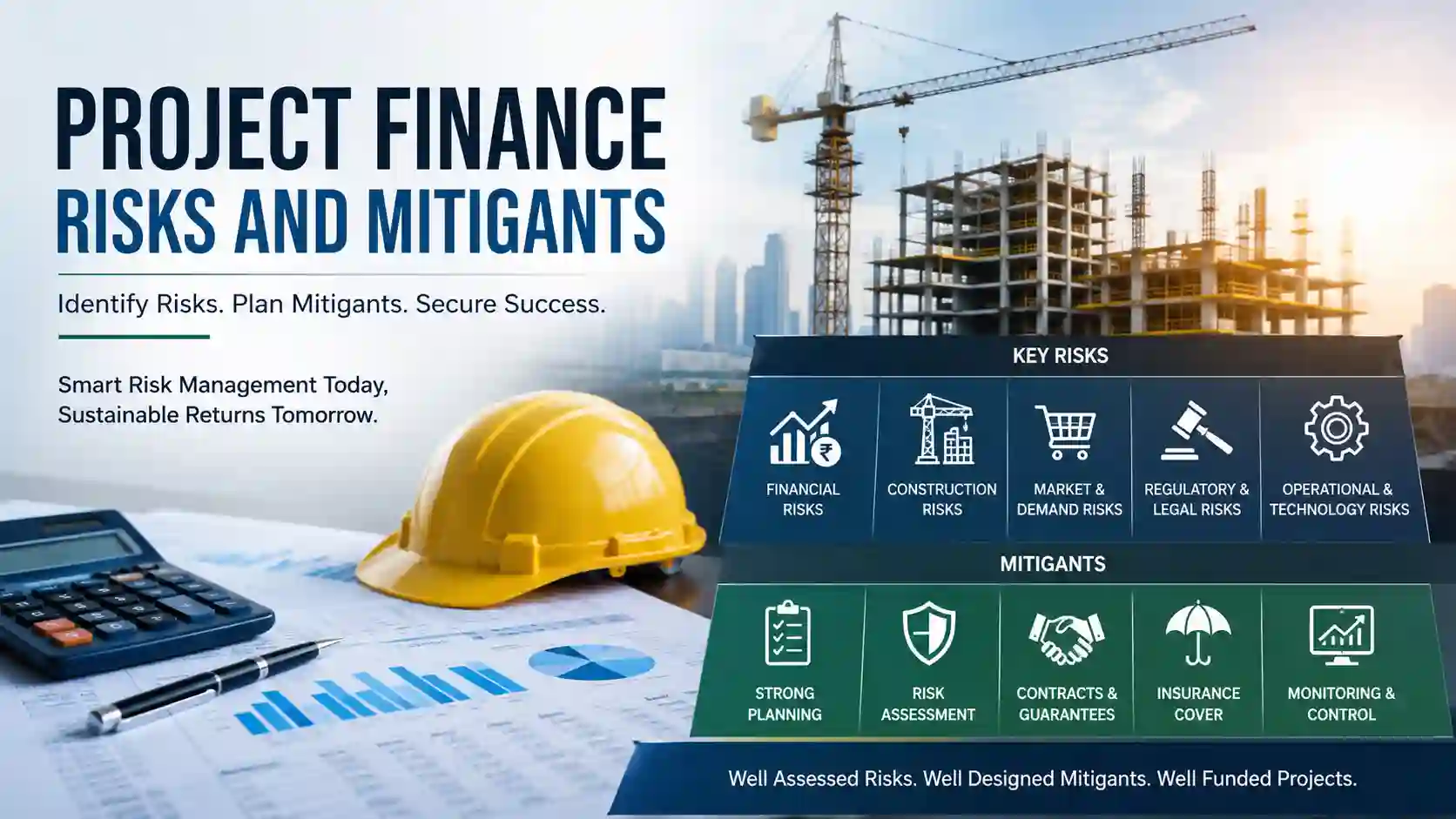
Understanding Project Finance Risks and Mitigants
Project finance is rarely rejected because a project idea is
bad on paper. More often, the concern is whether the project can withstand
delays, cost increases, weaker revenues, regulatory changes, operating problems
and repayment pressure once money has been committed. This is where
understanding project finance risks and mitigants becomes important for both
the borrower and the lender.
In a typical Indian project, lenders are not only looking at
the promoter's experience or the estimated profitability. They want to know
what could go wrong and what has been planned to deal with it. A manufacturing
company seeking finance for a new plant, for example, may have strong orders
from customers. But if land approvals are incomplete, machinery delivery is
uncertain and the promoter has not arranged enough margin money, the lender
will still see considerable risk.
Project finance risks and mitigants therefore need to be
considered from the beginning of project planning rather than after the bank
asks questions.
A proper Detailed Project Report helps bring many of these
issues together. A Techno Economic Viability assessment goes a step further by
examining whether the project makes commercial and financial sense. For
lenders, these documents provide a basis for testing assumptions before taking
a credit decision.
There is no single formula that removes project risk. A risk
may be transferred through a contract, covered through insurance, reduced
through additional equity, controlled through monitoring or accepted because it
is considered manageable. The important point is that the mitigation should
match the actual risk.
I have seen promoters spend considerable time preparing
revenue projections while giving very little attention to what happens if
construction takes six months longer than planned. That is usually when the
lender starts asking uncomfortable questions.
Many business owners also believe that a profitable project
automatically qualifies for funding. It does not. A project may look profitable
in a financial model and still carry unacceptable execution or repayment risk.
Key Financial Risks in Project Finance
Financial risks are at the centre of most lender discussions
because project debt is ultimately expected to be repaid from project cash
flows. The lender therefore studies how much money is required, how much the
promoter is contributing, when the project will start generating cash and
whether that cash will be sufficient for debt servicing.
One common concern is cost escalation. A project initially
estimated at Rs 100 crore may eventually require Rs 115 crore because of higher
equipment costs, changes in civil work or delays. If the promoter has no
additional funding capacity, the project can face a liquidity problem even
before commercial operations begin.
Interest rate risk is another consideration, particularly
for projects with long repayment periods. A rise in borrowing costs can reduce
cash available for repayment. This becomes more serious when the original
financial model assumes a relatively narrow interest margin.
Foreign currency exposure can also matter when machinery is
imported or project debt is denominated in another currency. Exchange rate
movements can increase the rupee cost of equipment or debt servicing.
Then there is working capital risk. A manufacturing unit may
have enough funds to construct its plant but insufficient cash to purchase raw
materials, maintain inventory and provide credit to customers after
commissioning. This gap can affect operations and eventually weaken debt
servicing.
Debt service coverage is therefore closely examined. DSCR
indicates whether the project's available cash flow provides enough coverage
for scheduled debt obligations. A strong DSCR does not remove every risk, but a
weak DSCR can quickly raise questions about repayment capacity.
The mitigation may involve a suitable debt structure,
adequate promoter contribution, realistic working capital assessment,
contingency provisions and repayment schedules that match the project's actual
cash generation pattern.
For example, a hospital project normally requires time to
build occupancy and establish patient volumes. Expecting the same repayment
profile as an established manufacturing company may create unnecessary stress.
A lender may instead consider a suitable moratorium and repayment structure
based on the project's expected ramp up.
Project finance risks and mitigants should also be tested
under weaker assumptions. What happens if sales are 15 percent lower than
expected? What if the project is delayed by nine months? What if raw material
costs rise? What happens to DSCR when interest rates increase?
These questions are often more useful than simply looking at
the base case.
Construction, Completion and Cost Overrun Risks
Construction risk is one of the most important project
finance risks because lenders may disburse significant amounts before the
project begins generating revenue.
A solar project is a straightforward example. The developer
may have land, a power purchase arrangement and an approved financial model.
But if modules arrive late, evacuation infrastructure is delayed or civil work
takes longer than expected, commercial operations may be pushed back. During
this period, interest continues to accumulate while the project produces little
or no revenue.
The same problem appears in warehouses, roads, hospitals,
hotels and manufacturing plants.
Cost overruns are closely connected with completion risk. A
promoter may initially estimate civil construction at Rs 20 crore, only to find
that changes in design, material prices or site conditions push the actual
requirement higher.
The lender wants to know who will bear that additional cost.
This is where proper contracts and financial planning
matter. Fixed price or appropriately structured EPC contracts can provide
greater cost visibility. Performance guarantees, liquidated damages, insurance
and clearly defined contractor responsibilities can also provide protection.
But contracts alone are not enough. The promoter must have
the financial ability to meet unforeseen requirements. A contingency provision
in the project cost can help, but it should be realistic rather than inserted
simply to make the financial model appear comfortable.
The role of a Lenders Independent Engineer becomes relevant
in larger projects. The LIE reviews technical progress, construction status,
project costs and other matters from the lender's perspective. Banks use such
monitoring to understand whether funds are being deployed as intended and
whether the project is progressing towards commercial operation.
Consider a warehouse expansion where the promoter has
already borrowed for land and construction. If the independent technical
assessment finds that civil work is substantially behind schedule, the lender
may need to reassess the disbursement schedule and the project's funding
requirement.
This is one reason project finance risks and mitigants
should be reviewed throughout execution rather than only at financial closure.
Sometimes perfectly good projects get delayed because
documentation was prepared in the wrong sequence. It still surprises me.
Market, Revenue and Demand Risks
A technically sound project can still struggle if the
expected market demand does not materialise.
Market risk is particularly relevant in sectors where
revenues depend heavily on customer demand, selling prices or long term
contracts. A manufacturing company may plan a new production line based on
projected demand for its products. If competitors add capacity at the same
time, actual sales could fall below the level assumed in the project report.
A hospital faces a different form of demand risk. Its
project may be based on assumptions about bed occupancy, average billing and
patient growth. These numbers may look reasonable, but the actual ramp up can
take longer.
Solar and infrastructure projects may have more predictable
revenues where long term contracts are in place, but counterparty risk then
becomes important. The presence of a power purchase agreement does not mean
every commercial risk has disappeared.
Lenders therefore examine the quality of the customer base,
contractual arrangements, pricing assumptions, competition, industry conditions
and the promoter's experience in the relevant market.
Revenue projections should not be based only on what the
promoter hopes to achieve. They should be supported by existing orders,
historical sales, market studies, customer agreements or other reasonable
evidence where available.
One practical mitigation is diversification. A company
dependent on one customer for most of its revenue has a different risk profile
from a business serving several established customers. Similarly, a project
relying on one product may face greater market pressure than a facility capable
of producing several related products.
Sensitivity analysis is useful here. If a financial model
remains viable even when selling prices decline or volumes fall moderately, the
lender may have greater comfort. If a small change in revenue immediately
pushes the project into cash flow stress, the assumptions deserve closer
review.
This does not mean every project needs conservative
assumptions to the point where the business becomes unattractive. The numbers
need to be credible.
I might be wrong here, but in actual lender discussions, the
quality of the assumptions often matters as much as the projected profit. A
promoter who can explain why a particular sales assumption has been used
usually has a much stronger discussion with the lender than someone who simply
says that the market is large.
Regulatory, Legal and Environmental Risks
Regulatory and legal risks can delay a project even when
funding and construction arrangements are ready.
Land ownership, land use permissions, environmental
clearances, pollution control approvals, building permissions, factory
licences, electricity connectivity and sector specific approvals can all affect
the implementation schedule.
The exact requirements vary by project and location. This
doesn't apply everywhere.
A manufacturing unit, for instance, may require several
statutory permissions before full operations can begin. A hospital has its own
regulatory requirements. Infrastructure and renewable energy projects may
involve land, environmental, transmission and contractual approvals.
Lenders pay attention to these matters because an incomplete
approval can affect both construction and revenue generation. If a project
cannot legally commence operations, its projected cash flows become irrelevant
until that issue is resolved.
Environmental risk has also become more important in project
appraisal. A project involving significant land use, emissions, water
consumption or other environmental considerations needs appropriate assessment
and compliance planning.
Legal documentation is equally important. Loan agreements,
security documents, land records, EPC contracts, concession agreements, offtake
contracts and insurance arrangements need to be reviewed carefully.
A promoter may sometimes assume that a signed commercial
agreement is sufficient. The lender may look deeper and examine termination
provisions, payment obligations, guarantees, dispute clauses and
enforceability.
Frontline Consultants works on these requirements as part of
broader project and financial advisory assignments. Its services include
Detailed Project Reports, Techno Economic Viability Reports, Lenders
Independent Engineer Services, project advisory and bank liaison support. In
suitable cases, such work helps bring technical, financial and lender related
concerns into one coordinated assessment rather than treating each report as an
isolated document.
The practical value of good documentation is often seen when
the lender begins due diligence. If approvals, project costs, contracts and
financial assumptions are consistent across the DPR, financial model and
supporting documents, the appraisal discussion becomes much easier.
If they do not match, even small inconsistencies can lead to
additional questions, requests for clarification and delays in sanction or
disbursement.
Project finance risks and mitigants are ultimately about
this balance. The objective is not to pretend that a project has no risks.
Every serious project has them. The lender wants to see that the promoter
understands those risks, has identified the important ones and has a practical
way of dealing with them.
Operational and Technology Related Risks
Once a project becomes operational, the nature of risk
changes. During construction, the main concern is whether the project will be
completed on time and within the approved cost. After commissioning, attention
shifts towards production, operating costs, equipment performance, manpower,
maintenance and actual cash generation.
Operational risk is particularly important for manufacturing
projects. A company may successfully install a new production line, but that
does not guarantee that the line will immediately operate at the planned
capacity. Production losses can arise from equipment breakdowns, shortage of
skilled workers, poor quality raw materials, inadequate maintenance or delays
in stabilising the process.
Technology risk can be equally significant. This is common
in projects involving specialised machinery, renewable energy equipment,
advanced manufacturing processes and technology dependent infrastructure.
For example, a manufacturing company may import machinery
from overseas because the equipment offers higher production efficiency. If
local technicians are not trained properly or spare parts take several months
to arrive, the expected operating efficiency may not be achieved. The financial
model may have assumed a certain level of production from the first year, while
actual output remains much lower.
This gap can affect the project's cash flow and repayment
capacity.
The mitigation depends on the nature of the project.
Appropriate warranties, annual maintenance arrangements, performance
guarantees, spare parts planning, operator training and insurance can reduce
operational exposure. A lender may also examine the track record of the
technology provider and the promoter's previous experience with similar
equipment.
Technology selection itself deserves attention. A lower
priced machine is not necessarily the better choice if maintenance costs are
high or technical support is weak.
There is also a human element. Projects sometimes depend
heavily on one technical person who understands the production process. If that
person leaves, the company can face unexpected operational difficulties. Proper
documentation, training and a capable second line of technical staff can reduce
this dependence.
For infrastructure and renewable energy projects, operating
performance may be linked to availability, maintenance schedules and
contractual service arrangements. In a solar project, for instance, equipment
performance directly influences generation and therefore revenue. The lender
may examine the expected generation assumptions, equipment quality, warranties
and operation and maintenance arrangements.
Operational risks should therefore be tested alongside
financial projections. A financial model showing attractive returns means
little if the underlying production assumptions are not achievable.
Role of DPR, TEV Reports and Lenders Independent Engineer in Risk
Assessment
A Detailed Project Report, or DPR, is often the first
document that brings together the technical and commercial picture of a
proposed project. It normally covers the project concept, location, capacity,
machinery, implementation schedule, raw materials, manpower, market, project
cost and financial projections.
A good DPR should not merely describe what the promoter
wants to build. It should explain how the project is expected to work in
practical terms.
This becomes important when assessing project finance risks
and mitigants. If the implementation schedule assumes that land development,
machinery installation and trial production will all happen within a very short
period without supporting evidence, the lender may question the entire
timeline.
A Techno Economic Viability Report takes the assessment
further. TEV assessment examines whether the proposed project is technically
feasible and economically viable. The focus is not simply on whether the
project can be constructed, but whether it makes commercial sense and has the
capacity to generate adequate returns and repay debt.
For a warehouse expansion, for example, the assessment may
examine location, construction cost, expected occupancy, rental assumptions,
operating expenses, funding structure and debt repayment capacity.
For a hospital, the review may consider bed capacity,
medical infrastructure, expected occupancy, staffing, project cost, patient mix
and projected revenue.
The numbers in the report need to connect with one another.
If project cost increases but the financial model does not change, the lender
will naturally ask why.
The Lenders Independent Engineer has a different but
complementary role. The LIE acts as an independent technical reviewer from the
lender's perspective. Depending on the assignment, the engineer may examine
project progress, construction quality, cost utilisation, technical
specifications, implementation schedules and completion status.
During construction, this monitoring can provide early
visibility into problems.
Suppose a borrower has received sanction for a Rs 150 crore
industrial project. Six months into construction, the civil work is behind
schedule and equipment procurement has been delayed. If the issue is identified
early through independent monitoring, the lender and promoter can discuss
corrective measures before the problem becomes a major financial issue.
These reports are not substitutes for one another.
|
Document or service |
Main purpose |
|
DPR |
Presents the overall technical, commercial and financial
plan |
|
TEV Report |
Assesses technical feasibility and economic viability |
|
LIE Services |
Independently monitors technical and implementation
aspects |
|
Financial Model |
Tests cash flows, debt servicing and financial viability |
In practice, banks may ask for different combinations
depending on the size, sector and risk profile of the project.
How Banks and Lenders Evaluate Project Finance Risks and Mitigants
Banks generally approach project finance by asking a
straightforward question: if something goes wrong, what protects the lender and
what gives the project enough time to recover?
Credit appraisal is therefore broader than checking whether
the promoter has a profitable business.
The lender first looks at the promoter. Experience,
financial strength, existing borrowings, repayment history, contribution to the
project and track record in executing similar projects all matter.
Then comes the project itself.
The bank examines project cost, means of finance,
implementation schedule, technology, market assumptions, customer arrangements,
operating costs and expected cash flows. It also looks at the security package
and the structure of the proposed debt.
One of the most important areas is cash flow.
A project may have substantial assets but still face
repayment problems if those assets do not generate sufficient operating cash.
This is why DSCR, interest coverage, break even analysis and sensitivity
analysis are commonly examined.
The lender may test several scenarios.
What happens if project completion is delayed?
What happens if sales are lower than expected?
What happens if raw material prices increase?
What happens if interest rates rise?
What happens if the promoter needs additional working
capital?
The purpose is not necessarily to reject the project under
every adverse scenario. Banks understand that projections are projections. The
objective is to understand how much stress the project can absorb.
Security and collateral may also be considered, especially
where the lending structure requires it. Asset valuation can become relevant
when property, machinery or other assets are offered as security. Enterprise
valuation may be relevant when the lender needs to understand the overall value
of the operating business.
For a borrower facing restructuring, the analysis becomes
different. The lender may examine why the account came under stress, whether
the underlying business remains viable and what changes are required in the
repayment structure.
Many business owners believe that if sufficient collateral
is available, project risk becomes unimportant. I disagree with that view.
Collateral provides protection, but lenders generally want to understand
repayment capacity as well. Selling security is not the normal business
objective of a bank.
Documentation is another important part of appraisal. Banks
compare information across the DPR, financial statements, GST records, existing
loan statements, projected financials, statutory approvals and other supporting
documents.
If turnover in the financial model does not reconcile with
historical financial statements, questions will arise.
If the project cost in the DPR differs from the quotation
submitted by the equipment supplier, the lender may ask for clarification.
These issues may appear small, but they can delay appraisal.
This is where proper project finance risks and mitigants
analysis becomes useful. It allows the promoter to identify weak areas before
the proposal reaches the credit desk.
How Frontline Consultants Supports Project Finance Risk Mitigation
Frontline Consultants works with businesses that need to
present projects and financial requirements in a form that lenders can properly
evaluate. The role is not simply to prepare a report and hand it over.
A project finance proposal normally involves several
connected pieces. Project cost, promoter contribution, debt requirement,
working capital, implementation schedule, technical feasibility and repayment
capacity must make sense together.
Frontline Consultants has more than 30 years of experience
in financial and project advisory work and supports requirements involving
Techno Economic Viability Reports, Detailed Project Reports, Lenders
Independent Engineer Services, Agency for Special Monitoring, Enterprise
Valuation, Asset Valuation, Credit Syndication, Debt Restructuring, Bank
Liaison, Project Advisory and Business Financial Consulting.
Consider a manufacturing company planning a capacity
expansion. The promoter may know the production process extremely well but may
not have the time or financial expertise to prepare a lender focused proposal.
The advisory exercise can bring together the project cost, funding structure,
projected cash flows, working capital requirement and implementation plan.
In another case, an infrastructure or solar project may
require independent technical monitoring after financial closure. Here, LIE
services can help the lender obtain periodic information about project progress
and identify deviations from the approved plan.
For a business facing debt pressure, the requirement may be
different. Debt restructuring involves understanding the reason for stress,
assessing future viability and working out a repayment structure that is
connected to realistic cash flows.
Frontline Consultants also supports bank liaison and credit
syndication requirements where appropriate. Credit syndication can become
relevant when a project requires funding beyond the appetite of one lender or
when several financial institutions need to participate.
The important point is that risk mitigation should be
project specific.
A hospital does not have the same risks as a solar plant. A
warehouse does not face exactly the same issues as a chemical manufacturing
unit. The reports and advisory work should reflect these differences.
Sometimes the biggest benefit of advisory work is simply
finding an inconsistency before the bank finds it.
A promoter may have strong financials but weak
documentation. Another may have a technically excellent project but unrealistic
revenue assumptions. A third may have sufficient collateral but insufficient
cash flow. Each situation requires a different response.
Project finance risks and mitigants should therefore be
treated as part of the funding strategy rather than as a separate report
prepared only because a lender requested it.
Frequently Asked Questions About Project Finance Risks and Mitigants
What are the major project finance risks?
The major risks generally include financial, construction,
completion, cost overrun, market, demand, revenue, operational, technology,
regulatory, legal and environmental risks. The relative importance changes
according to the sector and project structure.
Why are project finance risks and mitigants important for
lenders?
Lenders want to understand what could prevent the project
from generating sufficient cash flow for debt repayment. Mitigation measures
help demonstrate how identified risks will be controlled, transferred or
absorbed.
How does a DPR help reduce project risk?
A properly prepared DPR brings the technical, commercial and
financial assumptions into one document. It can help identify gaps in project
cost, implementation schedules, market assumptions and funding requirements
before the proposal is submitted to a lender.
What is the role of a TEV Report?
A Techno Economic Viability Report assesses whether a
project is technically feasible and economically viable. It helps lenders
examine project assumptions, financial viability, risks and expected debt
servicing capacity.
When is a Lenders Independent Engineer required?
LIE services are generally relevant for projects where
lenders need independent technical monitoring during implementation or
operations. The exact requirement depends on the lender, project size, sector
and financing structure.
Can collateral eliminate project finance risk?
No. Collateral can provide security to a lender, but
repayment capacity and project cash flow remain important. A project with weak
operating economics can still create repayment problems despite having valuable
assets.
How can cost overrun risk be mitigated?
Cost overrun risk can be addressed through realistic project
costing, appropriate contingency provisions, well structured EPC contracts,
fixed or controlled pricing where practical, contractor guarantees and adequate
promoter funding capacity.
How do banks test project finance risks and mitigants?
Banks commonly review promoter strength, project cost,
funding structure, implementation schedule, market assumptions, projected cash
flows, DSCR, sensitivity analysis, security, statutory approvals and the
borrower's existing financial obligations.
Can project finance risks be completely eliminated?
No. The objective is to identify material risks and put
practical controls around them. Some risks can be transferred through contracts
or insurance, while others have to be managed through financial buffers,
monitoring and operational planning.
How can Frontline Consultants help with project finance
requirements?
Frontline Consultants provides project and financial
advisory services including DPR preparation, TEV Reports, Lenders Independent
Engineer Services, Agency for Special Monitoring, valuation, credit
syndication, debt restructuring, bank liaison and project advisory. The
specific support depends on the project's requirements and lender expectations.