
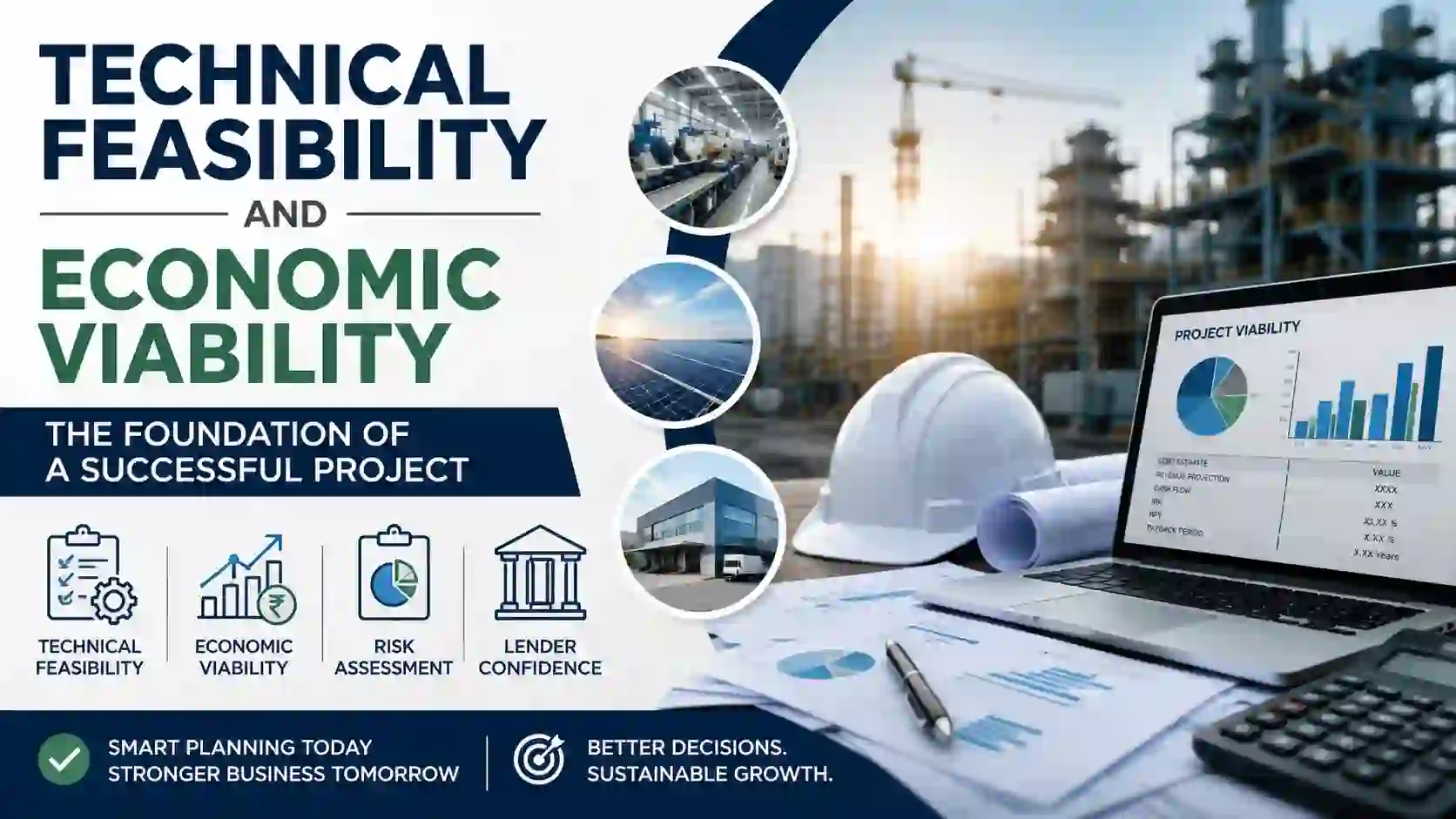
1. What Technical Feasibility and Economic Viability Mean for a Business
Project
Before putting significant money into a new project,
expansion, manufacturing unit, solar plant, hospital or infrastructure
development, one basic question needs to be answered properly: can this project
actually be executed and will it make financial sense over time?
This is where technical feasibility and economicviability become important.
Technical feasibility looks at whether the proposed project
can realistically be implemented. It considers practical aspects such as
technology, plant and machinery, raw material availability, location,
infrastructure, utilities, production capacity, manpower requirements and the
ability to operate the project as planned.
Economic viability, on the other hand, examines whether the
project is financially sustainable. The assessment looks at project cost,
expected revenue, operating expenses, profitability, cash flow, repayment
capacity and the overall ability of the business to support the proposed
investment.
The two areas are closely connected. A technically sound
project may still struggle if the projected sales are unrealistic or the cost
of financing is too high. Similarly, a project may appear profitable on paper
but face problems because the proposed technology, capacity or operational
assumptions are not practical.
For example, a manufacturing company planning to expand
production may have strong demand for its products. However, if the company has
underestimated its power requirement, raw material dependency or machinery
installation timeline, the expansion may not achieve the expected production
levels. That technical issue can eventually affect revenue, profitability and
loan repayment.
In practical project advisory work, technical feasibility
and economic viability should not be treated as two separate boxes to tick.
They are part of the same business question. Can the project be built, operated
and financially sustained?
2. Why Technical Feasibility and Economic Viability Matter Before Project
Investment
Many promoters become deeply involved in the opportunity
before examining the underlying assumptions. They may identify land, negotiate
with machinery suppliers or begin discussions with investors before properly
reviewing whether the complete project is viable.
That can become expensive.
A detailed technical feasibility and economic viability
assessment helps identify potential weaknesses before substantial financial
commitments are made. This is particularly important when the project involves
borrowed funds, because a business is not only required to generate profits but
also sufficient cash flow to meet interest and principal repayment obligations.
Consider a promoter planning a new industrial unit. The
market opportunity may appear promising, and the machinery supplier may provide
attractive production estimates. But questions still remain. Is the proposed
capacity appropriate for the market? How long will stabilisation take? What
happens if raw material prices increase? Is the working capital requirement
sufficient for the initial operating period?
These questions often decide whether a project succeeds
comfortably or faces financial pressure shortly after commissioning.
Many business owners believe that preparing a DPR is enough
for getting a loan. In reality, that rarely happens. A lender may review the
DPR, but the underlying assumptions can still be examined through technical
appraisal, financial analysis, credit appraisal or an independent technical
feasibility and economic viability assessment.
For businesses, doing this work early can also prevent the
project from being designed around unrealistic financial expectations.
Sometimes the original project cost itself needs revision. Sometimes the
capacity needs to be reduced or expanded. Sometimes the proposed debt and
equity structure simply does not leave enough room for repayment pressure.
I might be wrong here, but in many cases the cost of
correcting a weak project assumption before financial closure is far lower than
correcting it after machinery has been ordered.
3. Understanding the Technical Feasibility of Manufacturing and Industrial
Projects
Technical feasibility is often misunderstood as simply
checking whether machinery can produce a particular product. The actual
assessment is wider than that.
For a manufacturing project, technical feasibility may
involve examining the proposed manufacturing process, technology selection,
machinery specifications, installed capacity, production assumptions, utility
requirements, raw material sourcing and operational infrastructure.
Take the example of a manufacturing company planning an
expansion. The promoter may intend to install an additional production line to
increase capacity. On paper, the machinery capacity may support the planned
output. But the existing facility may not have adequate power infrastructure,
storage capacity, skilled manpower or raw material handling systems.
The machinery can be technically capable of producing the
required quantity. The overall plant may still not be.
This is why technical feasibility and economic viability
require practical project-level analysis rather than relying entirely on
supplier quotations or projected financial statements.
Some of the common technical areas reviewed in industrial
projects include:
|
Area |
What is generally examined |
|
Technology |
Suitability, reliability and operational requirements |
|
Machinery |
Capacity, specifications, installation and integration |
|
Raw Materials |
Availability, quality and supply dependency |
|
Location |
Access, logistics and infrastructure suitability |
|
Utilities |
Power, water, fuel and other operational requirements |
|
Capacity |
Whether the proposed production level is practical |
|
Manpower |
Availability of skilled and operational staff |
|
Implementation |
Construction and commissioning timelines |
A warehouse expansion presents a different example. The
project may appear relatively straightforward because it does not involve a
complex manufacturing process. Yet technical questions remain regarding land
use, building design, storage capacity, loading systems, fire compliance,
logistics movement and infrastructure requirements.
Sometimes perfectly good projects get delayed because
documentation was prepared in the wrong sequence. It still surprises me.
Technical feasibility is therefore not about proving that a
project looks possible. It is about identifying whether it can function
properly under actual operating conditions.
4. How Economic Viability Is Evaluated Before Approving a Project
Economic viability focuses on the financial logic behind the
project.
The assessment generally begins with the project cost and
moves towards projected operations, revenue, expenses, profitability, cash
generation and debt servicing capacity. However, preparing financial
projections alone does not establish economic viability. The assumptions behind
those projections need to be reasonable.
For example, a hospital project may estimate a certain
occupancy level within the first year of operations. If the projected occupancy
is significantly higher than what the location or market can reasonably
support, the projected revenue may be overstated from the beginning.
The numbers may add up mathematically. That is not the same
as being economically viable.
A proper review of technical feasibility and economicviability may examine areas such as:
- Total
project cost and funding requirement
- Promoter
contribution and equity availability
- Revenue
assumptions
- Operating
expenses
- Raw
material and input costs
- Working
capital requirements
- Interest
burden
- Profitability
projections
- Cash
flow
- Debt
servicing ability
- Break-even
assumptions
- Sensitivity
to changes in costs or revenue
An important point is that profitability and repayment
capacity are not always the same thing. A project can report accounting profits
while experiencing cash flow pressure because funds are locked in inventory,
receivables or other working capital requirements.
This is especially relevant for MSMEs.
An MSME may secure new orders and increase turnover but
still struggle to obtain sufficient working capital because receivables remain
outstanding for extended periods. In such cases, economic viability needs to
consider the operating cycle rather than focusing only on projected sales
growth.
This doesn't apply everywhere. Some businesses have short
collection cycles and stronger cash conversion patterns. But for companies
dependent on large customers, contractors or institutional buyers, working
capital assumptions can become a major part of the viability assessment.
A solar project provides another example. Revenue
projections may appear stable because electricity generation and tariff
arrangements are relatively predictable. Yet the assessment may still need to
consider generation assumptions, project cost, financing structure, operational
expenses and potential delays.
A project can look profitable over its lifetime while facing
repayment difficulties during the early years.
That distinction matters.
5. Technical Feasibility and Economic Viability in Bank and Lender Decision
Making
Banks and financial institutions do not evaluate projects
only by looking at the promoter's confidence or the projected profitability in
a report.
They need to understand the risks.
When a borrower approaches a lender for project finance,
expansion finance or a substantial term loan, the lender may examine whether
the project can be implemented as proposed and whether it can generate
sufficient cash flow to support the proposed debt.
This is where technical feasibility and economic
viability become closely connected with lender decision making and credit
appraisal.
A bank may want answers to questions such as:
Is the proposed technology suitable?
Is the project cost reasonable?
Can the company complete the project within the estimated
time?
Are the projected sales achievable?
Is the promoter bringing sufficient equity?
Can the business handle interest and principal repayment?
What happens if the project takes longer than expected to
commence operations?
These are not unnecessary formalities. A delayed project can
result in cost overruns, additional interest and pressure on the original
financing structure.
Consider an industrial borrower seeking restructuring after
an expansion project failed to perform according to projections. The original
project may have been technically workable, but the production ramp-up could
have taken longer than expected. Revenue generation may have been delayed while
loan repayment obligations had already started.
The problem then becomes more complicated because the
business is no longer only dealing with project implementation. It is dealing
with existing debt pressure.
A properly conducted technical feasibility and economicviability assessment before funding may help identify such risks earlier.
Frontline Consultants, with more than 30 years of experience
in financial and project advisory, works with businesses, lenders and project
stakeholders on areas including Techno Economic Viability Reports, Lenders
Independent Engineer services, Detailed Project Reports, credit-related project
assessments and broader business financial consulting.
For a lender, an independent assessment can provide another
perspective beyond the promoter's own projections. For a business owner, it can
help identify issues that may otherwise surface only during bank appraisal.
And sometimes that is the real value of the exercise. Not
producing a report that says everything looks good, but finding the question
that nobody had properly asked yet.
6. Key Financial and Technical Factors That Can Affect Project Viability
A project does not become viable simply because the promoter
has experience, the product has demand or a bank is willing to consider
funding. Technical feasibility and economic viability depend on several
connected assumptions. If one important assumption changes, the impact can move
through the entire project.
Project cost is one of the first areas that requires careful
attention.
Businesses sometimes prepare estimates based on machinery
quotations and construction costs but do not adequately account for
pre-operative expenses, interest during construction, contingency requirements,
installation costs, working capital margins or delays. The project may
therefore be underfunded from the beginning.
A manufacturing company may receive approval for a term loan
based on an estimated project cost. During implementation, machinery
installation takes longer, construction costs increase and additional working
capital becomes necessary before operations stabilise. The original funding
arrangement then starts looking inadequate.
Technical feasibility and economic viability are affected
because the project has changed, even if the original business idea remains the
same.
Some important factors generally include:
|
Factor |
Possible Impact on the Project |
|
Project Cost |
Higher funding requirement and increased debt burden |
|
Technology Selection |
Operational inefficiency or unexpected maintenance costs |
|
Production Capacity |
Underutilisation or capacity constraints |
|
Raw Material Costs |
Pressure on margins and working capital |
|
Revenue Assumptions |
Lower cash generation than projected |
|
Implementation Delays |
Cost overruns and additional interest burden |
|
Debt Structure |
Higher repayment pressure |
|
Working Capital |
Operational difficulties despite business growth |
|
Market Demand |
Lower capacity utilisation |
|
Promoter Contribution |
Greater dependence on external borrowing |
Capacity utilisation is another important area. A project
may be technically capable of operating at 100 percent capacity, but that does
not mean it will achieve that level.
In many industrial sectors, the first few years involve
gradual stabilisation. Production processes are refined, customers are acquired
and distribution arrangements develop over time. A financial projection that
assumes immediate high utilisation can make the project appear stronger than it
actually is.
The relationship between technical assumptions and financial
projections is therefore very close.
A machinery supplier may estimate a particular production
output. But actual output can be influenced by maintenance, downtime, labour
availability, raw material quality and operational efficiency. If the projected
production volume falls, revenue may also fall.
That is why technical feasibility and economic viability
should be reviewed together rather than as independent exercises.
A small personal observation here. In project discussions,
promoters often spend considerable time negotiating the machinery price but
comparatively less time questioning the assumptions used for the first two
years of operations. Both matter, of course, but the second one can sometimes
create more trouble.
7. Common Problems Found During Technical Feasibility and Economic
Viability Assessments
Many projects do not have one dramatic weakness. The problem
is usually a combination of smaller assumptions that appear reasonable
individually but create significant pressure when considered together.
During a technical feasibility and economic viability
assessment, some common issues tend to appear repeatedly.
Project Cost Is Underestimated
This is particularly common in projects involving
construction, imported machinery or extensive infrastructure development.
The promoter may prepare a project cost based on current
quotations, but implementation takes longer than expected. Prices increase,
additional civil work becomes necessary and interest costs rise.
The project then requires additional funding.
For a lender, this can create concern because the original
debt-equity structure may no longer be appropriate.
Revenue Projections Are Too Optimistic
Optimistic projections are not necessarily dishonest. Often,
they are based on the promoter's confidence in the market.
But confidence and financial assumptions are different
things.
A company may expect to achieve substantial sales because
there is growing demand in the industry. The assessment still needs to consider
competition, customer acquisition, pricing pressure, production capacity and
the time required to reach the projected sales level.
Many business owners disagree with this approach because
they believe the market opportunity is obvious. Sometimes they are right. A
strong promoter with confirmed orders and an established customer base can
achieve faster growth than a new entrant.
Still, projections should have a practical basis.
Working Capital Requirements Are Ignored or
Underestimated
This is a particularly important issue for manufacturing
companies and MSMEs.
A business may complete the project and commence production
successfully but still face financial stress because it does not have
sufficient funds for inventory, wages, receivables and operating expenses.
An MSME struggling to obtain working capital may have a
profitable business on paper. Yet cash may be locked in unpaid customer
invoices.
Technical feasibility and economic viability assessments
therefore need to consider how the business will actually operate after the
project is commissioned.
Implementation Timelines Are Unrealistic
Promoters often expect construction, approvals and machinery
installation to proceed according to the original schedule.
In practice, delays happen.
Land-related issues, approvals, supplier delays, logistics
problems and changes in project scope can all affect implementation.
Even a few months of delay can have a financial impact
because revenue generation is postponed while certain costs continue.
And then there is another issue...
The repayment schedule may already be approaching.
Promoter Contribution Is Not Clearly Available
Banks and lenders generally examine the promoter's
contribution carefully because it indicates the financial commitment behind the
project.
A proposed equity contribution that depends entirely on
future asset sales, uncertain investments or expected business receipts may
create funding uncertainty.
A financially viable project can still face implementation
problems if the required equity is not available at the right time.
Documentation Does Not Support the Financial Projections
Sometimes the projected figures appear reasonable but the
supporting documentation is weak.
For example, projected capacity may not match the proposed
machinery. Revenue assumptions may not be supported by market information or
customer relationships. Project costs may not correspond with quotations.
This can create delays during lender appraisal.
Proper documentation often saves time and money because it
reduces the need to repeatedly explain or revise the same assumptions.
8. Technical Feasibility and Economic Viability for Manufacturing,
Infrastructure and Renewable Energy Projects
The basic purpose of technical feasibility and economic
viability remains similar across industries. However, the areas of
assessment can differ significantly depending on the project.
A manufacturing project cannot be examined in exactly the
same manner as a solar power project or hospital development.
Manufacturing Projects
Manufacturing projects generally require close examination
of production processes, technology, machinery, raw materials, capacity
utilisation, utilities and operating costs.
For example, a company establishing a new industrial unit
may have identified demand for its product. The assessment must still consider
whether the proposed machinery can meet quality and volume requirements and
whether raw material availability can support continuous operations.
Economic viability then considers the cost of production,
expected selling price, operating margins, working capital requirements and
debt servicing ability.
For manufacturing companies seeking expansion finance, this
becomes particularly important because the existing business performance also
needs to be understood.
An expansion project may look viable independently but place
additional financial pressure on the existing business.
Infrastructure Projects
Infrastructure projects often involve longer implementation
periods and larger capital requirements.
Technical feasibility may include engineering
considerations, land availability, construction requirements, contractor
capability and implementation schedules.
Economic viability can depend heavily on project cost,
funding structure, expected revenue, operating expenses and the time required
to begin generating income.
Cost overruns can become a major concern.
A project that was financially comfortable at the original
estimated cost may require restructuring of its funding if implementation
expenses increase significantly.
Renewable Energy and Solar Projects
Solar and renewable energy projects involve a different set
of assumptions.
Technical feasibility may consider location, generation
potential, equipment quality, capacity, grid connectivity and operational
arrangements.
Economic viability may depend on project cost, expected
generation, revenue arrangements, financing cost and debt repayment schedules.
A solar project requiring lender approval may therefore need
more than a general business projection. The technical assumptions directly
influence financial estimates.
If the expected generation is lower than projected, the
revenue model can change.
Healthcare Projects
Hospitals and healthcare facilities create another type of
challenge because operations may take time to stabilise.
The project may have technically appropriate infrastructure
and equipment, but patient occupancy, doctor availability, operating costs and
service mix can affect financial performance.
A hospital requiring project finance may therefore need
realistic assumptions about the period required to build patient volumes.
Warehousing and Logistics Projects
Warehouse projects may appear less complicated than
manufacturing facilities, but their viability can depend heavily on location,
customer demand, logistics connectivity and occupancy.
A warehouse expansion requiring a TEV assessment may need to
establish whether the proposed capacity has practical demand and whether the
projected rental or operational income can support the investment.
The important point is that technical feasibility and
economic viability cannot be reduced to a standard template. The project
itself determines what requires greater attention.
9. How Frontline Consultants Approaches Technical Feasibility and Economic
Viability Assessments
A meaningful assessment should begin with understanding the
actual project rather than immediately filling financial ratios into a report.
For Frontline Consultants, with more than 30 years of
experience in financial and project advisory, technical feasibility and
economic viability assessments are approached by considering both the
practical implementation of the project and the financial implications of the
underlying assumptions.
The process can involve understanding the project
background, promoter experience, proposed business model, technical
requirements, estimated cost and funding structure.
The technical side may include reviewing areas such as
project scope, technology, plant and machinery, capacity, infrastructure,
implementation plans and operational requirements.
The economic side may consider projected revenue, expenses,
profitability, cash flows, working capital and repayment capacity.
The objective is not simply to create favourable
projections.
That is an important distinction.
A report is more useful when it identifies assumptions that
require attention. If the project cost appears inadequate, the issue should be
examined. If the repayment schedule appears aggressive, it should be
considered. If the capacity assumptions are difficult to support, they should
not simply be repeated because they were part of the original proposal.
Frontline Consultants also brings experience across related
advisory areas including Techno Economic Viability Reports, Lenders Independent
Engineer Services, Detailed Project Reports, Enterprise Valuation, Asset
Valuation, Credit Syndication, Debt Restructuring, Bank Liaison, Project
Advisory and Business Financial Consulting.
This wider exposure can be useful because project viability
is often connected with other financial decisions.
A business preparing a project for bank funding may need a
properly structured DPR. A lender may require an independent technical
assessment. A company facing financial stress may need to reconsider its debt
structure.
These situations are different, but they are often connected
through the same underlying question.
Is the business or project financially sustainable?
For promoters, an independent technical feasibility and
economic viability assessment can provide greater clarity before
approaching lenders or committing substantial funds.
For banks and financial institutions, it can support the
appraisal process by providing a structured review of the project's technical
and financial assumptions.
For businesses, finding weaknesses before implementation can
be uncomfortable. But it is generally easier than finding them after the money
has been spent.
10. Frequently Asked Questions About Technical Feasibility and Economic
Viability
What is technical feasibility and economic viability?
Technical feasibility and economic viability involve
assessing whether a proposed project can be practically implemented and whether
it can generate sufficient financial returns and cash flow to remain
sustainable.
Technical feasibility considers operational and technical
requirements, while economic viability focuses on financial performance, costs,
revenue and repayment capacity.
Why is technical feasibility and economic viability
important before investing in a project?
The assessment helps identify potential technical,
operational and financial risks before significant investments are made. It can
also help businesses prepare stronger documentation when approaching banks,
NBFCs or financial institutions.
Is a DPR enough for obtaining project finance?
A DPR is an important document, but it may not be sufficient
on its own. Lenders can examine the assumptions within the DPR through their
credit appraisal process and may require additional technical or financial
assessment depending on the nature and size of the project.
What factors are checked during a technical feasibility
and economic viability assessment?
The assessment may consider technology, machinery,
production capacity, project cost, implementation timelines, market
assumptions, operating expenses, working capital requirements, projected
revenue, cash flow and debt servicing ability.
The exact scope depends on the project.
Can technical feasibility and economic viability help
with bank loan approval?
A properly prepared assessment can help present the project
assumptions in a structured and supportable manner. However, it does not
guarantee loan approval. Banks consider several factors, including promoter
profile, financial position, security, industry conditions and their internal
lending policies.
Which businesses should consider a technical feasibility
and economic viability assessment?
Manufacturing companies, infrastructure developers, solar
companies, hospitals, warehousing businesses, industrial units, educational
institutions and businesses planning major capital investments can benefit from
examining project viability before implementation.
What is the difference between technical feasibility and
financial feasibility?
Technical feasibility focuses primarily on whether the
project can be implemented and operated using the proposed technology,
infrastructure, resources and capacity.
Financial feasibility examines whether the project can
generate sufficient financial returns and cash flows. Economic viability
generally considers the broader financial sustainability of the project.
When should a promoter conduct a technical feasibility
and economic viability assessment?
Ideally, the assessment should be conducted before major
financial commitments are made and before the project is presented to lenders
for significant funding.
For an expansion, new manufacturing unit or
capital-intensive project, identifying weaknesses early can make subsequent
planning easier.
Can Frontline Consultants assist with project viability
assessments?
Frontline Consultants provides financial and project
advisory services, including Techno Economic Viability Reports, Detailed
Project Reports, Lenders Independent Engineer Services, Project Advisory,
Credit Syndication, Debt Restructuring and Business Financial Consulting.
Technical feasibility and economic viability are mainly
concerned with whether a project can be implemented successfully and whether it
can remain financially sustainable. However, for many businesses, the
assumptions used in a project report also depend on future customer demand,
market reach and the company's ability to generate enquiries and sales.
This is where the discussion can extend beyond finance and
project planning.
A manufacturing company setting up additional capacity, for
example, may project higher sales based on expected market demand. But those
projections also depend on how effectively the business reaches potential
customers. The same applies to new healthcare facilities, renewable energy
companies, industrial service providers and growing MSMEs entering competitive
markets.
Today, business growth is increasingly connected with how
companies present themselves online, attract relevant customers and build a
consistent presence across search engines and digital platforms. Businesses
planning expansion can therefore benefit from considering their marketing and
customer acquisition strategy alongside their financial and project planning.
For companies looking to understand the digital side of
business growth, including SEO, digital marketing, AI-led marketing and
customer acquisition strategies, working with an experienced digital marketing
partner such as StratMarketer can be relevant to the wider business
planning process.
In summary, a project may be technically feasible and
economically viable on paper, but long-term performance can still depend on
whether the business is able to reach the market and generate the revenue
assumed during project planning.