
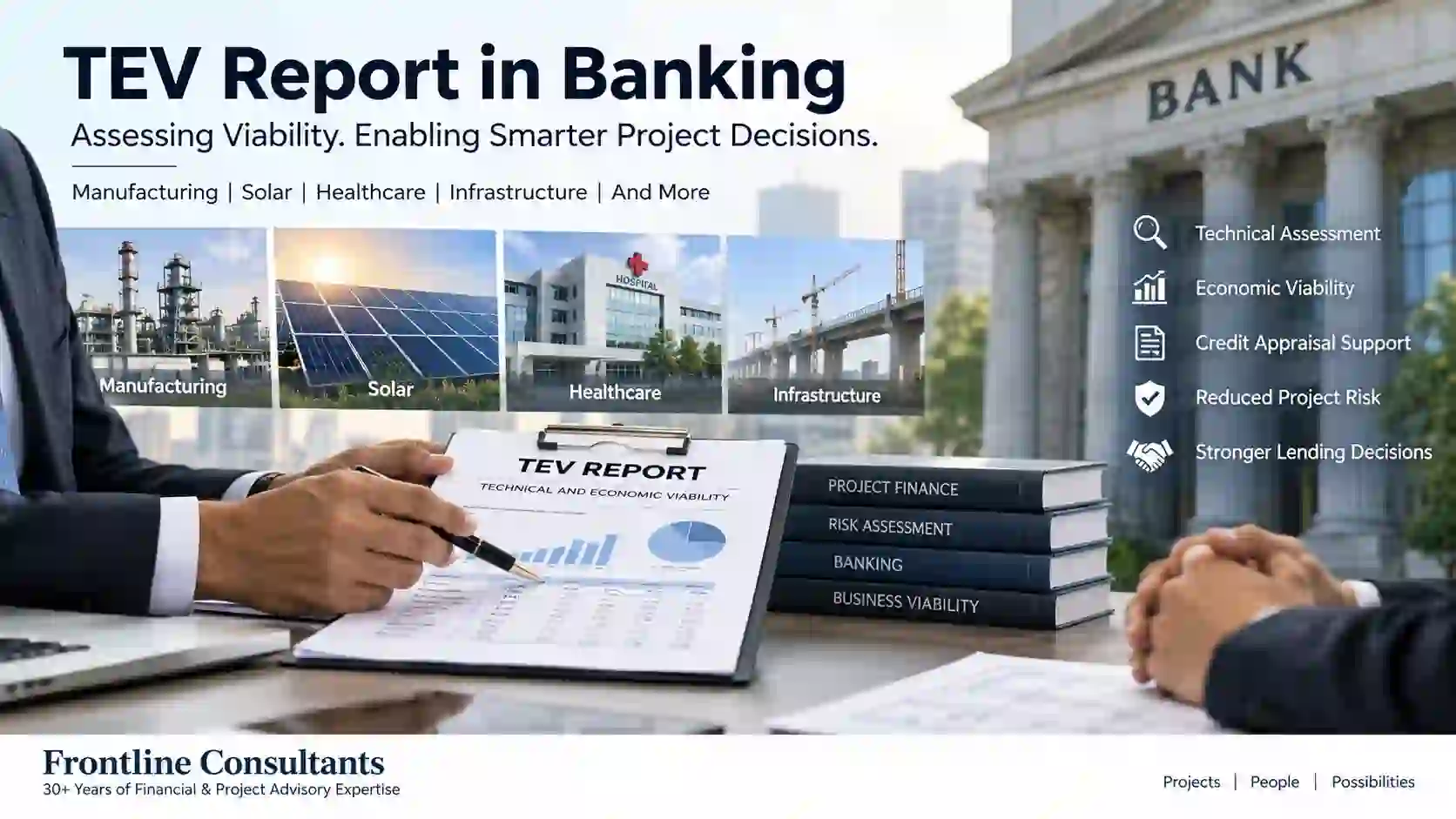
1. What a TEV Report in Banking Actually Tells a Lender
A TEV report in banking is not simply a project
report with more financial numbers added to it. For a lender, it is an
independent assessment of whether a proposed project makes technical and
economic sense and whether the assumptions supporting the funding request are
reasonably achievable.
When a promoter approaches a bank for project finance, the
bank has to look beyond the promoter's enthusiasm and the projected
profitability. The lender wants to know whether the plant can actually be
built, whether the proposed technology is appropriate, whether the cost
estimates are realistic, whether the business can generate enough cash, and
whether the borrower will be able to service the proposed debt.
This is where a TEV report in banking becomes useful.
Suppose a manufacturing company wants to establish a new
production unit. The promoter may have already prepared a detailed project
report showing machinery costs, expected production, sales projections and
projected profits. But a lender cannot rely entirely on those figures. Someone
has to examine whether the proposed capacity is technically practical and
whether the commercial assumptions stand up to scrutiny.
A TEV assessment brings these two sides together.
The technical side generally looks at the proposed
manufacturing process, machinery, capacity, utilities, raw material
availability, site conditions, implementation schedule and other
project-related matters. The economic side examines project cost, means of
finance, production assumptions, revenue, operating expenses, profitability,
cash generation and debt servicing capability.
There is also a question of reasonableness.
If a project proposes a machinery cost that appears
significantly different from prevailing quotations, the issue is not
necessarily that the project is wrong. The figures need to be understood.
Perhaps the machinery is imported. Perhaps additional tooling or installation
costs have been included. Perhaps the promoter has negotiated a special
supplier arrangement.
A good TEV report in banking does not blindly accept
or reject such assumptions. It investigates them and explains the position to
the lender.
This distinction matters during credit appraisal.
Banks are taking exposure based on future cash flows. The
project may not have an operating history, particularly in the case of a new
manufacturing unit, hospital, warehouse or solar project. Therefore, the lender
needs a structured assessment of the assumptions before committing substantial
funds.
A TEV report helps convert a promoter's proposal into
something that can be examined from a lender's perspective.
2. Why Banks Ask for a TEV Report Before Funding Certain Projects
Not every business loan requires the same level of technical
assessment. A routine working capital facility for an established trading
business is different from a ₹100 crore greenfield manufacturing project.
The larger and more complex the project, the more questions
a lender normally has.
Consider an industrial borrower proposing a new production
facility. The promoter may have land, some equity contribution and a confirmed
machinery quotation. On paper, the project can look straightforward. But the
bank still needs to understand how the proposed capacity compares with market
demand, whether the implementation schedule is achievable and whether the
estimated cost is adequate.
This is one reason banks seek a TEV report in banking
for selected projects.
There is another practical reason. Credit appraisal involves
several people and departments. A relationship manager may understand the
borrower and the business. The credit team examines financial strength and
repayment risk. Technical specialists may examine engineering aspects. Senior
sanctioning authorities then consider the overall proposal.
An independent TEV report gives these stakeholders a common
technical and economic reference point.
It can also identify inconsistencies early.
For example, a DPR may assume commercial production
beginning in April. However, the machinery delivery schedule may indicate that
installation and commissioning would realistically extend into July. That three
month difference can affect interest during construction, working capital
requirements, revenue generation and debt servicing.
These are not small matters.
A project that starts generating revenue later than expected
may need additional funding before it reaches stabilised operations. If this is
not considered at the initial appraisal stage, the borrower and lender can both
face unnecessary pressure later.
Many business owners believe preparing a DPR is enough for
getting a loan. I disagree with that assumption. A DPR explains the promoter's
proposal. A TEV report in banking examines whether the proposal stands
up when viewed independently.
The two documents can support each other, but they serve
different purposes.
Banks may also ask for TEV assessment where the project
involves specialised technology, substantial capital expenditure, unusual
operating assumptions or significant implementation risk.
A solar project is a good example. The lender may want to
understand the proposed technology, generation assumptions, site
characteristics, evacuation arrangements, project cost and expected cash flows.
A healthcare project brings different questions around bed capacity, equipment,
occupancy, operating costs and implementation.
The reason for the report is ultimately simple. The bank
wants fewer unanswered questions before taking a credit decision.
3. How Banks Review Technical and Economic Viability
A TEV report in banking is generally reviewed as part
of the wider credit appraisal process. It does not replace financial analysis,
promoter assessment, security evaluation or legal due diligence.
The technical review usually begins with the basic project
concept.
Is the proposed process technically workable? Is the
technology established? Is the selected machinery suitable for the intended
output? Does the plant layout make sense? Are adequate utilities available?
Does the implementation schedule have some practical basis?
For a manufacturing unit, machinery is often one of the most
closely examined areas.
A promoter might plan a plant with a production capacity of
50,000 units per month. The technical assessment should consider whether the
proposed machinery can realistically achieve that output. Rated capacity and
practical operating capacity are not always the same thing.
Maintenance, changeover time, product mix, manpower, quality
requirements and operating shifts can all affect actual production.
This is where a purely spreadsheet based assessment can
become misleading.
The economic assessment then looks at whether the proposed
business can support the investment. Expected selling prices, production
volumes, raw material costs, employee costs, power expenses, administrative
costs, depreciation, interest and other operating assumptions are examined.
The relationship between these assumptions is important.
A small change in utilisation can have a noticeable effect
on a capital intensive project. A plant designed around high fixed costs needs
sufficient throughput to generate adequate contribution. If the project assumes
very high utilisation immediately after commissioning, the assumption deserves
closer examination.
Banks also consider the project's implementation risk.
A promoter may have obtained land and machinery quotations,
but several activities remain before commercial production. Civil construction,
equipment delivery, installation, testing, statutory approvals, electrical
infrastructure and recruitment can all affect the timeline.
The TEV report in banking therefore provides a
reasoned view of whether the proposed implementation schedule appears
achievable.
This doesn't mean every report can predict exactly what will
happen. Projects rarely follow a perfect timetable. I might be wrong here, but
in practical lending work, the value of a TEV assessment is often less about
predicting every event and more about identifying the assumptions that deserve
attention before money is committed.
That is a useful distinction.
4. Key Areas Covered in a TEV Report in Banking
The exact scope varies according to the project, lender and
industry. A manufacturing project will require a different examination from a
hospital or infrastructure development.
Still, several areas commonly receive attention in a TEV
report in banking.
Project background and promoter profile
The assessment begins by understanding what is being
proposed, who is implementing it and why the project is being undertaken.
Existing operations, experience, proposed expansion and the promoter's
involvement can be relevant.
Technical configuration
This can include manufacturing process, technology, plant
capacity, machinery, equipment specifications, utilities and proposed layout.
Where appropriate, technical specifications are checked against the intended
production capacity.
Location and infrastructure
Land, site development, power, water, transportation and
other infrastructure requirements can influence project viability. A project
may look financially attractive but face practical problems if essential
infrastructure is unavailable.
Project implementation
The expected sequence from project commencement to
commercial production is examined. Major milestones and dependencies matter
because delays can increase project costs.
Project cost
Land, building, plant and machinery, electrical
installation, preliminary expenses, contingencies, working capital margin and
other components may be reviewed. The objective is to establish whether the
estimated project cost is realistic for the proposed scale.
Means of finance
The proposed contribution from promoters, term debt and
other sources is examined. The lender wants to see whether the financing
structure is adequate and whether the promoter's contribution is realistically
available.
Market and operating assumptions
Demand, competition, selling price, production volume and
capacity utilisation are relevant to the economic assessment.
Financial projections
Projected profit and loss, cash flow, balance sheet and debt
servicing are generally examined alongside the underlying operating
assumptions.
Sensitivity and risk considerations
A sensible assessment does not only look at the base case.
It considers what may happen if selling prices decline, costs rise,
implementation is delayed or capacity utilisation takes longer to build.
This is particularly important for new projects where there
is limited historical evidence.
5. How Project Cost, Revenue and Cash Flow Are Examined
One of the most important parts of a TEV report in
banking is the connection between project cost and future cash generation.
A project can have excellent technology and an experienced
promoter but still struggle financially if the investment required is too high
compared with the cash it can generate.
Project cost is therefore examined component by component.
Take a manufacturing expansion. The promoter may submit
machinery quotations worth ₹20 crore, civil construction of ₹8 crore and other
project expenses of ₹2 crore. On paper, the total is ₹30 crore. The technical
assessment may examine whether the machinery specification matches the proposed
capacity and whether civil and installation costs appear reasonable.
Sometimes an apparently low project cost is more concerning
than a high one.
If essential components have been omitted from the estimate,
the project may require additional funding later. This can create a funding gap
during implementation.
Revenue assumptions receive similar scrutiny.
Suppose a proposed unit expects ₹60 crore annual sales
shortly after commissioning. The question is not simply whether ₹60 crore is
mathematically possible. The assessment should consider installed capacity,
utilisation, selling price, product mix and the market supporting those sales.
If the project requires 90 percent utilisation from the
first year to remain viable, that assumption deserves attention.
A more realistic ramp-up may be necessary.
Cash flow is where everything eventually comes together.
Profit on paper does not automatically mean money is available for debt
repayment. Inventory, receivables, working capital requirements and capital
expenditure can absorb cash even when the income statement shows a profit.
This is why lenders pay close attention to projected debt
servicing.
A borrower may show EBITDA of ₹12 crore, but if working
capital absorbs ₹5 crore and other cash requirements consume another portion,
the amount actually available for servicing debt is different.
The TEV report in banking helps lenders understand
this relationship rather than looking at isolated financial ratios.
Consider a warehouse expansion. The promoter may expect
additional rental income once the facility is completed. The project cost,
construction period, occupancy assumptions, rental rates, maintenance costs and
financing structure all need to work together. If completion is delayed by six
months, the expected revenue is delayed too, while interest costs continue.
That is the sort of practical mismatch that can create
problems later.
Documentation also matters more than many promoters realise.
Updated machinery quotations, land documents, project cost estimates, statutory
approvals, power availability information and realistic implementation
schedules can save considerable back and forth during appraisal.
Sometimes perfectly good projects get delayed because
documentation was prepared in the wrong sequence. It still surprises me.
Frontline Consultants works in this space by bringing
technical, financial and lender oriented considerations together. With more
than 30 years of experience, the firm undertakes Techno Economic Viability
Reports, Lenders Independent Engineer Services, Agency for
Special Monitoring, Detailed Project Reports, Enterprise
Valuation, Asset Valuation, Credit Syndication, Debt
Restructuring, Bank Liaison, Project Advisory and Business
Financial Consulting.
The useful part is not simply preparing another report. The
report has to make sense in the context of the actual funding requirement and
the lender's appraisal process.
For a promoter preparing a DPR before approaching banks,
this can mean identifying gaps before the proposal reaches the credit desk. For
an existing borrower facing expansion funding, it can mean testing whether the
proposed investment and debt structure remain manageable. For a solar or
infrastructure project, the technical assumptions may require a different depth
of review.
This doesn't apply everywhere. The scope of a TEV report
in banking depends on the nature, size and complexity of the project and
also on what the lender requires.
The important thing is that the report should answer the
questions a lender is likely to ask, not merely fill pages with projections.
6. TEV Assessment for Manufacturing, Solar, Healthcare and Infrastructure
Projects
The practical value of a TEV report in banking
becomes clearer when we look at how the assessment changes from one industry to
another. The basic principle remains the same, but the questions asked by a
lender can be very different.
A manufacturing project is not assessed in the same way as a
solar plant. A hospital has a different revenue model from an infrastructure
project. Treating all projects through one standard checklist can miss issues
that matter to the bank.
Manufacturing projects
For a manufacturing company, technical viability usually
starts with capacity, machinery and the manufacturing process.
Suppose an existing MSME wants to add another production
line and has approached a bank for a term loan. The promoter may have strong
experience and an established customer base. That helps, but the lender still
needs to understand whether the proposed expansion is technically appropriate.
The assessment may look at machinery specifications,
installed capacity, production cycle, utility requirements, raw material
availability, manpower and the proposed implementation schedule.
Capacity utilisation is particularly important.
A promoter may project 80 or 90 percent utilisation within
the first year. That may be possible in an established business with confirmed
orders, but it needs stronger support than an assumption in a spreadsheet.
The economic side then considers selling prices, raw
material costs, operating expenses, working capital requirements and debt
servicing.
For a greenfield project, the scrutiny can be even more
detailed because there may be no operating history from the proposed facility.
Solar projects
A solar project brings a different set of technical
questions.
The lender may examine the proposed site, installed
capacity, generation assumptions, technology, equipment specifications,
evacuation arrangements, project implementation schedule and operating
assumptions.
Generation estimates are particularly important because
project cash flows depend on actual power generation and the applicable revenue
arrangement.
The assessment may also consider degradation assumptions,
operating and maintenance costs, project completion timelines and the financial
effect of delays.
For a lender, a solar project that looks attractive because
of projected revenue can still present repayment concerns if the technical
assumptions behind generation have not been properly examined.
Healthcare projects
A hospital or healthcare project requires a closer look at
the relationship between infrastructure and operating revenue.
The assessment may consider the number of beds, departments,
medical equipment, proposed utilisation, staffing, operating expenses and the
promoter's experience.
A new hospital may take time to reach stable occupancy.
Therefore, assuming full utilisation from the beginning can create an
unrealistic cash flow picture.
Medical equipment also represents a significant investment
in many healthcare projects. The useful life, procurement cost, installation
requirements and proposed utilisation can influence the overall economics.
A lender therefore needs more than a projected profit
figure.
Infrastructure projects
Infrastructure projects can involve longer implementation
periods and multiple dependencies.
Land availability, statutory permissions, construction
schedules, contractor arrangements, cost escalation, project completion and
expected revenue are among the areas that can affect viability.
For a project with a long construction period, even a
moderate delay can have a meaningful impact on interest during construction and
the point at which operating cash flows begin.
This is one reason an experienced TEV report in banking
should connect technical assumptions with financial consequences.
The technical side cannot be treated as separate from the
lending decision.
7. Common Issues Banks Find in TEV Reports
A TEV report can be professionally prepared and still create
questions during credit appraisal if the underlying information is incomplete
or inconsistent.
One common problem is unrealistic project cost.
A promoter may obtain an old machinery quotation and use it
in the DPR even though prices have changed. In another case, installation,
freight, electrical work or civil modifications may not have been adequately
considered.
The problem becomes visible when the lender compares the
project cost with quotations or other supporting documents.
Another issue is aggressive revenue projection.
For example, an industrial unit may assume that the entire
proposed capacity will be sold from the first year. Unless there are firm
orders, established distribution channels or some other credible basis, the
assumption may require adjustment.
Working capital is another area where proposals often become
weak.
A project may be technically viable and profitable on paper,
but the promoter may underestimate inventory and receivables. Once operations
begin, the business then needs additional funds simply to maintain production.
This can create pressure on the borrower and lender.
There can also be inconsistencies between the DPR, financial
projections and TEV assessment. Machinery capacity may indicate one level of
production while the financial model assumes another. Project cost may differ
between documents. Implementation dates may not match the loan repayment
schedule.
These discrepancies are avoidable.
Banks also pay attention to promoter contribution. If the
proposal assumes a substantial equity contribution but the source of those
funds is unclear, the lender may ask for supporting information.
Statutory approvals and implementation dependencies can
create another concern. A project should not be presented as though
construction can start immediately if important approvals are still pending.
The same applies to land, power and other infrastructure
requirements.
A TEV report in banking should bring these issues
into the open rather than hide them. An uncomfortable observation made before
sanction is generally easier to deal with than the same problem discovered
after disbursement.
There is also a misconception that a TEV report is prepared
only to satisfy a bank's paperwork requirement. That is too narrow a view.
A properly examined report can help the promoter identify
funding gaps, weak assumptions and execution risks before committing
substantial capital.
8. How a Proper TEV Report Supports Credit Appraisal and Project Funding
Credit appraisal is essentially about understanding risk
before lending money.
For a project finance proposal, the bank needs to establish
whether the project can be implemented as proposed and whether the resulting
business can generate sufficient cash to meet its obligations.
A TEV report in banking supports this process by
bringing technical and economic observations into the credit discussion.
Imagine a manufacturing company seeking ₹40 crore of term
finance for a new unit.
The promoter may submit a DPR, projected financial
statements, machinery quotations and details of the proposed equity
contribution. The bank then has to examine whether the project cost is
reasonable, whether the proposed capacity is technically feasible and whether
the projected cash flows can support the debt.
The TEV assessment can provide an independent view of these
matters.
It may point out that the proposed machinery is suitable but
that the estimated installation period is too short. It may observe that the
production assumptions appear achievable after stabilisation but are aggressive
for the first operating year.
These observations can then influence the financial
appraisal.
The lender may consider an appropriate repayment schedule,
moratorium or funding structure based on the project's actual implementation
requirements.
This is where a good report becomes useful. It is not merely
about saying that a project is viable or non viable.
The lender needs to understand the conditions around that
viability.
A project could be economically viable but dependent on
timely completion. Another may be technically sound but require stronger
working capital support. A third may be viable under the base case but more
exposed to raw material price movements.
The TEV report in banking helps put these issues into
context.
It can also support project funding discussions where
several lenders are involved. When the same technical and economic information
is available to the relevant stakeholders, discussions around project cost,
debt requirement and implementation assumptions become more structured.
For promoters, this can reduce avoidable queries.
It does not guarantee sanction. That point should be clear.
The final lending decision remains with the bank or financial institution after
considering the full credit proposal, security, promoter background, financial
position, documentation and other applicable factors.
A TEV report supports the decision. It does not make the
decision.
9. How Frontline Consultants Approaches TEV Assignments for Borrowers and
Lenders
Frontline Consultants approaches a TEV report in banking
from the perspective of both the project and the eventual lender.
The first requirement is understanding what the business is
actually proposing.
A manufacturing expansion, solar installation, hospital,
warehouse or infrastructure project can have completely different technical and
financial characteristics. So the assessment has to begin with the project
itself rather than a fixed reporting format.
For an industrial project, this may mean examining the
production process, machinery, capacity, utilities, project cost and
implementation schedule.
For a solar assignment, generation assumptions and project
infrastructure can receive greater attention.
For a healthcare project, the operating model,
infrastructure, equipment and expected utilisation become important.
The financial analysis then connects these technical
observations with project economics.
Frontline Consultants has more than 30 years of experience
in financial and project advisory work. Its services include Techno Economic
Viability Reports, Lenders Independent Engineer Services, Agency for Special
Monitoring, Detailed Project Reports, Enterprise Valuation, Asset Valuation,
Credit Syndication, Debt Restructuring, Bank Liaison, Project Advisory and
Business Financial Consulting.
For borrowers, one practical benefit of this approach is
that potential gaps can be identified before the proposal reaches the lender.
Suppose a promoter is preparing a DPR for a new
manufacturing facility. If the project cost does not adequately account for
installation and associated infrastructure, that issue should ideally be
identified during preparation rather than after the bank raises the query.
Similarly, if projected revenue depends on an aggressive
capacity ramp-up, the assumption should be examined rather than simply accepted
because it produces a better projected DSCR.
For lenders, the focus is different but related. The
assessment should provide a clear view of the technical and economic
assumptions that influence the credit decision.
There is no value in making a report complicated merely for
the sake of appearing technical. Bankers need to understand what matters, where
the risks are and how those risks affect project economics.
That practical communication is important.
In assignments involving existing borrowers, the context may
also extend beyond a fresh project. An industrial borrower undergoing
restructuring, for example, may need an assessment of whether the underlying
business remains viable after changes to the debt structure.
The report then becomes part of a larger financial
discussion.
A good TEV report in banking should therefore be
useful after it is submitted. If a banker cannot identify the key assumptions,
risks and financial implications without going through pages of unnecessary
detail, something has been missed.
10. Frequently Asked Questions About TEV Report in Banking
What is a TEV report in banking?
A TEV report in banking is an assessment of the technical
and economic viability of a proposed project. It helps lenders examine whether
the project can be implemented as proposed and whether its expected operations
and cash flows can support the proposed investment and debt.
Why do banks require a TEV report?
Banks may require a TEV report when the project involves
substantial capital expenditure, technical complexity, new technology,
significant implementation risk or other factors that require independent
technical and economic assessment.
Is a TEV report the same as a DPR?
No. A Detailed Project Report generally presents the
promoter's project proposal, including technical details, project cost,
operations and financial projections. A TEV report in banking provides
an independent assessment of the project's technical and economic viability.
Both documents can be used together during project
appraisal.
Does a TEV report guarantee bank loan approval?
No. A positive TEV assessment does not guarantee loan
sanction. Banks consider several other factors, including promoter credentials,
financial performance, repayment capacity, security, credit history,
documentation and their internal lending policies.
What does a TEV report examine?
Depending on the assignment, it may examine project cost,
technology, machinery, production capacity, location, utilities, implementation
schedule, market assumptions, operating expenses, revenue projections, cash
flows and debt servicing capability.
Is a TEV report required for every business loan?
No. The requirement depends on the nature and size of the
funding proposal and the lender's assessment requirements. A simple working
capital facility for an established business may not require the same level of
technical assessment as a large greenfield project.
Can an existing manufacturing company require a TEV
report?
Yes. An existing company may require a TEV report in
banking when it is undertaking a major expansion, diversification,
modernisation or capacity addition and is seeking substantial project finance.
Who prepares a TEV report?
A TEV report is generally prepared by professionals with
relevant technical, financial and project appraisal experience. The exact
eligibility and scope may depend on the requirements of the concerned bank or
financial institution.
How does a TEV report help during credit appraisal?
It gives the lender an independent view of the project's
technical feasibility and economic assumptions. This can help the credit team
understand project risks, funding requirements, implementation issues and the
relationship between projected cash generation and debt obligations.
What information is normally needed for a TEV assignment?
The requirements vary by project but can include the DPR,
machinery quotations, project cost details, land and site information,
technology details, implementation schedule, financial projections, promoter
information and supporting approvals or documents.