
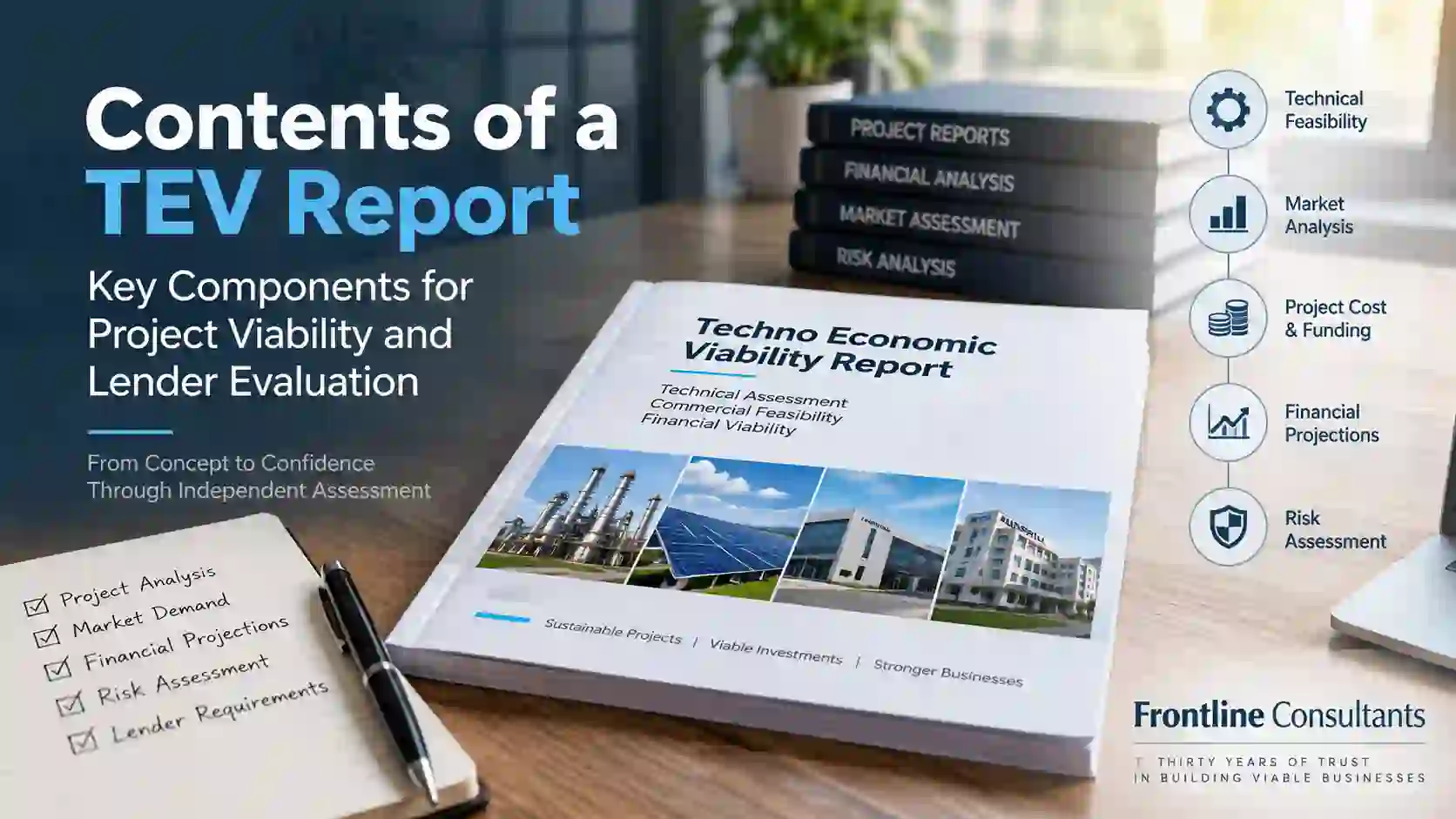
What Are the Contents of a TEV Report?
A Techno Economic Viability report is often discussed as if
it were simply a detailed document prepared before approaching a bank or
financial institution. In practice, the contents of a TEV report go much
deeper. The report examines whether a proposed project is technically feasible,
commercially practical and financially viable enough to support the proposed
investment and debt.
For a manufacturing expansion, for example, a lender may
want to understand whether the proposed machinery is suitable, whether the
production capacity is realistic and whether the company can sell the
additional output. For a solar project, the focus may move towards project
cost, technology, generation assumptions, implementation timelines and the
ability of project revenues to service debt.
This is why the contents of a TEV report are
important to promoters as well as lenders. A properly prepared report connects
technical assumptions with market realities and financial projections. If one
part is unrealistic, the impact usually appears somewhere else.
Many business owners believe that preparing a DPR is enough
for getting a loan. In reality, that rarely happens. A Detailed Project Report
primarily presents the promoter's plan and assumptions, while a TEV assessment
independently examines whether those assumptions are reasonable.
The exact contents of a TEV report can differ
depending on the nature and size of the project. A manufacturing unit,
hospital, warehouse, infrastructure project and renewable energy project will
not be assessed in exactly the same way. This doesn't apply everywhere. Smaller
projects may have relatively simpler assessment requirements, while large
projects involving consortium lending can require a much more detailed review.
Still, some areas remain central to most TEV assessments.
The report generally examines the project background, promoter capability,
technical feasibility, market potential, cost of the project and means of
finance. Financial viability and risk assessment are also critical parts of the
overall process.
From a lender's perspective, the contents of a TEV report
help answer a basic question: does the project make practical and financial
sense?
That question sounds simple. It rarely is.
A project can have a good market but weak financial
assumptions. It can have strong promoters but an unrealistic implementation
schedule. It can have modern machinery but insufficient working capital.
Sometimes the project looks perfectly acceptable on paper until the assumptions
behind the projected revenue are examined.
This is where an independent assessment becomes valuable.
Project Background and Promoter Details Included in a TEV Report
One of the first areas covered in the contents of a TEV
report is the background of the proposed project and the profile of the
promoters behind it.
Banks do not finance projects in isolation. They finance
projects promoted and managed by people or organisations. Therefore,
understanding who is implementing the project is an important part of the
assessment.
The project background generally explains what the company
intends to establish, expand or modernise. This may include details such as the
proposed location, nature of business, installed capacity, products or
services, project objectives and expected implementation period.
For an existing manufacturing company seeking expansion
finance, the report may also examine the company's present operations. How much
capacity is currently utilised? What products are being manufactured? Is the
proposed expansion connected with an existing customer base or a completely new
market?
These details matter because an expansion project is not
assessed in the same way as a greenfield project.
The promoter profile generally covers the experience,
business background and involvement of the key management team. Lenders may
also review the existing business interests of the promoters and their
experience in the relevant industry.
For example, consider a promoter proposing a specialised
engineering manufacturing facility. If the promoter and management team have
several years of experience in the engineering sector, this may support the
project's implementation capability. On the other hand, if the business is
entering an entirely unfamiliar sector, the assessment may require closer
examination of the technical and managerial arrangements.
The contents of a TEV report may therefore include
information relating to:
- Promoter
background and industry experience
- Existing
business operations
- Management
capability
- Group
companies and business interests
- Past
financial performance where applicable
- Experience
relevant to the proposed project
- Organisation
structure and implementation responsibility
This section should not become a promotional profile of the
promoter. The purpose is to understand capability.
A strong promoter profile alone cannot make a technically
weak project viable. But an otherwise viable project can also face difficulties
if the implementation capability of the management team is uncertain.
I might be wrong here, but this is one area that is
sometimes underestimated by promoters. Considerable time is spent preparing
projected financial statements, while the practical capability required to
execute the project receives less attention.
The project background also helps explain why the proposed
investment is necessary.
A manufacturing company may require additional capacity
because existing facilities are operating close to practical limits. A hospital
project may be planned to meet demand for specialised healthcare services in a
particular region. A warehouse expansion may be required because of growing
storage requirements from existing customers.
The reason behind the project should connect logically with
the financial proposal.
If the project background and the financial projections
appear unrelated, lenders are likely to ask more questions. And rightly so.
Properly prepared contents of a TEV report create a
foundation for the later technical, commercial and financial assessment.
Without understanding the project and the people implementing it, the numbers
alone do not tell the full story.
Technical Feasibility Assessment and Project Implementation Details
The technical assessment is one of the most important parts
of the contents of a TEV report. Financial projections can only be as
reliable as the underlying technical assumptions.
A technical feasibility assessment examines whether the
proposed project can realistically be established and operated as planned.
For an industrial project, this may involve reviewing the
proposed technology, manufacturing process, machinery, installed capacity, raw
material requirements and utilities. For a solar project, the assessment may
consider the selected technology, project configuration, generation assumptions
and implementation arrangements. For a hospital, the review may include
infrastructure requirements, medical equipment and operational planning.
The level of technical detail depends on the project.
A basic question remains common across industries: can the
proposed facilities actually produce or deliver what the financial model
assumes?
The contents of a TEV report generally examine the
proposed project configuration in relation to the expected capacity and output.
If a company projects production of a certain volume, the technical capacity,
operating assumptions and implementation plans should support that projection.
Sometimes the problem is not the machinery itself. The
machinery may be appropriate, but the infrastructure needed to support it has
not been properly considered.
A manufacturing unit may require significant power
availability, water supply, skilled manpower and specialised installation
arrangements. A project cost estimate that focuses only on machinery can later
prove inadequate.
The technical assessment may also examine:
|
Area |
What is generally reviewed |
|
Technology |
Suitability and relevance to the proposed project |
|
Plant and machinery |
Capacity, specifications and appropriateness |
|
Location |
Availability of infrastructure and operational suitability |
|
Raw materials |
Availability and sourcing arrangements |
|
Utilities |
Power, water and other project requirements |
|
Implementation |
Expected timeline and execution arrangements |
|
Capacity assumptions |
Practicality of projected production or operations |
Project implementation is another important part of the contentsof a TEV report.
A delay in implementation can significantly affect project
economics. Interest during construction may increase. Working capital
requirements may change. Expected revenues may be postponed.
This is particularly relevant in infrastructure, renewable
energy and large industrial projects where multiple approvals, equipment
deliveries and construction activities need to come together in the correct
sequence.
Sometimes perfectly good projects get delayed because
documentation was prepared in the wrong sequence. It still surprises me.
The implementation assessment therefore considers whether
the proposed timeline is realistic. A project schedule should account for
activities such as land development, statutory approvals, procurement,
equipment installation, testing and commercial operations.
A technical assessment does not mean that every possible
issue must be predicted. Projects can face unexpected problems. But major
assumptions should be tested before the financing process moves too far ahead.
This is why the technical section of the contents of a
TEV report is closely connected with project cost and financial viability.
If implementation takes longer than expected, costs can
rise.
If machinery performance assumptions are optimistic,
production can be lower.
If utility availability is inadequate, operations may
suffer.
And once these changes occur, the financial model has to
deal with them.
Market Analysis and Demand Assessment
A technically sound project still requires customers.
This is where market analysis becomes an important part of
the contents of a TEV report.
The purpose is not simply to describe an industry. The
assessment should examine whether there is a reasonable basis for the projected
sales and revenue assumptions.
For an existing manufacturing company expanding capacity,
the market assessment may consider current customers, existing orders, industry
demand and the company's ability to increase sales. For a new project, more
attention may be required to understand the target market and competition.
Demand assessment is particularly important when projected
revenues are significantly higher than the company's existing business.
For example, an MSME may currently have annual sales of a
certain level but propose a project that assumes a substantial increase in
turnover within a short period. The financial projections may show
profitability, but the market assumptions behind the projected sales need to be
examined.
The contents of a TEV report may therefore consider
factors such as:
- Nature
of the industry
- Demand
for the proposed product or service
- Existing
and potential customers
- Competition
- Pricing
assumptions
- Market
entry capability
- Sales
arrangements
- Capacity
utilisation assumptions
There is a common misconception that market demand should
always be supported by a large amount of general industry data. That is not
necessarily enough.
General market growth does not automatically mean that a
particular company will achieve the projected sales.
The company's product positioning, customer relationships,
pricing, production capability and distribution arrangements can matter just as
much.
A warehouse project, for instance, may benefit from
increasing demand for organised logistics. But the assessment should still
consider the project's specific location, connectivity, customer requirements
and competition from nearby facilities.
Similarly, a hospital may operate in a region with a growing
population, but projected occupancy and revenue should still be based on
realistic operational assumptions.
The market assessment within the contents of a TEV report
should connect with the proposed capacity utilisation.
Most new projects do not operate at full capacity
immediately. Production and sales generally increase over time. The financial
model should reflect this reality.
An overly aggressive capacity utilisation assumption can
make a project appear financially stronger than it actually is.
This does not mean every project should use conservative
assumptions simply for the sake of caution. The assumptions should be
reasonable and supported by the business situation.
For promoters, this section can sometimes be uncomfortable
because it questions sales projections that may have been prepared with
confidence. But identifying an unrealistic assumption before financial closure
is usually less expensive than discovering the problem after the project is
commissioned.
A good TEV assessment asks where the revenue will come from,
how quickly it can reasonably be achieved and what happens if sales take longer
than expected.
Sometimes the answer is not available immediately. And that
itself can be important.
Project Cost and Means of Finance
Project cost and means of finance form a central part of the
contents of a TEV report because they determine how the proposed project
will actually be funded.
The project cost generally includes the expenditure required
to establish the project until it reaches the stage of commercial operations.
Depending on the project, this may include land, building, plant and machinery,
technical equipment, preliminary expenses, interest during construction,
contingency provisions and margin for working capital.
The exact components vary.
A manufacturing project may have substantial expenditure on
plant and machinery. A hospital project may require significant investment in
medical equipment and specialised infrastructure. An infrastructure project may
involve major civil construction costs.
The important issue is whether the estimated project cost is
realistic.
A low project cost may initially appear attractive because
it reduces the financing requirement. However, underestimating the actual cost
can create serious problems later. The promoter may need to bring in additional
funds. Project completion may be delayed. Lenders may require revised
assessments.
The contents of a TEV report therefore examine the
basis of project cost estimates rather than simply accepting the figures
provided.
Means of finance explain how the project cost is proposed to
be funded. This may include promoter contribution, term loans, unsecured loans
where considered acceptable, internal accruals and other approved sources.
A simplified example may look like this:
|
Particulars |
Source of Funding |
|
Promoter contribution |
Equity or internal funds |
|
Term loan |
Bank or financial institution |
|
Other approved sources |
Depending on project structure |
The important issue is not merely whether the total sources
equal the total project cost on paper.
The availability and timing of the funds also matter.
Suppose a manufacturing company proposes a project with a
substantial promoter contribution. The lender may want clarity regarding the
source of those funds. If the contribution is expected to come from internal
accruals, those accruals should be realistically available.
Similarly, debt funding should be aligned with the project
requirements and repayment capacity.
The contents of a TEV report may also review the debt
equity structure and the adequacy of the promoter's financial commitment. A
project that relies too heavily on debt can face pressure during the initial
years if revenue generation is slower than expected.
For a promoter preparing a DPR before approaching banks,
this is often an area where better preparation can save considerable time.
Project cost estimates, quotations, funding sources and assumptions should be
organised properly before discussions with lenders become advanced.
Frontline Consultants, with more than 30 years of experience
in financial and project advisory, works on areas such as Techno Economic
Viability Reports, Detailed Project Reports, Credit Syndication, Project
Advisory and Bank Liaison. In practical project financing situations, clarity
around project cost and means of finance often helps avoid repeated queries
during lender appraisal.
There is also a simple but important connection between this
section and the rest of the report.
Project cost affects debt requirements.
Debt requirements affect interest costs.
Interest costs affect profitability and repayment capacity.
So even a small error in the cost assumptions can continue
through the entire financial assessment.
That is why the contents of a TEV report should not
treat project cost and means of finance as a basic accounting exercise. They
form part of the overall viability assessment.
A well-prepared funding structure gives the project a
practical financial base. A weak structure may look acceptable at the beginning
and create pressure much later, when the project has already been committed.
Revenue Estimates, Operating Costs and Financial Projections
The financial section is where different parts of the
project finally come together. The technical capacity, expected demand, project
cost, funding structure and implementation timeline all begin to affect the
numbers. For this reason, revenue estimates and financial projections form a
critical part of the contents of a TEV report.
A financial projection should not be prepared by simply
applying a growth percentage to the previous year's turnover. That happens more
often than one would expect.
For a new manufacturing project, revenue is generally linked
to installed capacity, expected capacity utilisation, product mix and estimated
selling prices. An existing company undertaking expansion may have historical
sales figures that provide a useful starting point, but future revenue still
needs to be examined separately.
Suppose a manufacturing company plans to increase production
capacity significantly. The financial projections may show higher turnover
immediately after the new facility starts operations. The real question is
whether the company can achieve the projected capacity utilisation within that
period.
The answer may depend on existing customer demand, confirmed
orders, marketing arrangements, distribution capability and competition.
A realistic revenue estimate generally considers:
- Installed
production or service capacity
- Expected
capacity utilisation over different years
- Product
or service mix
- Estimated
selling prices
- Existing
customer relationships
- Market
demand
- Expected
ramp-up period
The contents of a TEV report should ideally show how
revenue assumptions have been developed rather than presenting only the final
projected turnover.
Operating costs are equally important.
A project may generate substantial revenue and still face
financial pressure because operating expenses have been underestimated.
Manufacturing companies, for instance, may have significant expenditure on raw
materials, power, labour, repairs, transportation and other production costs.
For a hospital, operating costs may include salaries,
medical consumables, equipment maintenance and administrative expenses. A solar
project has a different cost structure, where operation and maintenance
expenses, debt servicing and generation performance may become important
considerations.
Financial projections should reflect the nature of the
business.
The operating cost assessment may consider fixed costs and
variable costs. Variable costs generally change with the level of production or
activity, while fixed costs may continue even when the business operates below
full capacity.
This distinction becomes important when assessing a project
during the initial years.
A company may have sufficient installed capacity but
lower-than-expected sales. Revenue may decline, while many fixed expenses
remain. That can place pressure on profitability and cash flow.
The contents of a TEV report generally include
projected financial statements covering areas such as:
- Projected
profit and loss account
- Projected
balance sheet
- Cash
flow projections
- Debt
servicing requirements
- Working
capital requirements
- Repayment
capacity
The projected profit and loss account helps examine whether
the proposed operations are expected to generate adequate profitability.
The balance sheet shows the projected financial position of
the company, including assets, liabilities and net worth.
Cash flow projections are particularly important because a
profitable project does not always have sufficient cash at the required time. A
business may report profits while facing delays in customer collections or high
working capital requirements.
This is a point that many promoters initially find difficult
to accept.
Profit and cash are not the same thing.
An MSME may show healthy sales and profits but still
struggle to pay suppliers or service bank borrowings because receivables are
taking longer to convert into cash.
The working capital position therefore needs to be
considered along with the term loan requirement.
For a business expanding manufacturing operations, the
project may require funds for machinery and infrastructure, but additional
working capital will also be required once production increases. More raw
materials may need to be purchased. More inventory may be held. Receivables may
increase as sales grow.
If this requirement is ignored, the company can face a
liquidity shortage even after successfully completing the project.
The financial projections within the contents of a TEV
report should therefore be internally consistent.
Revenue assumptions should connect with capacity
utilisation.
Raw material costs should connect with production levels.
Interest expenses should reflect the proposed borrowing
structure.
Depreciation should be based on the asset base.
Repayment obligations should match the proposed loan terms.
A financial model can contain many spreadsheets and still be
unreliable if these connections are weak.
There is one practical observation here that adds little to
the technical discussion, but it is worth mentioning. A large spreadsheet often
gives people more confidence than it deserves. The number of tabs does not make
the assumptions correct.
A proper financial assessment should focus on whether the
numbers make business sense.
Key Financial Ratios and Viability Analysis
Financial ratios are another important part of the contents
of a TEV report because they help lenders and other stakeholders understand
the financial strength and repayment capacity of the proposed project.
A ratio by itself does not approve or reject a project. It
needs to be understood in the context of the industry, business model and
financing structure.
For example, a manufacturing company with long production
cycles may have different working capital characteristics compared to a service
business. A renewable energy project may have a different debt servicing
pattern compared to a hospital project.
Still, some financial indicators are commonly reviewed
during a viability assessment.
Debt Service Coverage Ratio
The Debt Service Coverage Ratio, commonly known as DSCR,
examines whether the project is expected to generate sufficient cash to meet
its debt obligations.
This is important because lenders need to understand whether
interest and principal repayments can be serviced from the expected cash
generation of the project.
A strong revenue projection may look attractive, but if cash
generation after operating costs is insufficient to service debt, the project
can face financial stress.
The contents of a TEV report may examine DSCR over
different years rather than relying only on a single average figure.
Internal Rate of Return and Project Returns
Depending on the nature of the assessment, the financial
viability analysis may also consider returns generated by the project.
The purpose is to understand whether the proposed investment
is expected to generate a reasonable financial return based on the assumptions
used in the financial model.
However, return calculations are highly dependent on the
quality of the underlying assumptions.
If projected sales are overly optimistic, the calculated
returns may also appear stronger than they are likely to be.
Break-Even Analysis
Break-even analysis helps understand the level of operations
required for the business to cover its costs.
For a manufacturing company, this can provide an indication
of the minimum operational level needed before the project begins generating
meaningful profitability.
This does not mean a project automatically becomes weak
because it takes time to reach break-even. The interpretation depends on the
nature of the industry and the project.
A new industrial facility may require a ramp-up period.
A hospital may take time to establish patient volumes.
A warehouse may initially operate below its planned
utilisation.
The important issue is whether the projected ramp-up is
financially manageable.
Debt Equity and Capital Structure
The financing structure is also examined as part of the
viability assessment.
If a project relies excessively on borrowed funds, debt
servicing can become difficult when operations are below projections.
At the same time, a higher promoter contribution may reduce
debt pressure but can also depend on the actual availability of promoter funds.
The contents of a TEV report should therefore
consider whether the overall capital structure is suitable for the project.
Working Capital Indicators
Working capital assessment can be particularly important for
MSMEs and manufacturing companies.
The project may be profitable in the long term but still
face immediate pressure because money is tied up in inventory and receivables.
This is one reason why an industrial borrower may approach a
bank for additional working capital after completing an expansion project.
In some cases, the original financial planning did not
adequately account for the higher operating cycle.
Viability analysis is therefore not limited to calculating a
few ratios.
It involves understanding what the ratios indicate about the
project.
A DSCR may appear acceptable on paper, but what happens if
capacity utilisation is delayed?
The project may show profitability, but what happens if
receivables increase?
The debt equity ratio may appear reasonable, but are the
promoter funds actually available?
These questions form part of a meaningful viability
analysis.
The contents of a TEV report should bring technical
assumptions, market conditions and financial performance together. A ratio
without context can be misleading. A project with strong ratios based on weak
assumptions is not necessarily a strong project.
Risk Assessment and Sensitivity Analysis
Every project carries risk.
The purpose of a TEV assessment is not to prove that a
project has no risk. That would be unrealistic. The purpose is to identify the
important risks and understand how they may affect project implementation and
financial viability.
Risk assessment is therefore an important part of the contents
of a TEV report.
Different industries face different risks.
A manufacturing company may face raw material price
fluctuations, customer concentration, power availability issues or delays in
machinery commissioning.
A solar project may face generation-related assumptions,
implementation delays or revenue risks depending on its commercial structure.
A hospital may face slower patient acquisition, higher
operating costs or delays in obtaining required approvals.
The assessment generally considers risks related to:
- Project
implementation
- Technology
- Market
demand
- Raw
material availability
- Cost
escalation
- Revenue
generation
- Working
capital
- Debt
servicing
- Regulatory
and approval requirements
The key point is that not every possible risk needs equal
attention.
The focus should be on risks that can materially affect the
project.
Sensitivity analysis examines how changes in key assumptions
may affect financial viability.
For example, what happens if revenue is lower than expected?
What happens if project cost increases?
What happens if raw material prices rise?
What happens if project implementation is delayed?
These changes can be tested to understand how much pressure
the project can absorb.
Suppose a warehouse expansion project assumes that it will
reach a certain occupancy level within the first year. If actual occupancy
takes longer, revenue generation may be delayed while many operating and
financing costs continue.
Sensitivity analysis can help examine the financial impact
of this situation.
Similarly, an industrial project may be viable under the
base case assumptions but become financially stressed if capacity utilisation
remains lower than expected for an extended period.
The contents of a TEV report should therefore not
present the base case as the only possible outcome.
A realistic assessment recognises uncertainty.
This doesn't apply everywhere, particularly where a
project's revenues are supported by highly stable contractual arrangements.
Even then, other risks may remain.
Sensitivity analysis is useful because it can show where the
project is most vulnerable.
Sometimes a small change in selling price may have limited
impact.
Sometimes a small delay in implementation can significantly
affect debt servicing.
The results are different for every project.
There is also an emotional aspect to this process. Promoters
naturally believe in their projects. They have invested time, money and effort
into developing the business. Questioning key assumptions can sometimes feel
like questioning the project itself.
But a good risk assessment is not intended to discourage
investment.
It helps identify where preparation is required.
Common Mistakes Found in the Contents of a TEV Report
The quality of a TEV report depends heavily on the quality
of the information and assumptions provided during the assessment.
One common mistake is treating the contents of a TEVreport as a standard list of information that can simply be completed and
submitted.
A TEV assessment is more than a document.
It requires consistency between the technical proposal,
market assumptions, project cost and financial projections.
Revenue Projections Without a Clear Basis
Some projects show strong future turnover but provide
limited support for how those sales will be achieved.
Existing sales trends, market demand, customer relationships
and capacity utilisation assumptions should connect with the projected figures.
A sudden increase in turnover without an operational or
commercial explanation can raise questions during lender appraisal.
Underestimating Project Cost
Project costs are sometimes prepared using incomplete
quotations or outdated estimates.
Expenses relating to installation, infrastructure, interest
during construction, contingency requirements and other associated costs may be
missed.
The project later requires additional funding.
This can create avoidable pressure.
Ignoring Working Capital Requirements
This is a common issue among growing MSMEs.
The promoter focuses on the term loan needed to purchase
machinery or construct facilities. Once operations expand, the requirement for
inventory, raw materials and receivable financing increases.
The project is completed.
The cash is not enough.
Unrealistic Implementation Timelines
A project may be shown as operational within a short period
without adequately considering approvals, procurement, construction and
equipment commissioning.
A delayed project can affect both costs and expected
revenues.
The contents of a TEV report should therefore use
practical implementation assumptions.
Inconsistent Financial Information
The projected financial statements, project cost and funding
structure should be aligned.
Sometimes different documents contain slightly different
figures because they were prepared separately.
Small inconsistencies can lead to repeated lender queries.
Treating the TEV Report as a Formality
This may be the most significant mistake.
A properly prepared TEV assessment can identify weaknesses
before major financial commitments are made. If the process is treated only as
a requirement for loan processing, the promoter may miss an opportunity to test
the project properly.
Frontline Consultants' experience across areas such as
Techno Economic Viability Reports, Lenders Independent Engineer Services,
Detailed Project Reports, Credit Syndication, Debt Restructuring and Business
Financial Consulting allows the firm to approach projects from both the
business and lender perspective.
That practical connection matters.
How Frontline Consultants Helps Prepare a Reliable TEV Report
Preparing the contents of a TEV report requires more
than collecting project information and preparing financial calculations. The
different parts of the project need to be examined together.
A reliable TEV assessment begins with understanding the
project itself.
What is being proposed?
Why is the investment required?
Can the project be implemented as planned?
Is there a reasonable basis for the projected demand?
Can the expected cash generation support the proposed
financing?
Frontline Consultants, with more than 30 years of experience
in financial and project advisory, assists businesses across different stages
of project development and financing. The firm's work includes Techno Economic
Viability Reports, Lenders Independent Engineer Services, Agency for Special
Monitoring, Detailed Project Reports, Enterprise Valuation, Asset Valuation,
Credit Syndication, Debt Restructuring, Bank Liaison, Project Advisory and
Business Financial Consulting.
For a manufacturing company seeking expansion finance, the
focus may include reviewing the proposed capacity, project cost, market
assumptions and debt servicing ability.
For a solar project, the assessment may require greater
attention to technical assumptions, project implementation and financial
viability.
For a hospital or healthcare project, the analysis may need
to connect infrastructure planning, service capacity, operating assumptions and
projected revenue.
The contents of a TEV report should reflect these
differences.
A report prepared for a warehouse project should not simply
follow the same assumptions used for a manufacturing facility. Similarly, a
business facing financial stress may require a different approach compared to a
promoter planning a new project.
Frontline Consultants can support businesses in preparing
and reviewing the information required for a TEV assessment while maintaining
practical alignment between technical, commercial and financial assumptions.
This can also be useful during lender discussions.
Banks and financial institutions generally need clarity, not
unnecessary complexity. When project documentation is properly organised and
the assumptions can be explained clearly, the appraisal process becomes easier
to manage.
Not necessarily quick. But easier to manage.
That distinction matters.
The value of properly prepared contents of a TEV report
is often seen before the final report is completed. The process itself can
reveal missing information, unrealistic assumptions or funding gaps that need
attention.
For promoters, this provides an opportunity to address
issues before they become larger financing problems.
For lenders, it provides an independent basis for
understanding project feasibility and risk.
And for the project itself, a reliable assessment creates a
more practical foundation for the decisions that follow.